


Formal used to mean the room nobody sat in, the one with the plastic-covered sofa waiting for a holiday that deserved it. That version deserves its retirement. The modern reading of formal living room ideas is about polish: a room with composed proportions, furniture that holds its posture, colors chosen with restraint, and not one object out of place by accident. It still welcomes people. It simply does so with its shoes shined.
A formal living room repays the effort because it ages slowly. Where trendy rooms expire with their season, a room built on symmetry, good materials, and calm color looks right for decades. This guide covers the principles behind that longevity, how to layout large and open great rooms formally, and how to keep all that polish genuinely comfortable for the family that lives with it the other 364 days of the year.
What “Formal” Means Now (Polished, Not Stuffy)
The formal living room descends from the parlor and the drawing room, spaces designed for receiving guests at the front of the house, a history traced in the evolution of the living room itself. The DNA that survives is not stiffness. It is intentionality: matching pairs, a clear focal point, furniture arranged for conversation, and surfaces that are edited rather than accumulated.
Today’s formal room trades the old fragility for durability. Performance fabrics stand in for silk that cannot be touched. The antiques might be reproductions, or real pieces chosen in finishes that forgive a coffee ring. The chandelier can be a sculptural modern piece. What has not changed is the discipline: a limited palette, repeated motifs, and every object earning its place.
Think of formal as a dress code rather than a personality. The room is wearing the tailored jacket, but it can still laugh. If your household needs the room daily, aim for what designers call relaxed formal: formal bones, symmetry, pairs, good materials, with washable textiles and one or two softening, personal elements layered on top.
Symmetry: The Oldest Trick in the Formal Book
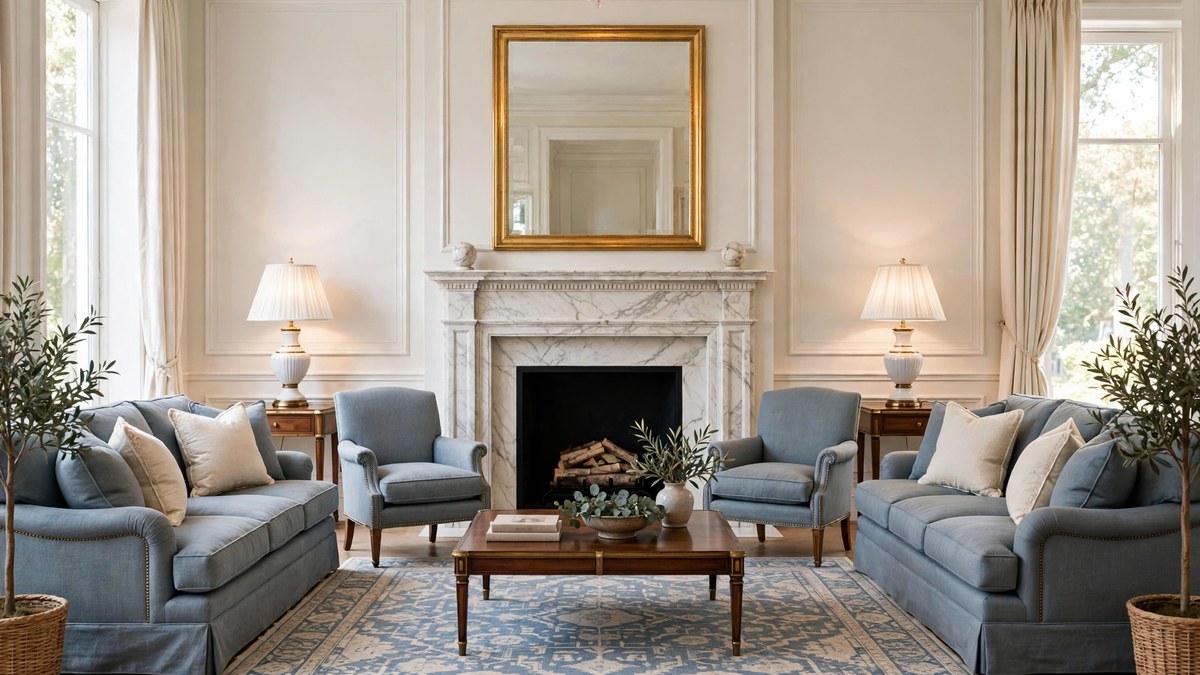
If you learn one formal technique, learn symmetry. The human eye reads mirrored arrangements as calm, expensive, and intentional, even when the individual pieces are modest. Two chairs flanking a fireplace, identical lamps on identical side tables, a pair of sconces framing a painting: these pairs are the grammar of the formal room.
Build the room around a central axis. It usually runs from the entry point through the focal point, often the fireplace or a large window. Arrange the sofa centered on that axis, matched chairs to either side, and the coffee table centered between them. Even in a room where perfect symmetry is impossible, establishing one strongly symmetrical grouping creates the formal impression for the whole space.
Symmetry also operates at the small scale, and that is where most people can apply it today. The mantel dressed with matching candlesticks at each end, the sofa flanked by identical side tables, the pair of cushions mirrored on a bench: these micro-symmetries cost little and register instantly. When you shop, buy formal accessories in pairs by default and singles only on purpose. A room accumulates its formality through these doublings more than through any single grand gesture.
Break it once, deliberately. A single asymmetrical note, an off-center plant, a leaning piece of art, a stack of books on one table only, keeps the room from feeling like a hotel lobby. Formal rooms need that one human gesture. The trick is that it must look chosen, and in a sea of symmetry, it will.
Large Living Room Decorating Ideas for Grand Spaces
Scale is the challenge and the opportunity in a big room, and the best large living room decorating ideas begin by refusing to spread the furniture to the walls. A grand room needs a complete, composed arrangement floating in its center: a large rug, often 10 by 14 feet or bigger, with the full seating group on it, anchored to the fireplace or the room’s architectural center. The perimeter then becomes a second, quieter zone for a console, a pair of chairs with a chess table, or a piano.
Go bigger with everything, proportionally. Art that would fill a normal wall disappears on a grand one, so commission the scale up: one oversized piece, or a pair of large matching pieces, which suit formal symmetry beautifully. Coffee tables should be substantial, lamps taller, and ceiling fixtures sized to the room’s volume, not its floor plan alone. A chandelier’s diameter in inches is often estimated by adding the room’s length and width in feet; treat that as a starting point and verify against ceiling height.
Height is the third dimension most large rooms waste. Tall curtains hung near the ceiling, bookcases that reach up, and long vertical art all honor the room’s proportions. If your large room is also an open great room, the next section’s zoning ideas apply directly, and our general ideas for designing a living room cover the layout sequence in more depth.
Great Room Furniture Ideas That Define Zones
A great room asks furniture to do the work walls do elsewhere: one open space must host conversation, media, dining, and passage without any of them feeling homeless. The most useful great room furniture ideas are all about definition. Each zone gets a complete kit: its own rug or floor boundary, its own lighting, and furniture arranged in a closed, conversational shape rather than lined up facing one direction.
Anchor the living zone with the largest rug the space allows and a sofa with a strong back, since the sofa’s back is effectively a wall. A console table behind that sofa sharpens the boundary and adds a surface for lamps that light the zone from within. Keep walkways between zones generous, about 36 inches, so the room flows even with every zone occupied.
Consistency ties the zones together. Carry one material, the same wood tone or metal finish, and a shared palette across all of them, varying the proportions rather than the elements. A dining zone in walnut and brass beside a living zone in walnut, brass, and cream reads as one designed room. Our guide to design ideas for a combined living and dining room works through open-plan combinations in detail. And give the whole great room one hierarchy: the living zone is the star, the others support, or the space feels like three rooms arguing.
A Refined Color Palette: Neutrals With Depth
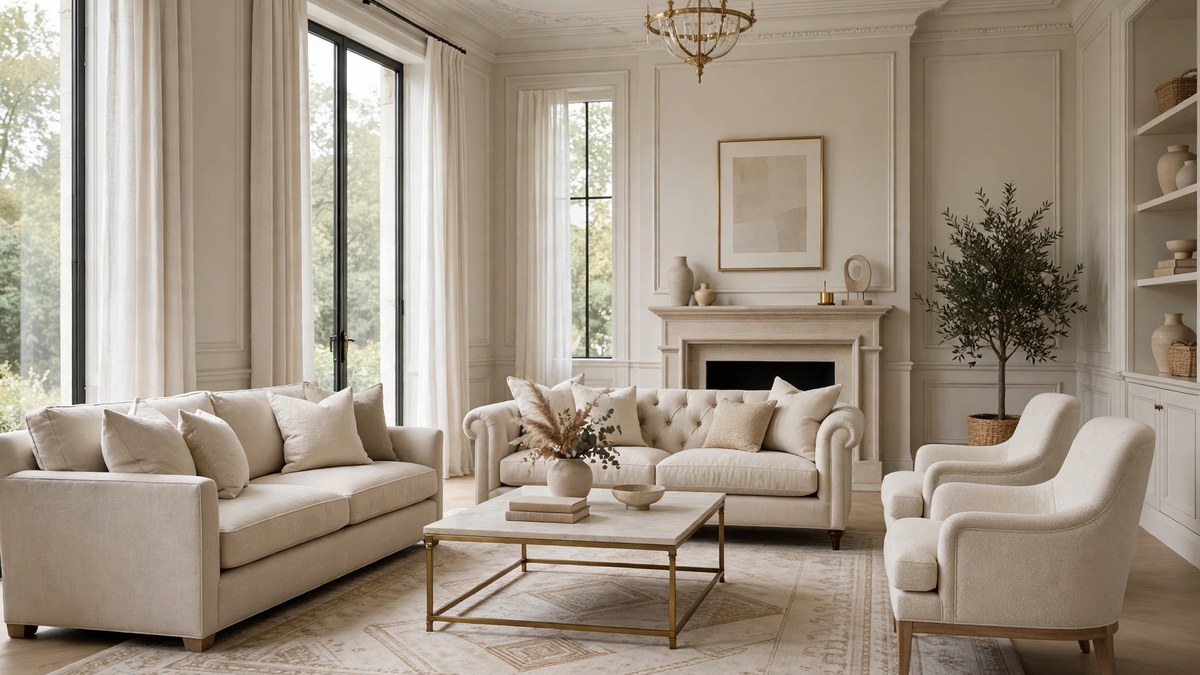
Formal palettes are restrained, but restrained is not the same as colorless. The classic formal scheme builds on warm neutrals, ivory, greige, taupe, soft gray, and layers depth through tone rather than hue: the same family in five values from pale walls to deep wood. Against that ground, one or two saturated accents, navy, deep green, oxblood, or black, land with enormous authority precisely because they are rationed.
Metallics are the formal room’s jewelry. Brass, antique gold, polished nickel, and blackened bronze should be chosen as one primary metal with, at most, one supporting metal, and repeated in the lighting, hardware, frames, and table accents. Mixed-metal chaos is the fastest way to make a formal room look accidental.
Paint sheen matters here more than usual. Flat or matte walls with satin or semi-gloss trim is the traditional formal formula, because the contrast in sheen quietly articulates the architecture. In rooms with handsome moldings, painting trim a shade lighter than the walls makes the craftsmanship visible. Deep-colored formal rooms, in library green or navy, are a bolder but classic route, and they make pale upholstery and gilt frames glow in lamplight.
Furniture With Formal Bones: What to Look For
Formal furniture announces itself in silhouette. Look for structure: sofas with defined arms and tailored upholstery rather than slouchy cushions, chairs with exposed wood frames or elegant legs, and case goods with real joinery and weight. Camelback and tuxedo sofas, wingback and bergère chairs, and skirted or waterfall tables all carry formal DNA without a single antique among them.
Upholstery fabrics lean smooth and refined: linen, velvet, tight-woven cotton, and leather, in solids or subtle patterns like a tone-on-tone stripe or small damask. Velvet is the formal room’s best friend, since it reads luxurious in any color, photographs beautifully, and modern performance velvets clean up far better than their reputation suggests.
The supporting cast has formal standards too. A console or serving table against the wall gives the room its staging area for drinks and display, and a pair of ottomans or benches under it adds flexible seating that disappears when not needed. A bar cart, in the room’s primary metal with cut-glass or crystal-look pieces, is both practical entertaining equipment and a sanctioned sparkle. Even the wastebasket and the tissue box get chosen in a formal room; the style forgives humble materials but never inattention.
Buy the best two pieces you can. In a formal room, quality shows more than quantity: a superb sofa and a pair of good chairs on a decent rug will always out-dress a roomful of mediocre matches. And mind the legs. Formal rooms sit up straight; furniture on visible, finished legs, rather than pieces sunk to the floor, keeps the whole composition light and deliberate. For a room whose heart is the fireplace, our living room fireplace design ideas show how formal seating groups arrange around a hearth.
Lighting That Flatters: Chandeliers, Sconces, and Lamps in Pairs
Formal lighting is architectural and symmetrical. A central ceiling fixture, a chandelier or a handsome lantern, establishes the room’s axis and should hang low enough to belong to the furniture arrangement, typically with its bottom around 7 feet from the floor in a standard room, higher with taller ceilings. It is a statement piece, and in a formal room it may be the single splurge the whole design leans on.
Wall sconces in pairs flank the fireplace, the main artwork, or the mirror, washing the walls and reinforcing the room’s symmetry. Table lamps arrive in pairs as well, matched on matched tables at either end of the sofa. This doubling is not fussiness; paired light sources balance a room’s glow and prevent the lopsided look that single lamps create at night.
Layer in dimmers everywhere. Formal rooms are evening rooms, and the difference between a showroom and a salon at 8 p.m. is light level. Keep bulbs consistent and warm, around 2700K, and consider candlelight, real or flameless, on the mantel and tables for the final degree of flattery that no fixture can match.
Window Treatments With Presence
In formal rooms, curtains are architecture. Full-length drapery panels, hung high near the ceiling and wide enough to stack mostly off the glass, frame windows the way columns frame a doorway. The fabric should puddle very slightly or break just at the floor; the too-short curtain is the formal room’s most common wardrobe malfunction, ending awkwardly at ankle height.
Interlining and lining give drapes the body that makes them hang in sculpted folds, and they protect the fabric and the room’s privacy. Hardware matters at this scale: substantial rods in the room’s primary metal, with rings and finials that look intentional from across the room. For privacy and light control, layer sheers or woven shades beneath the panels rather than asking the drapes to do everything.
Rods and rings deserve the same thought as the fabric. In a formal room the hardware is visible jewelry: substantial diameter, a finish that matches the room’s primary metal, and finials with enough presence to terminate the line properly. Clip rings read casual; rings sewn or pinned to the panel’s back read tailored. It is a small distinction that guests will never name and always register, which is a fair definition of formal detail in general.
Shutters and tailored Roman shades are the cleaner formal alternatives, particularly in rooms where full drapes would crowd furniture placed near windows. Whichever you choose, keep the treatment consistent across every window in the room; formality is, in large part, the absence of exceptions.

Art and Mirrors at Proper Scale
Formal rooms hang art like institutions: centered over the furniture it relates to, at eye level, in frames with real presence. A single large piece over the sofa, sized at roughly two-thirds the sofa’s width, or a symmetrical pair of equal pieces, suits the formal grammar best. Frames lean classic: gilt, dark wood, or black, with mats that give the art breathing room.
Mirrors do double duty, reflecting light and doubling the room’s best features. A large mirror over the mantel is the traditional anchor, and it should be sized to the mantel, about two-thirds to three-quarters of its width. Placed opposite a window or a chandelier, a mirror multiplies the light the room worked so hard to arrange.
Resist the scatter. One strong art wall beats five walls of small, unrelated pieces in a formal scheme. If you have many smaller works, group them into one disciplined gallery arrangement with consistent frames and spacing, hung as a single composition rather than a constellation. The grouping reads as one large artwork, which is exactly the scale the room wants.
Making Formal Comfortable: The Livability Layer
The failure mode of the formal living room is a room so composed that the family avoids it. Prevent that with a deliberate livability layer. Start with seating comfort: formal silhouettes come in genuinely comfortable versions now, so sit-test everything and add down-blend cushions where a tailored sofa feels stern. A throw in a refined fabric, cashmere or fine wool, folded over one chair softens the room and invites use.
Plan for real evenings. Side tables at the right height for drinks, coasters that live in a drawer of the coffee table, reading light at the best chair, and a discreet basket for the blanket and the dog’s toy. None of these breaks the formal spell; they are simply edited like everything else.
Sound and scent belong to this layer as well. A formal room used for conversation should be quiet: rugs, upholstered pieces, full drapes, and books absorb the echo that makes talk tiring. A single considered scent, a candle in cedar, fig, or something green, lit when guests are expected or when you settle in yourself, becomes part of the room’s signature. These are the details guests cannot photograph but always remember, and they separate the rooms people admire from the rooms people envy.
Then use the room. Hold the dinner party’s drinks there. Read there on Sundays. A formal room that hosts real life keeps its polish, because rooms that are used get maintained, while rooms kept for best quietly become storage. The goal was never a museum. It was a room that makes ordinary evenings feel a little ceremonious.
Common Formal Living Room Mistakes
The classic mistake is the matched set: sofa, loveseat, chairs, tables, and lamps bought as one package. It produces a showroom, not a room, and kills the collected quality formality needs. Mix pieces that share formality and palette instead. Second is symmetry abandoned halfway, one matched pair of lamps and chaos everywhere else; commit to the main axis at least.
Third is scale gone timid: small art, a small rug, and a small chandelier in a room that needed presence. Formal rooms reward bolder sizing. Fourth is lighting from the ceiling alone. And fifth is confusing formal with fragile, choosing pieces and fabrics so delicate that the room must be policed. Polish that cannot survive a Tuesday is not polish; it is anxiety with good posture.

Frequently Asked Questions
Can a formal living room work for everyday family life?
Yes, with relaxed-formal choices: formal silhouettes in performance fabrics, washable textiles, and a livability layer of throws, side tables, and good reading light. Keep the symmetry and palette discipline, drop the fragility. Many families find the formal room becomes the calmest room in the house precisely because it is edited.
What colors are most formal for a living room?
Warm neutrals, ivory, greige, taupe, and soft gray, with deep accents such as navy, deep green, oxblood, or black used sparingly. One primary metal, brass or nickel, repeated through the room completes the classic palette. Deep wall colors are equally formal when paired with pale upholstery and good lighting.
How do I make a formal room without buying antiques?
Formal is a set of principles, not a period. New furniture with tailored silhouettes, exposed legs, and smooth upholstery reads formal immediately. Add symmetry, paired lighting, full-length drapes, and one large piece of art, and no one will ask where the antiques went.
What rug size suits a formal living room?
The rug should hold the entire seating arrangement, with all furniture legs on it in a formal scheme, which usually means an 8 by 10 foot rug at minimum and 9 by 12 or larger in most rooms. Leave a consistent border of floor showing around it, roughly 12 to 18 inches, so the arrangement reads as composed.
How high should a chandelier hang in a living room?
As a starting point, the bottom of the fixture should sit around 7 feet from the floor in a room with standard ceilings, rising with ceiling height so it never crowds heads or blocks sight lines. It should center on the furniture arrangement’s axis, which may not be the exact center of the room.
Can I mix modern art in a formal living room?
Absolutely, and it often improves it. A large abstract piece over a traditional sofa is a classic high-low pairing. Keep the frame treatment formal, a proper frame with a mat, and let the art’s colors echo somewhere in the room’s textiles so the pairing looks chosen rather than accidental.
What is the difference between formal and traditional style?
Traditional is a period language: specific historical furniture styles, patterns, and details. Formal is a level of polish and order that any style can wear. You can have a formal modern room or a casual traditional one. Most of the rooms people call formal traditional are simply both at once.
Final Thoughts
A formal living room is not a relic; it is a discipline. Symmetry for calm, scale for presence, a restrained palette for longevity, and a livability layer so the room earns its keep daily. Build those bones and the room will look right in every season and every decade, and your family will have one room that always rises to the occasion.
