


Some living rooms are designed to be admired. An artistic living room is designed to be felt. It is the room where the painting is not an afterthought but the reason the sofa is that particular shade of green, where a sculptural chair earns its place like a piece in a gallery, and where guests start conversations about what is on the walls instead of what is on television. If safe neutrals have begun to bore you, this is the direction that rewards courage.
The fear that stops most people is chaos: that bold color and real art will tip into a jumble. It does not have to. Artistic rooms follow rules just as surely as minimal ones do; the rules are simply about curation rather than restraint. This guide lays them out: how to build the room around one loved piece, deploy serious color without losing livability, mix eras and patterns, and display what you own like it matters. Because in this room, it does.
What Makes a Living Room “Artistic”?
An artistic living room is organized around expression rather than around a furniture set. Art is not the garnish; it is the anchor. The room usually has at least one strong focal piece, a large painting, a textile hanging, a sculpture, or a dramatic wall treatment, and the rest of the design takes its cues from that piece’s colors, mood, and scale.
The style overlaps with maximalism, the more-is-more philosophy that answers minimalism with abundance, pattern, and personal collection. But artistic is broader than maximalist. A spare room with white walls, one enormous abstract canvas, and a single sculptural chair in a saturated color is every bit as artistic as a jewel box stuffed with treasures. What unites both versions is intention: everything visible was chosen, and the choices say something about the people who live there.
That is the real definition to decorate by. If a stranger could walk in and learn three true things about you from the room alone, you have an artistic living room. If they could learn nothing except that a store had a sale, you have furniture. The sections below are about closing that gap, whatever your budget or boldness level.

Start With One Piece of Art You Genuinely Love
Every artistic room needs a seed: one piece you love without qualification. It does not need to be expensive. It might be a poster from an exhibition you actually attended, a painting by a local artist, a woven textile, a vintage movie poster, or a photograph you took and had printed large. What matters is that it is yours, chosen for love rather than for matching the sofa.
Give the seed piece the room’s best position and proper scale. Above a sofa, art generally looks best at about two-thirds the width of the sofa below it, hung so its center sits near eye level, roughly 57 inches from the floor. A beloved piece hung too small and too high is the most common way good art gets wasted. If your piece is small, group it with companions or frame it with a generous mat to give it presence.
Then let the piece direct traffic. Pull two or three colors from it for the room’s textiles, echo one of its shapes in a cushion pattern or a lamp base, and let its mood, serene landscape or electric abstract, set the room’s energy. Decorating outward from art you love is the single most reliable method in this entire guide, and it guarantees the room could only ever be yours. Our deeper maximalist decor guide expands on building rooms around collections and bold anchor pieces.
Colorful Living Room Ideas That Stay Livable
Bold color fails when it is everywhere at equal volume, and succeeds when it has a hierarchy. These colorful living room ideas all rely on that principle: one dominant color statement, supporting players in related tones, and enough neutral ground for the eye to rest. Choose your dominant statement first: the walls, the sofa, or the rug. Only one of them gets to shout.
The wall route is the most reversible and the most dramatic. A deep teal, aubergine, or saturated ochre behind the seating turns the whole room into a backdrop for art, and pale or metallic-framed pieces glow against it. The sofa route keeps walls calm and lets one glorious piece of upholstery, emerald velvet, cobalt, marigold, carry the room; everything else can then be quieter. The rug route suits the cautious: a vivid, patterned rug under neutral furniture gives you a room that is colorful from standing height and calm at eye level.
Manage the temperature as well as the volume. Warm brights, reds, oranges, golds, feel energetic and social. Cool brights, teals, blues, violets, feel creative and slightly calmer. Mixing a warm dominant with cool accents, or the reverse, creates the productive tension that makes colorful rooms interesting. For help structuring a scheme before you commit, our guide to choosing colors for a living room lays out tested combinations by mood. And always sample at scale: a color that charms on a swatch can overwhelm on four walls, so paint the largest test patch you can stand and live with it for two days.
The Statement Wall: Paint, Paper, and Gallery Displays
One wall in an artistic room gets to be the exhibition. The simplest version is paint: the deepest color in your scheme, applied to the wall behind the sofa or the fireplace wall. A painted statement wall needs little else, perhaps the seed artwork and a pair of sconces, because the color itself is the statement.
Wallpaper is the second route, and modern papers make it glorious: large-scale florals, geometric repeats, scenic murals, and grasscloth textures all turn a wall into a piece. Paper the one wall the seating faces or the wall behind it, and keep the other walls in a color pulled from the paper’s background. If commitment worries you, peel-and-stick papers have improved enormously and suit renters and the chronically indecisive alike.
The third route is the gallery wall: a composed group of art, objects, and mirrors covering much of one wall. Gallery walls succeed on planning, not luck. Lay the arrangement on the floor first, photograph it, keep spacing consistent at about 2 to 3 inches between frames, and anchor the group with the largest piece slightly off-center. Mix frame finishes within one family, all dark wood and brass, say, so the collection reads as curated rather than accumulated. Our dedicated guide to living room wall art ideas covers layouts, heights, and hardware in detail.

Sculptural Furniture as Functional Art
In an artistic room, furniture earns its floor space twice: once by working, once by being worth looking at. A chair with an unusual silhouette, a coffee table in an unexpected material, or a bookshelf with genuine architectural presence does not need art above it to justify itself. It is the art, and you get to sit on it.
You do not need a roomful. One or two sculptural pieces among comfortable, quieter companions create the gallery effect; a room where every piece shouts is a furniture showroom argument. The classic formula is a sculptural chair plus a distinctive coffee table, with the sofa kept simple and upholstered in a solid that supports both.
Commissioning is the other route to the sculptural, and it is more accessible than people assume. Local woodworkers, metal artists, and ceramicists often build coffee tables, shelving, and lighting for prices comparable to mid-range retail, and the result is a piece nobody else has, made for your room’s exact dimensions. If you have never commissioned anything, start with something small, a side table or a lamp, and you will likely join the ranks of people who plan rooms around their makers.
Vintage and secondhand sources are the artistic room’s best friends, because older furniture was often made in shapes no current catalog would risk. A mid-century credenza, an eighties postmodern lamp, a hand-knotted rug with a pattern nobody manufactures anymore: these pieces come with the patina and oddness that new furniture must fake. Buy the strange thing you cannot stop thinking about. In our experience it becomes the piece guests ask about, every single time.
Mixing Eras and Styles Without Chaos
Artistic rooms mix periods freely: a Victorian settee under abstract art, a farmhouse table with lucite chairs. The mixing works when the pieces share something, a color family, a material, a level of formality, or a scale. Shared DNA is what separates eclectic from random. Before a piece enters the room, name its connection to something already there; if you cannot, it probably belongs in another room.
A useful ratio keeps the mix grounded: roughly seventy percent from one dominant era or style, thirty percent wild cards. The dominant share makes the room coherent; the wild cards make it yours. A mostly mid-century room can absorb a gilt antique mirror and a contemporary neon piece precisely because the base is steady.
Repeat each wild card’s key trait at least once elsewhere. The mirror’s brass echoes in a lamp base; the neon’s pink appears in a cushion. These small echoes are the threads that stitch a mixed room together, and they cost almost nothing. Train your eye on them and you will start mixing with confidence instead of hope.
Pattern Play: Rugs, Cushions, and Upholstery
Pattern is where artistic rooms either soar or collapse, and the rules are simpler than they look. Vary the scale: pair one large-scale pattern (the rug, the curtains) with medium patterns (cushion prints) and small ones (a throw, a lampshade). Patterns of similar scale compete; patterns of different scales converse.
Keep a color thread running through all of them. A rug in rust, teal, and cream; cushions that each pick up one of those colors in different prints; a throw that repeats two. The prints can be wildly different in style, a stripe, a floral, and a geometric will happily coexist, as long as the palette is shared. This is the great secret of rooms that look collected by an artist: the freedom is in the pattern, the discipline is in the color.
If pattern makes you nervous, enter through textiles, which are cheap and changeable. Live with patterned cushions for a season before committing to a patterned rug. And remember the solid’s job: every pattern needs quiet neighbors. A patterned sofa wants solid cushions with texture; patterned cushions want a solid sofa beneath them. Alternate, and the room breathes.
Display Collections Like a Gallery
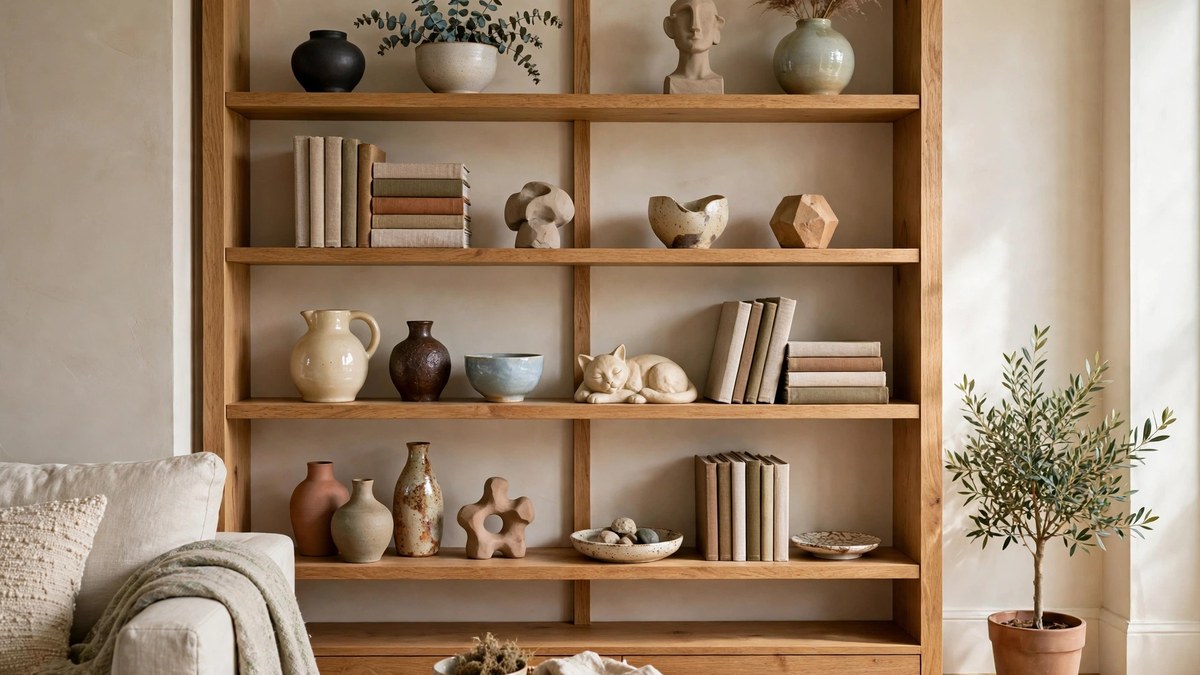
Artistic people collect things: ceramics, vinyl, vintage cameras, shells, books, masks, glass. In most homes those collections hide in boxes. In an artistic living room, they are the decor, and displaying them well is a learnable skill. The first rule is grouping: a collection displayed together, on one shelf, table, or wall section, reads as art. The same objects scattered around the house read as clutter.
Give the group a structure. Arrange by color for a graphic effect, by height for rhythm, or in a grid for a modern cabinet-of-curiosities feel. Leave negative space inside the display; objects need air around them to be seen. Glass-front cabinets and open shelves both work, and lighting matters enormously: a small picture light, LED strip, or nearby lamp turns a shelf of ceramics into an exhibit.
Rotate the collection with the seasons if it is large. A third of it on display, edited and gleaming, beats all of it crowded together, and rotation makes the room feel freshly decorated four times a year at no cost. This is also the kindest way to handle inherited pieces you love but cannot use daily: they get their season in the gallery, then rest.

Lighting That Treats Your Room Like an Exhibition
Galleries obsess over lighting because light decides whether art looks alive or dead. Borrow the approach. Every major piece or grouping in your room deserves a considered light source: a picture light above the main canvas, sconces flanking the gallery wall, a floor lamp washing the sculptural chair. Accent lighting like this is what makes an artistic room glow at night instead of going flat.
Layer it over a base of ambient light, lamps with warm bulbs around 2700K, and avoid the overhead fixture as your main source, since ceiling light rakes down walls and creates glare on glass and varnish. Angle matters for framed pieces: light from above at roughly a 30-degree angle minimizes reflections. Track lights with adjustable heads, unfashionable as they may be, remain the flexible professional solution, and modern versions are discreet.
Candles and small-scale sparkle belong in this conversation too. A cluster of candles near a metallic or mirrored piece multiplies light in a way fixtures cannot, and in an artistic room that flicker is part of the exhibition. Use them near reflective surfaces and sculptural objects rather than under framed art, and flameless versions give renters and the cautious the same effect with a timer. The point is movement: a room lit only by static sources looks photographed; a room with one living flame looks alive.
Do not neglect daylight either. Note where the sun lands during the day and keep light-sensitive pieces, textiles, works on paper, out of direct sun, which fades them measurably over a season. Sheer curtains diffuse harsh light beautifully and add a layer of softness the room will thank you for.
Tips for Renters and the Cautious
You can build an artistic room without a single permanent change. Lean large art against walls or on furniture instead of hanging it; a big canvas resting on a credenza looks deliberately gallery-like. Use removable hooks rated for real weight for lighter pieces, and test them overnight with something replaceable before trusting them with the good art.
Peel-and-stick wallpaper, removable decals, and tension-rod curtain panels transform surfaces reversibly. Furniture and textiles carry color without touching a wall: the bold sofa, the vivid rug, the patterned cushions all leave with you. Even a statement ceiling is possible with removable panels or a dramatic mobile or hanging sculpture, which changes the room’s whole geometry from a landlord-safe hook or two.
The cautious decorator’s best tool is sequencing. Start with the seed artwork, then textiles, then one bold element at a time, living with each for a week. Artistic rooms reward nerve, but nerve grows with evidence. Each successful layer proves the next one is safe to try, and within a season the room that began as beige can be the most personal space in the home.
Common Mistakes: When Artistic Tips Into Cluttered
The line between artistic and cluttered is editing. The first mistake is displaying everything you own at once; galleries rotate, and so should you. If a surface has more than a few objects, group them on a tray or remove a third. Negative space is not wasted space; it is what lets the eye find the art.
Second is equal volume: every color bright, every pattern large, every piece competing. Artistic rooms have a hierarchy, one star, supporting players, and quiet background. Turn the volume down on two-thirds of the room and the star third becomes thrilling instead of exhausting. Third is neglecting the functional base. If the seating is uncomfortable and the lighting is bad, no amount of art saves the room, because nobody stays in it long enough to look at anything.
Finally, beware buying “artistic” as a style from a single store in a single weekend. Rooms built that way look like everyone else’s rebellion. The genuine article accumulates: your travels, your makers, your strange finds. Shop slowly, from many sources, and let the room be a biography rather than a product line.
Frequently Asked Questions
How do I start an artistic living room on a small budget?
Begin with one piece of art you love, which can be a poster, a textile, or a large print of your own photograph, framed generously. Then shop secondhand for sculptural furniture and lamps, and use paint, the cheapest dramatic tool there is, on one wall. Textiles from your existing stash complete the first version for very little money.
What if my partner hates bold color?
Use the rug route or the sofa route so the color lives in one element rather than on the walls, and let the other partner control the neutrals around it. Pulling the scheme from a piece of art you both chose also helps: people rarely object to colors that arrived via something they love.
How many patterns are too many?
There is no fixed number, but the scale rule keeps you safe: one large-scale pattern, a couple of mediums, and small accents, all sharing a color palette. If two patterns share both scale and palette energy, they will fight. Change one pattern’s scale and the fight usually ends.
Can an artistic living room still be family-friendly?
Yes. Choose washable textiles, keep fragile collections on high shelves, and make the art itself durable: framed prints behind acrylic, textiles on walls, and sturdy sculpture. Kids grow up fine in expressive rooms, and arguably develop better eyes for it.
Where do I find affordable original art?
Local art schools and college shows, community art centers, open-studio weekends, online marketplaces for independent artists, and estate sales are the reliable sources. Prints and posters from museum shops are also legitimate art with real design pedigree. Buy the piece that stops your scroll or your steps; that reaction rarely lies.
What wall color works best behind colorful art?
It depends on the art’s mood. White and warm-white walls make colors pop in a gallery way but can feel stark. Deep walls, charcoal, navy, deep green, make pale and metallic pieces glow and feel moodier and richer. Mid-tone warm grays and greiges split the difference and flatter the widest range of art.
How do I keep an artistic room from looking dated?
Anchor the room in art and furniture you genuinely love rather than in a trend palette, and keep the trendiest elements in the cheapest, changeable layers: cushions, throws, and small objects. Rooms built on biography age slowly. Rooms built on a single year’s look age exactly as fast as that look did.
Final Thoughts
An artistic living room is a room with a point of view. Start with art you love, give color a hierarchy, let one or two pieces of furniture be sculpture, and edit like a curator. You do not need permission, a bigger budget, or a different house. You need the willingness to let the room say something true, and to keep arranging it until it does.
