


Everyone wants the room people walk into and immediately exhale. You know the one: the light is low and warm, the sofa looks like it has been saving you a seat, and there is a blanket within reach before you even know you wanted one. The good news is that this feeling is not luck and it is not money. Cozy living room ideas are a set of learnable moves involving light, texture, scale, and arrangement, and most of them cost little or nothing.
This guide breaks coziness down into the parts you can actually change: how the room is lit, what it is made of, how the furniture is gathered, and how the senses beyond sight are treated. Work through them in order and your living room will stop feeling like a place you pass through and start feeling like the destination it should be, especially on the evenings when the weather is doing its worst outside.
What Cozy Really Means (It’s Not Just Blankets)
Cozy is a physical sensation before it is a style. It comes from warmth, softness, low and warm light, a sense of enclosure, and the feeling that everything you need is within arm’s reach. The Danes built a whole philosophy around it: hygge, the practice of creating warmth, comfort, and contentment in everyday surroundings, especially during the long dark months. You do not need the word to use the idea, but the idea is worth stealing wholesale.
Notice what cozy is not. It is not clutter, though a few personal, lived-in objects help. It is not darkness, though dim beats bright. And it is definitely not a matching set of seasonal pillows bought in one trip. Coziness accumulates: the right lamp, a chair angled toward the fire, a rug that feels good under bare feet. Each layer is small. Together they change how your body relaxes in the room, and that, not the decor score, is the real test.
Keep one question in front of you as you decorate: does this make someone want to stay longer? Apply it to every purchase and arrangement, and the room will assemble itself more honestly than any mood board can.
Cozy Interior Design Principles That Work in Any Room
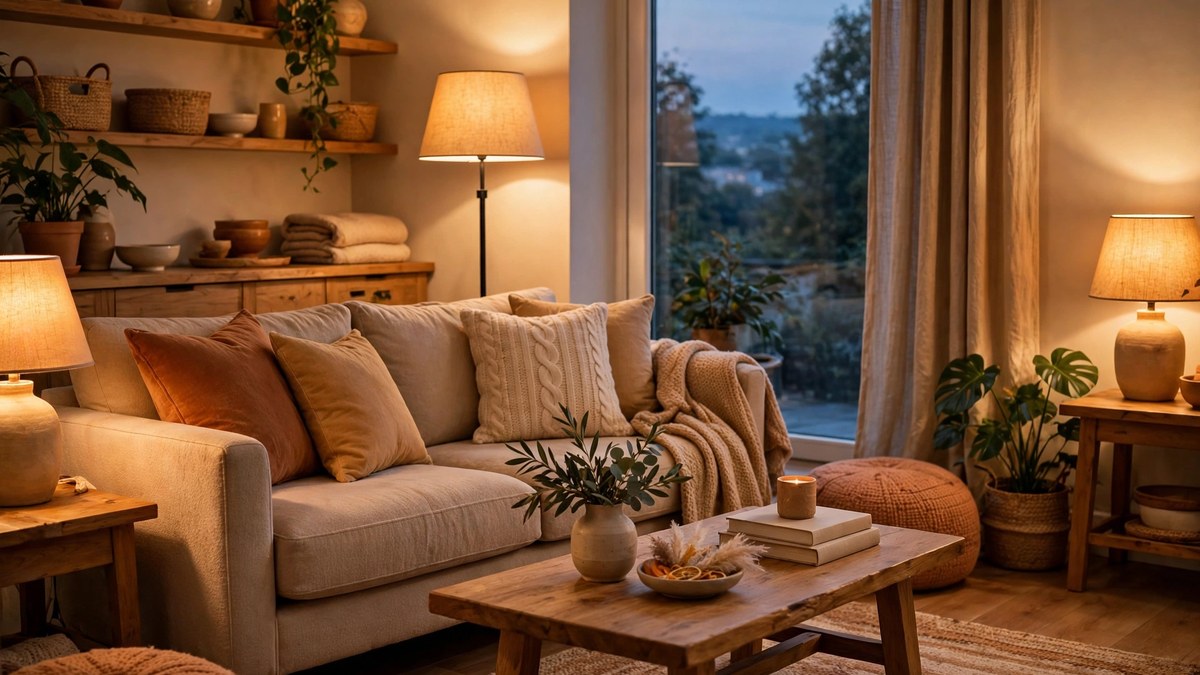
Underneath every successful scheme sit the same cozy interior design principles, and they scale from studio apartments to farmhouse great rooms. The first is enclosure: cozy rooms feel held. That can mean a gathered furniture arrangement, a rug that defines a territory, curtains that soften the walls, or simply a corner claimed and furnished completely. Open, undefined space is the enemy of snug.
The second principle is layering at human scale. Cozy rooms have things at the heights where people actually live: cushions at seat level, light at shoulder level, art at eye level when seated. The third is warmth in every sense, warm color temperature in the bulbs, warm tones in the wood and textiles, and literal warmth from throws and rugs underfoot.
The fourth principle is the one people skip: restraint. Cozy layers are curated, not accumulated. Each textile and object should earn its place by being soft, useful, beautiful, or loved. When everything in the room passes that test, the space feels rich instead of busy. These principles also explain why copying a photo rarely works: the photo has the layers but your room needs them in the proportions and palette that fit your light, your furniture, and your habits.
Start With Warm, Layered Lighting
If you change only one thing, change the light. Overhead lighting is the single biggest cozy-killer in American living rooms: it is bright, flat, and comes from the one direction that flatters nothing. Cozy rooms are lit from the sides, at sitting height, in pools rather than floods. Turn the ceiling light off, and build the room’s glow from lamps instead.
A workable formula for an average room is three to five light sources: a floor lamp near the reading chair, table lamps on side tables, and one accent source such as a candle cluster, a small lamp on a bookshelf, or a lantern. Use warm bulbs around 2700K everywhere, and put the main lamps on dimmers if you can. As the evening deepens, dropping the light level is what tells your body the day is over.
Our guide to living room lamp ideas goes deeper on choosing and placing each type. While you are at it, notice the light you block as well as the light you add: lined curtains closed at night wrap the room in fabric and cut the cold black mirror effect of bare windows, and that simple act can raise the cozy level more than a new piece of furniture.
Textiles: The Fastest Route to Cozy
Textiles are the highest-impact, lowest-cost layer in the room. Start underfoot: a soft rug in the seating zone, sized so the front legs of the sofa and chairs sit on it, instantly quiets a room’s echo and warms its floor. Wool and wool-look piles feel plushest; in high-traffic homes, a low-pile rug with a thick pad underneath gives most of the softness with easier cleaning.
On the seating, work in odd numbers and varied textures: two cushions in a nubby weave, one smooth velvet, a lumbar in a stripe. Faux fur, chunky knits, and washed linen each add a different kind of softness, and the contrast between them is what the eye reads as richness. Drape one throw over the sofa arm nearest the door, because that is the one that will actually get used, and fold a second at the foot of a chair.
Curtains are the final textile. Long, lined drapes soften the hardest edges in the room and insulate against drafts. Patterns matter here too: the guide to choosing curtain patterns for a living room shows how to mix prints with solids without visual noise. In a cozy scheme, lean toward warm solids and subtle textures, and let one patterned element carry the room’s personality.

A Color Palette That Wraps Around You
Cozy palettes are warm, mid-toned, and low in contrast. Think of the colors of late afternoon: camel, cognac, warm taupe, deep olive, rust, burgundy, and creams that lean yellow rather than blue. These tones absorb light softly instead of bouncing it around, which is why rooms painted in them feel like an embrace at dusk.
White is not banned, but choose warm whites with yellow or pink undertones rather than stark blue-whites, which can feel clinical in the evening. If you love a cooler scheme, gray and blue can still be cozy when the textiles are warm and the lighting is warmer; plenty of snug rooms are blue. The palette fails only when cool colors meet cool lighting and smooth textures all at once.
Do not forget the fifth wall and the trim. A ceiling painted a shade warmer or deeper than stark white removes the cold lid that hovers over many otherwise cozy rooms, and trim in a soft cream rather than bright white keeps the envelope unbroken. In older homes, picture rails, beams, and fireplaces in mid-tone wood or painted deep tones add to the cocoon; work with those features rather than whitening them into the background.
Paint is the boldest move, and a mid-tone on the walls, or even a deeper tone in a small room, increases the cocoon effect that cozy rooms depend on. If painting everything feels risky, paint one wall behind the sofa, or bring the deep color in through the largest textile instead: the rug or the curtains. Test any color at night under your lamps, not just in daylight, since night is when this room does its real work.
Furniture Arrangement for Snug, Not Cramped
Cozy arrangements gather in. Pull the seating off the walls and into a group where conversation happens at comfortable distances, roughly 4 to 8 feet between seats. A rug under the group, a coffee table or ottoman within reach of every seat, and lamps at the edges complete a territory that feels intentionally snug rather than accidentally small.
In a large room, resist spreading out. One tight, complete arrangement in the best part of the room, near the fireplace or the best window, is far cozier than furniture distributed evenly through the space. The leftover area can hold a bookshelf, a desk, or simply breathing room. In a small room, the same principle applies in miniature: choose fewer pieces, keep them close, and let one deep, comfortable seat be the hero.
The ottoman deserves special mention. As coffee table, footrest, extra seat, and blanket storage in one, it is the hardest-working piece in a cozy room. Top it with a tray for drinks and it does everything a table does, minus the sharp corners and the hard surface your feet are not allowed on. If your room also serves as the house’s quiet zone, the layout ideas in our sitting room decor ideas pair well with everything in this section.
Texture Mixing: Wood, Wool, and Woven Things
Texture is the difference between a room that looks cozy in a photo and one that feels cozy in person. Aim to touch something different in every direction: the rough weave of a basket, the grain of a wooden table, the nap of a velvet cushion, the cool smoothness of a ceramic lamp base, the soft density of a wool throw. This variety is what makes a neutral room interesting and a colorful room feel layered rather than loud.
Natural materials do most of the work. Wood warms any scheme, especially in mid and dark tones with visible grain. Woven things, rattan, seagrass, jute, wicker, bring an irregular, handmade quality that manufactured perfection cannot. Leather adds a third family: smooth, warm, and better with age. Metal should appear in small, warm doses, aged brass or blackened iron rather than chrome, which reads cold.
There is also an editing rule: the softer the room’s palette, the more texture it needs. An all-cream room survives on texture alone, so go bigger there, chunkier knits, rougher wood, deeper pile. A room with bold color can afford smoother surfaces, since the color itself provides the stimulation. Keep the balance in mind and you will rarely go wrong.
The Reading Corner: Cozy’s Proof of Concept
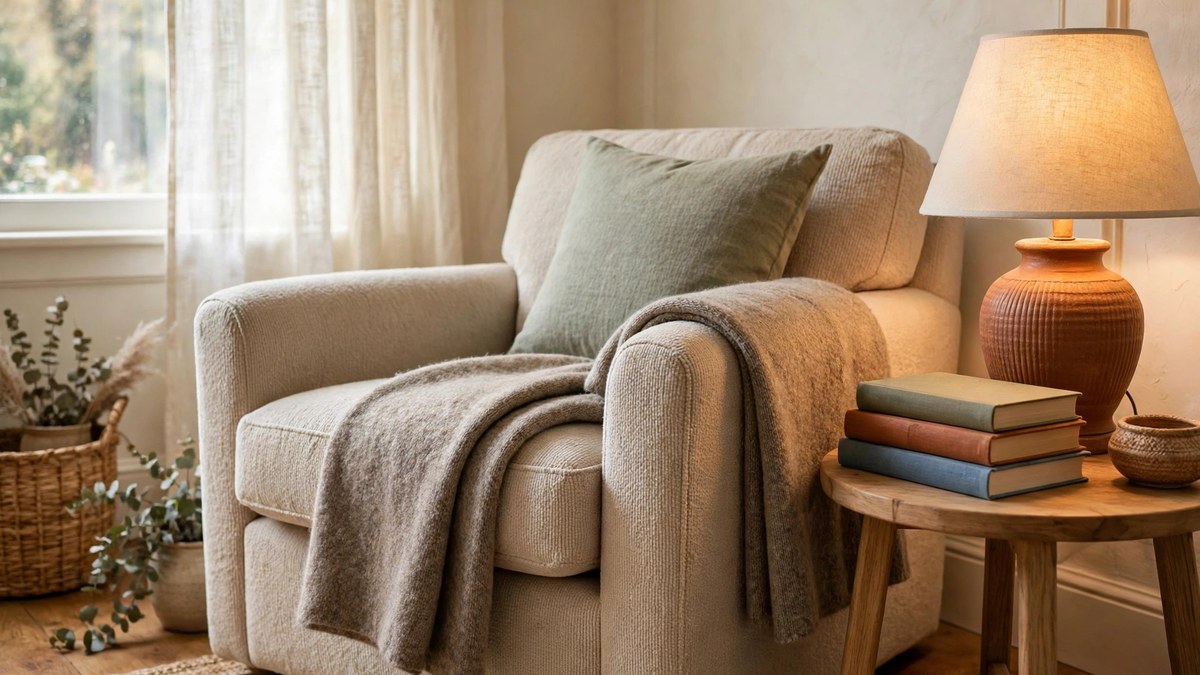
Every cozy living room deserves one perfect seat, and building it is the best way to learn what cozy actually requires. Choose the corner with the best combination of light and quiet: near a window for the daytime, away from the main traffic path. Place your most comfortable chair there, angled slightly into the room rather than flat against the wall.
Now give that chair its complete kit. A floor lamp or swing-arm wall lamp positioned to throw light over your shoulder onto the page. A side table big enough for a book, a mug, and glasses, about 18 to 24 inches across is plenty. A footstool or ottoman at the right height, a throw folded over the chair back, and a small rug or mat beneath to define the spot. A plant nearby if the light allows, because something living changes the air of a corner.
This corner will become the most contested seat in the house, and that is the point. It proves the formula: comfort, light, a surface, softness, and a defined territory. Once one corner feels this good, you will know exactly what the rest of the room is missing, and in what order to fix it.
Scents, Sounds, and the Senses Beyond Sight
Cozy is multisensory, and the rooms that feel best tend to be the ones whose owners decorated for ears and noses too. Scent is the fastest signal: a candle in a woodsy or spiced scent, a diffuser with cedar or vanilla, or simply the smell of real wood in the fireplace tells the body it is evening and safe to unwind. Choose one scent family per room and keep it consistent; competing fragrances read as noise.
Sound matters as much. Soft rooms are quiet rooms: rugs, upholstered pieces, curtains, and books all absorb echo, which is why a furnished room feels calmer than an empty one even before you sit down. If your living room has hard floors and bare walls, every textile you add is also an acoustic treatment, and a low background of music at conversation level completes the effect.
There is a ritual element too. Cozy rooms often have a small ceremony attached to them: lighting the candles when it gets dark, making the pot of tea, putting on the same kind of music. Rituals turn decoration into habit, and habit is what makes a room feel like home rather than a set. If your living room lacks one, inventing a tiny evening ritual is a legitimate decorating move, and it costs nothing but the decision.
Touch finishes the trio. Keep the things hands meet daily pleasant: a smooth wooden table edge, a soft throw, a mug with some heft. Even temperature is sensory design: kill the draft from the window with lined curtains and a door sweep, and the room’s warmth becomes something you feel, not just something you see in the styling.
Cozy on a Budget: High-Impact, Low-Cost Moves
The best cozy upgrades are cheap, because cozy is about light and softness, not expensive furniture. Start with bulbs: swapping harsh daylight bulbs for warm 2700K ones across the room’s lamps costs a few dollars and changes everything after dark. Add dimmers or smart plugs if the budget allows a little more.
Next, shop your own house. Most homes have a throw in a closet, candles in a drawer, and a basket doing nothing somewhere. Regroup them into the living room with intention and the room gains a layer for free. Thrift stores and secondhand shops are rich in exactly what cozy needs: real wood side tables, brass lamps, wool blankets, and baskets, usually for the price of one new cushion.
Spend the little you do spend on touchpoints: one good throw in a fabric you love, a rug pad to make the existing rug feel plush, and curtain panels that actually reach the floor. A realistic cozy refresh lands anywhere from about $50 for the bulb-and-regroup version to $300 or so with new textiles, and it will outperform a single expensive chair every time.
Common Mistakes That Kill the Cozy
The first mistake is overhead-only lighting, already covered, because it alone can defeat every other good choice. The second is the opposite of layering: buying a single matching set of cushions and one thin throw and calling it done. Cozy comes from varied textures in real quantities, not from a token blanket.
Third is furniture pushed to the walls, which leaves a cold empty center and forces conversation across a divide. Fourth is a palette of cool colors, cool light, and smooth surfaces combined; any two can work, all three cannot. Fifth is forgetting the floor: a beautiful room with a cold, bare floor under the seating will never feel snug in winter.
The last mistake is decorating for guests instead of for the people who live there. If the best chair is reserved, the good throw is decorative only, and the candles are never lit, the room teaches everyone to stay out of it. Cozy rooms are used hard and loved anyway, and they are better for it.
Frequently Asked Questions
What is the fastest way to make a living room feel cozy?
Change the lighting. Turn off the overhead, add two or three lamps with warm bulbs around 2700K, and put a soft throw and cushions on the main seat. Those moves take an afternoon and transform how the room feels after dark, which is when coziness matters most.
What colors are best for a cozy living room?
Warm, mid-to-deep tones work best: camel, warm taupe, olive, rust, burgundy, and warm whites with yellow undertones. Cool colors can work if the lighting is warm and the textures are soft, but the combination of cool colors, cool bulbs, and smooth surfaces will always feel chilly.
How do I make a large living room feel cozy?
Gather the furniture into one complete arrangement on a large rug in the best part of the room instead of spreading it out. Use the remaining space for a second, smaller zone like a reading corner or bookshelf wall. Deeper colors, tall curtains, and warm lamplight also shrink a big room’s feel in the right way.
Can a small living room be cozy without feeling cramped?
Yes, and small rooms often do cozy best. Choose fewer, comfortable pieces with exposed legs, keep the palette calm, and layer texture instead of adding objects. One deep chair with a lamp and a throw can carry the whole mood. The line to watch is clutter: every item should be soft, useful, or loved.
What fabrics feel coziest?
Wool, washed linen, velvet, chunky knit cotton, and faux fur each bring a different softness, and mixing them is the point. Natural fibers generally feel warmer to the touch than synthetics. For upholstery that must survive kids and pets, performance fabrics woven to mimic linen or velvet give most of the feel with far easier care.
Do I need a fireplace for a cozy living room?
No. A fireplace helps because it is a natural focal point with real warmth, but the effect can be built without one: a media console or art wall as the focal point, candles grouped where a hearth would be, and warm layered lighting do the same job. Electric and ethanol fireplaces are also an option in many homes if you want the glow.
How many textiles should a cozy living room have?
Count the touchpoints: a rug under the seating, curtains at the windows, at least three cushions and one or two throws on the main seats, and a basket or ottoman for storage. The exact number matters less than variety of texture and having something soft within reach of every seat.
Final Thoughts
Coziness is built, not bought. Warm the light, gather the furniture, layer textures you can feel, add one perfect corner, and decorate for the senses you cannot photograph. Start tonight with the bulbs and the throw you already own; the room will tell you what it needs next, and you will be surprised how quickly it becomes the place everyone chooses.
