
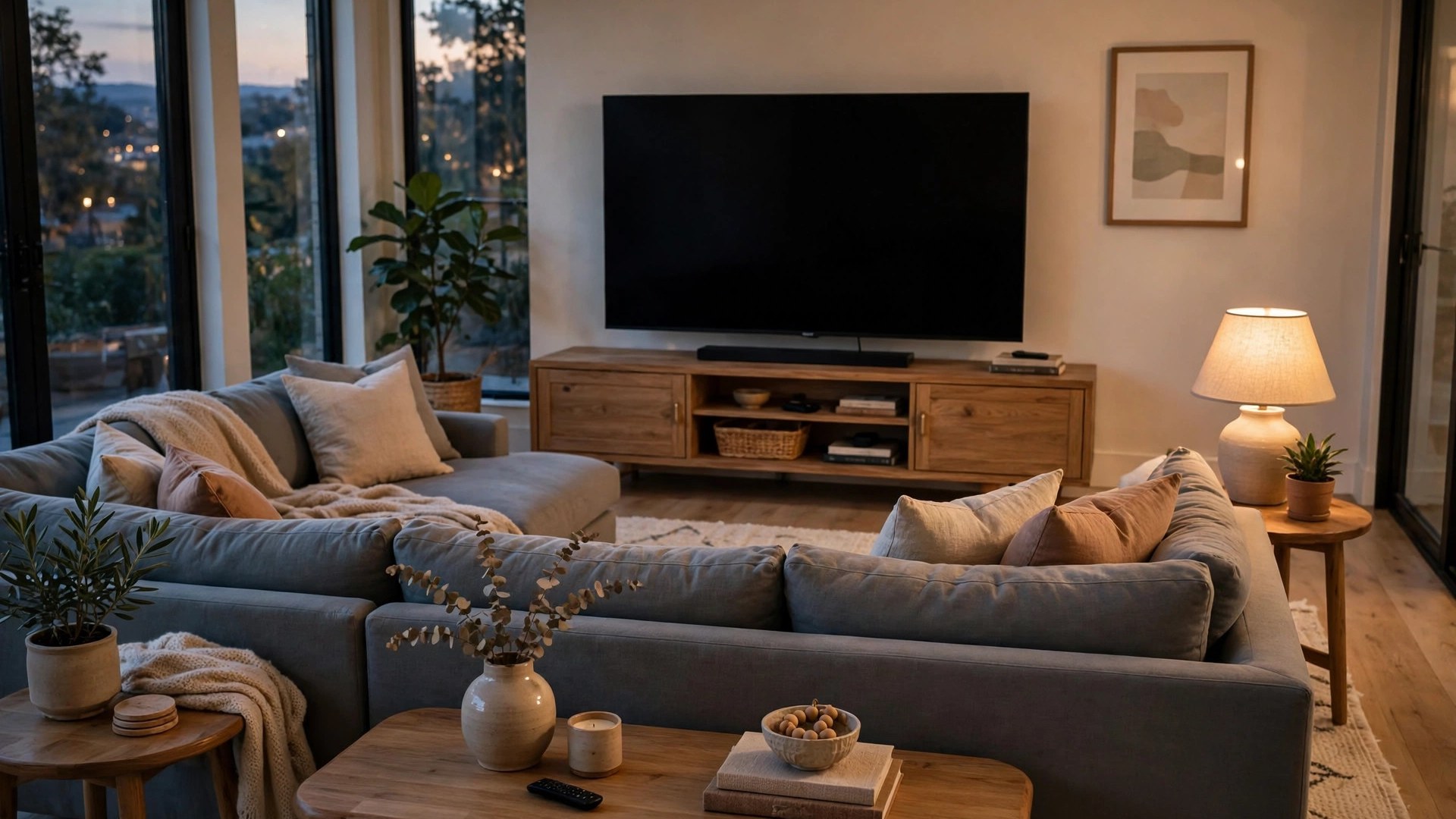

A TV room lives or dies on decisions most decorating advice skips. The sofa can be gorgeous, but if it sits twelve feet from a 55-inch screen, every movie feels like it is happening in another zip code. The console can be a design triumph, but if the cables spill out of it like a nest, the room never looks finished. Good tv room furniture ideas start with the screen, the seating distance, and the way people actually watch: sprawled, snacking, and staying for a double feature.
This guide works in the order the room does. First the geometry, where the screen goes and how far the seats belong from it. Then the furniture itself: consoles, sofas, chairs, and the tables that serve the evening. Finally the comfort layer of light control and sound, plus the sleeper furniture that lets the room host guests overnight. Get these right and the room stops being a sofa facing a rectangle and becomes the best seat in the house.
Design Around the Screen: Distance and Height First
Everything in a TV room is downstream of two numbers: how big the screen is and how far away the main seats sit. The standards used by home cinema designers come from viewing angles. SMPTE guidance suggests the screen fill about 30 degrees of your view; THX aims nearer 36 to 40 degrees for a cinematic feel. In plain terms, that means a viewing distance of roughly 1.6 times the screen’s diagonal at the relaxed end, and about 1.2 times the diagonal at the immersive end.
For the most common screen in America, 65 inches, that works out to roughly 6.5 to 8.5 feet from screen to eyes. A 55-inch TV suits about 5.5 to 7.5 feet; a 75-inch, about 7.5 to 10 feet. Measure to where your eyes will be, not to the front of the sofa, which usually means adding a foot or so of cushion depth to your tape work. If your room forces a distance, choose the screen size to fit it rather than apologizing for the mismatch forever.
Height matters just as much. The center of the screen should sit near seated eye level, roughly 42 inches from the floor for most sofas, give or take a few inches for your seat height. Mounting the TV high, over a mantel or near the ceiling line, forces an evening of tilted heads. If the only wall demands a higher mount, a tilting or pull-down mount is a purchase your neck will thank you for nightly.
The Media Console: Storage, Scale, and Cable Sanity
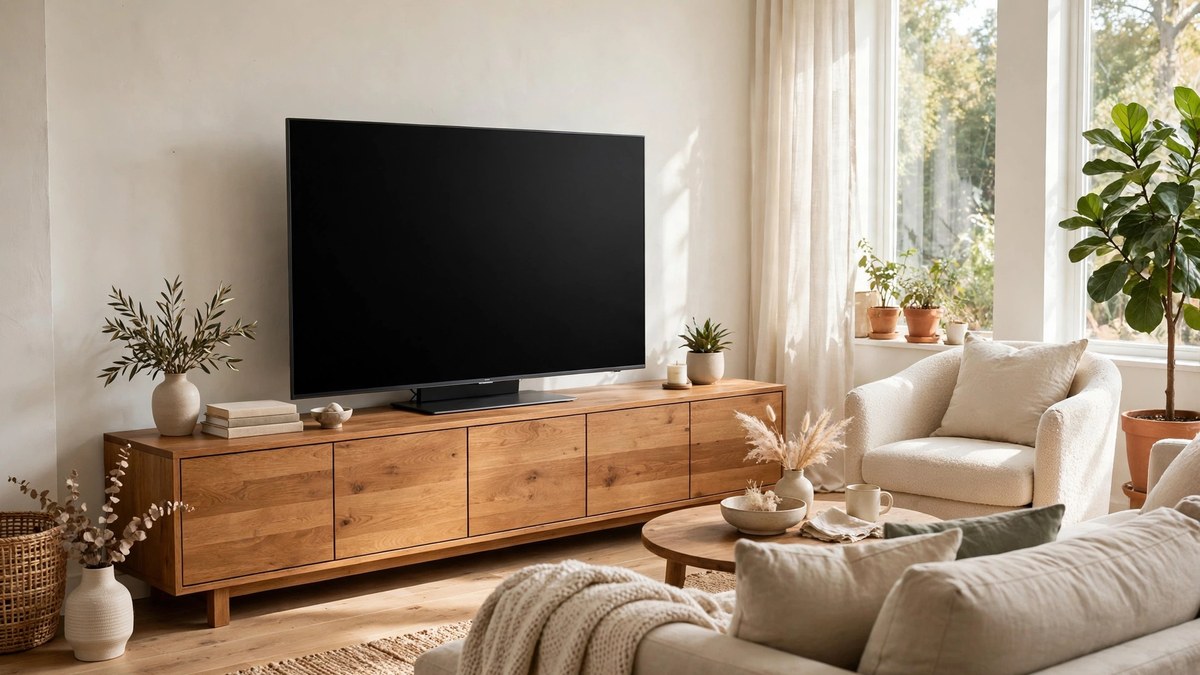
The media console is the TV room’s engine room, and it has three jobs: hold the screen at the right height if it is not mounted, swallow the equipment and cables, and look like furniture rather than infrastructure. Size it to the screen first. A console should be at least a few inches wider than the TV on each side; a console narrower than the screen makes the whole wall look top-heavy. For a 65-inch TV, which is about 57 inches wide, that means a console in the 64- to 72-inch range.
Storage is where consoles earn their keep. Closed cabinets hide routers, game consoles, and the remote collection; open sections or mesh and slatted doors let infrared remotes and ventilation work. Check the depth against your largest component, and plan the cable path before the furniture arrives: an open back or cable cutouts, a power strip inside the cabinet, and every cord bundled. Ten minutes of cable management is the difference between a media wall and a tech accident.
If your setup includes display shelving beside the screen for media, books, or a game collection, style it more like a library than a shrine to electronics: our guide to decor for shelves shows how to mix equipment and objects so the wall reads as furniture, not a control room.
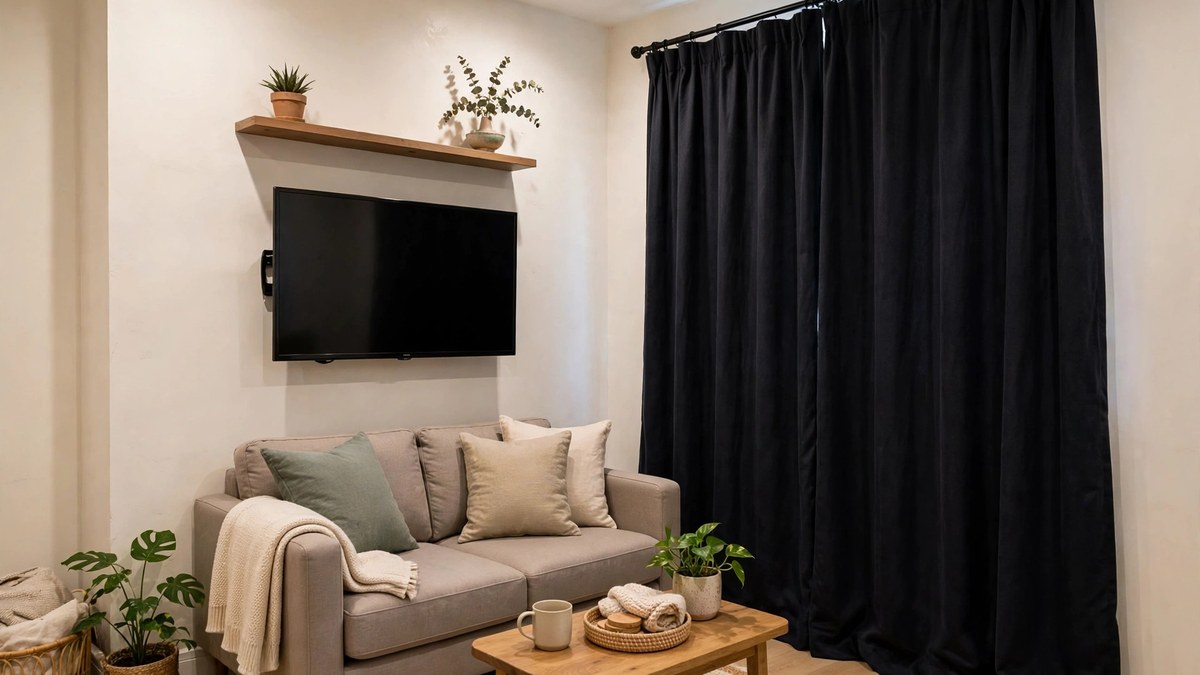
If the TV is wall-mounted, the console can be shallower and lighter in feel, a floating unit or low credenza that grounds the wall. Keep the top styled but minimal: a plant, a stack of books, the soundbar centered. Whatever sits up there competes with the screen for your eyes, so edit harder than in any other room. For general layout sequencing around the TV wall, our ideas for designing a living room walk through the order of decisions.
Sofas and Sectionals That Face the Action
In a TV room, the sofa is not a styling choice; it is seating for a two-hour sit, and comfort specifications matter. Seat depth is the first number: upright watchers do well around 21 to 23 inches of depth, while sprawlers and loungers want 24 inches or more, usually with back cushions they can rearrange. Seat height around 17 to 19 inches keeps feet on the floor and knees uncomplaining through a long film.
Sectionals suit TV rooms better than almost any other space, because the chaise end is prime real estate and the L shape aims everyone at the screen. Place the long axis facing the TV squarely; the angled conversation layouts that suit sitting rooms serve movie night poorly. Leave a walkway behind or beside the sectional of about 30 inches so latecomers are not climbing over legs in the dark.
Consider modular sofas if your household’s seating needs keep changing. Individual armless and corner units rearrange from a straight sofa to an L to a guest-night pit, and single pieces can be added as the family grows. The trade-off is a slightly less tailored look than a one-piece sectional, and modules can drift apart on hard floors without connectors or a rug to grip them. For rooms that host everything from toddler play to playoff parties, the flexibility usually wins the argument.
Fabric choices should assume snacks. Performance fabrics, washable covers, and leather all survive popcorn butter and soda incidents with dignity. Darker and patterned upholstery forgives the most, but a mid-tone with texture hides nearly as much while keeping the room lighter. Whatever you choose, test the actual sit: bring the whole household, sit the way you watch, and time it. Fifteen honest minutes in the showroom predicts two hours at home better than any review.
Recliners and Accent Chairs for Serious Watchers
The primary seats get the sofa, but the second row of social life is the accent seating, and TV rooms have their own requirements for it. Recliners, including the newer tailored styles that look like ordinary armchairs, are the connoisseur’s choice for long viewing: the back angle and footrest adjust to the viewer instead of the reverse. If you add one, place it inside the good viewing zone, not exiled to a corner at a punishing angle.
Viewing angle is the governing rule for every seat. Seats within roughly 30 to 40 degrees of the screen’s centerline get a true picture; beyond that, contrast and color degrade and necks pay the price. This is why a pair of swivel chairs is such a smart TV room purchase: they turn to conversation when the TV is off and rotate to the screen when it is on, solving the room’s double life in one mechanism.
Height harmony is the quiet detail in this section. Seats in one viewing group should put everyone’s eyes at roughly the same level, within a few inches, so nobody watches over a head or up past a recliner’s high back. This is why mixing a tall recliner into a low sofa row fails even when each piece is comfortable alone. If the recliner is non-negotiable, give it the end position where its height blocks nobody’s line to the screen.
Supplement with mobile seating for crowds: a pair of ottomans, a bench, or floor cushions that appear for the big game and vanish after. The room should gain seats without gaining permanent clutter. And keep one chair, ideally the swivel, near a lamp and side table for the household member who reads during the boring parts; every family has one, and the room should love them too.
Coffee Tables, Ottomans, and Side Tables That Serve Snacks
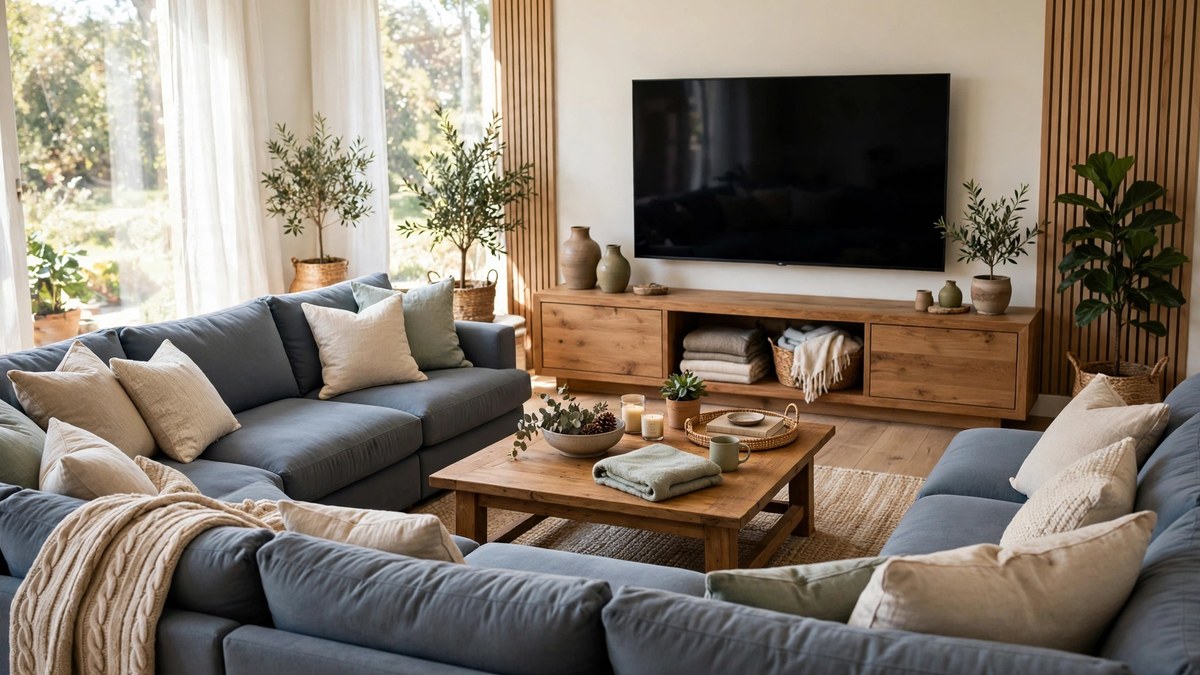
Tables in a TV room are catering staff. The coffee table must sit at the classic distance, about 14 to 18 inches from the sofa edge, close enough to reach a drink without a lunge, far enough to stretch out. Its height should meet or sit an inch or two below the sofa’s seat cushions so plates land at a comfortable level.
The upholstered ottoman is the TV room’s MVP and worth considering instead of a hard table: it takes feet without complaint, seats a surprise guest, and with a large tray on top performs every coffee-table duty including the drinks. If your household eats in front of the screen regularly, choose a table or ottoman with a surface that forgives heat and rings, or keep coasters and trivets in a drawer within arm’s reach; convenience is what makes habits stick.
Side tables matter more here than anywhere, because every seat needs its own landing spot in the dark. One per main seat is the goal, at about the height of the sofa arm, with room for a drink, the remote, and a phone. C-tables that slide over the sofa’s base are the small-room heroes of this category. Keep a lidded basket or a console drawer as the remote and charger depot so the tables stay clear enough to use.
Bed in Living Room Ideas: Sleeper Sofas and Daybeds That Host Overnight
When the TV room doubles as the guest room, sleeping furniture earns serious thought, and the best bed in living room ideas start with honesty about the mattress. Modern sleeper sofas have improved beyond their lumpy reputation: look for mechanisms that fold without a bar across the back, and mattresses at least 4 to 5 inches thick, ideally memory foam or innerspring rather than thin foam pads. A queen sleeper fits two guests; a full size suits one adult or two kids and leaves more room in tight spaces.
Test the conversion with the room arranged as it will be. The open bed typically extends 85 to 90 inches from the wall, which may swallow the coffee table’s spot entirely; know where the table goes on guest nights before the first guest arrives. Keep a bedding kit, sheets, two pillows, a blanket, folded inside an ottoman or console drawer so the transformation takes five minutes, not a scavenger hunt.
Daybeds are the other elegant answer, especially in a TV room that is also an office or den. Dressed with firm cushions against the wall, a daybed reads as a deep, lounge-worthy sofa by day, arguably better for sprawling movie posture than most sofas, and sleeps one guest in real comfort at night with a proper twin mattress. Futons and high-quality air mattresses stored in a closet remain the budget bench. For studio and small-space versions of this double-duty thinking, our guide on how to decorate an apartment covers rooms that must do everything at once.
Small TV Rooms: Furniture That Keeps It Cozy, Not Cramped
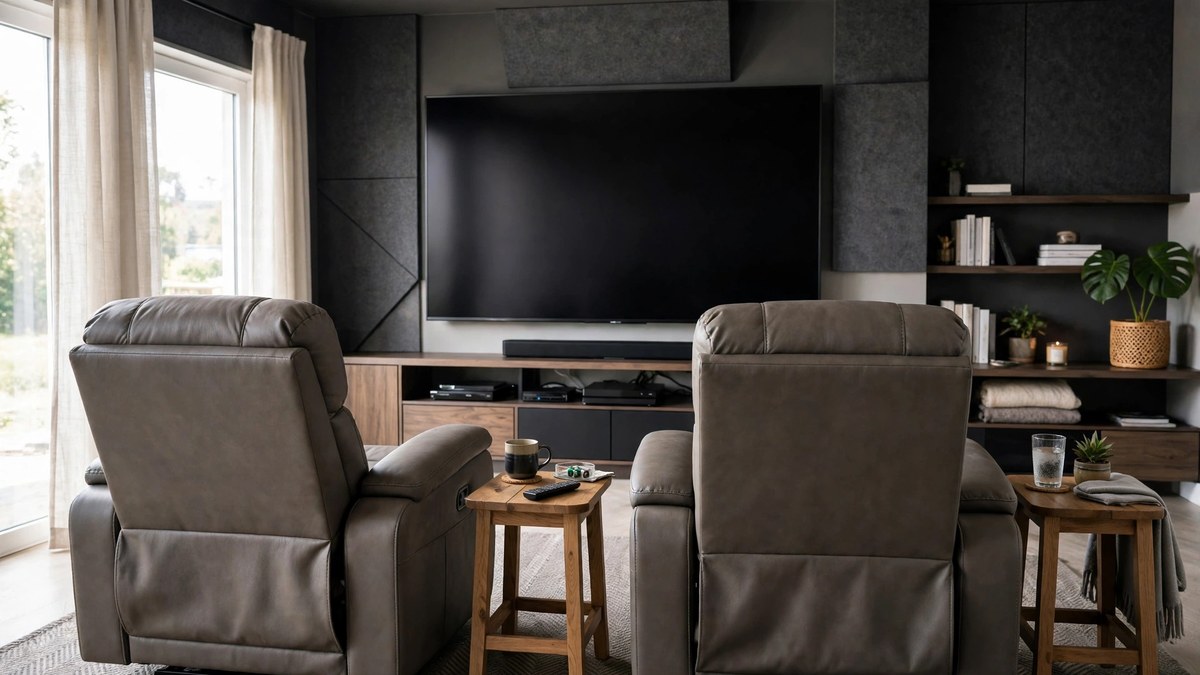
Small TV rooms benefit from the geometry most of all: a shorter viewing distance suits a 43- to 55-inch screen beautifully, so the modest room can deliver the most cinematic picture in the house. Scale the furniture to the distance, not to a furniture store’s floor set. A loveseat or a compact sofa around 72 inches wide, with slimmer arms and exposed legs, gives a true two-person theater without swallowing the floor.
Wall-mount the screen to reclaim the console’s depth, or choose a shallow console under 16 inches deep. Floating shelves hold components in some setups, though heat and cables need honest planning. Keep the floor as visible as possible; leggy furniture and a low-pile rug in a mid-tone make the room feel larger and vacuum up the popcorn evidence easily.
Fight the cave effect with the comfort layer rather than more furniture: blackout shades for daytime viewing, a dimmable lamp behind or beside the seating for bias light that eases eye strain, and soft furnishings that keep the small room’s sound from going tinny. Done right, a small TV room is not a compromise at all. It is the coziest ticket in town, and the one guests request.
Blackout, Glare, and Sound: The Comfort Layer
Furniture gets the credit, but light control decides whether the picture looks expensive. Any window in the TV room needs a treatment that can genuinely darken: blackout-lined curtains or blackout shades, ideally both layers, since light leaks at the edges are what spoil daytime sports. Note where the sun lands at your usual viewing hours; the glare problem is usually one window at one time of day, and that window gets the serious treatment.
Screen glare also comes from the room itself. Lamps placed where they reflect in the screen, roughly behind the seating is the danger zone, should move to the sides or behind the screen as bias lighting. A soft light behind the TV not only kills reflections; it reduces the contrast between the bright screen and the dark room, which is measurably easier on the eyes across a long evening.
Speaker placement follows the seating, not the walls. A soundbar centered under the screen handles most rooms honestly. Where separates exist, the front speakers belong at ear height flanking the screen at roughly the same distance as the main seat, with the center channel as close to the screen’s center as the console allows, since dialogue anchors there. Rear speakers behind the seating, slightly above ear level, complete the envelope. None of this needs to show: modern speakers in wood and fabric finishes sit on consoles and shelves like objects, not equipment.
Sound is the third leg. Soft rooms sound better: the rug, upholstered seating, curtains, and a bookcase all absorb the reflections that make dialogue muddy in hard, bare rooms. You do not need acoustic panels; you need the ordinary furnishings of a comfortable room, present in sufficient quantity. If dialogue still hides, a soundbar with a center-channel emphasis setting is the highest-value electronics upgrade most TV rooms can make, well ahead of a bigger screen.
Common TV Room Furniture Mistakes
The first mistake is the sofa against the far wall regardless of screen size, which guarantees a too-far picture and tempts buying an enormous TV to compensate. Float the seating at the right distance; the space behind the sofa is not wasted, it is where consoles, shelves, or a walkway belong. Second is mounting the screen at gallery height; art rules and eye level differ, and the TV belongs at seated eye level.
Third is furniture chosen for conversation in a room meant for viewing: swivel-less chairs stranded at bad angles, a coffee table a yard from the sofa. Fourth is forgetting the snack infrastructure, no side tables, no surfaces, drinks migrating to the floor and the floor winning. And fifth is the cable nest, left for later, which never comes. Ten minutes with cable ties on setup day is the cheapest decorating win in this entire guide.
Frequently Asked Questions
How far should the sofa be from a 65-inch TV?
For a 65-inch screen, aim for roughly 6.5 to 8.5 feet between the screen and the viewer’s eyes, the closer end for a more cinematic feel, the farther for relaxed everyday viewing. Measure to eye position when seated, which sits a foot or so behind the sofa’s front edge.
Should the TV go on a console or be wall-mounted?
Both work. A console is easier, needs no holes, and hides equipment and cables; mounting frees floor depth and suits small rooms. Either way, the screen’s center should land near seated eye level, about 42 inches from the floor, and a console should be wider than the TV by a few inches per side.
What size coffee table works best in a TV room?
One that sits 14 to 18 inches from the sofa, at or slightly below seat height, and long enough to serve the main seats, roughly two-thirds the sofa’s length is a good proportion. In snack-heavy rooms, an upholstered ottoman with a tray often outperforms a hard table on every measure except formality.
How can I make a TV room double as a guest room?
Choose a quality sleeper sofa with a mattress at least 4 to 5 inches thick, or a daybed with a real twin mattress, and confirm the open bed fits with the coffee table relocated. Store the bedding kit inside the room so conversion takes minutes. A privacy door and a small lamp complete the guest-night setup.
Do I really need blackout curtains for a TV room?
If you watch during daylight hours, yes, at least on the windows that throw light toward the screen. Blackout shades or lined curtains on the one problem window often solve the whole room. For evening-only rooms, ordinary lined drapes plus lamps placed to avoid reflections may be enough.
What is the best seating for long movies?
Deep, supportive seats with backs at a slight recline and room for feet: a sectional with a chaise, a good recliner, or a sofa deep enough to sit cross-legged. Test with the whole household for at least fifteen minutes in the store. Seat depth around 21 to 24 inches, matched to the viewers’ heights, is the number to shop by.
How do I hide TV cables without opening walls?
Bundle cords with ties or a cable sleeve, route them behind the console, and keep the power strip inside the cabinet. For wall-mounted screens, a paintable cord cover that runs from the TV to the console hides the drop cleanly and paints to match the wall. In-wall kits exist for the neater result if your lease and skills allow.
Final Thoughts
A great TV room is geometry plus comfort plus snacks, in that order. Set the screen at eye level and the seats at the honest distance, give every seat a table and a lamp it can reach, control the light and soften the sound, and let the furniture be as comfortable as the movies are long. Do that, and your TV room becomes the easiest room in the house to love.
