
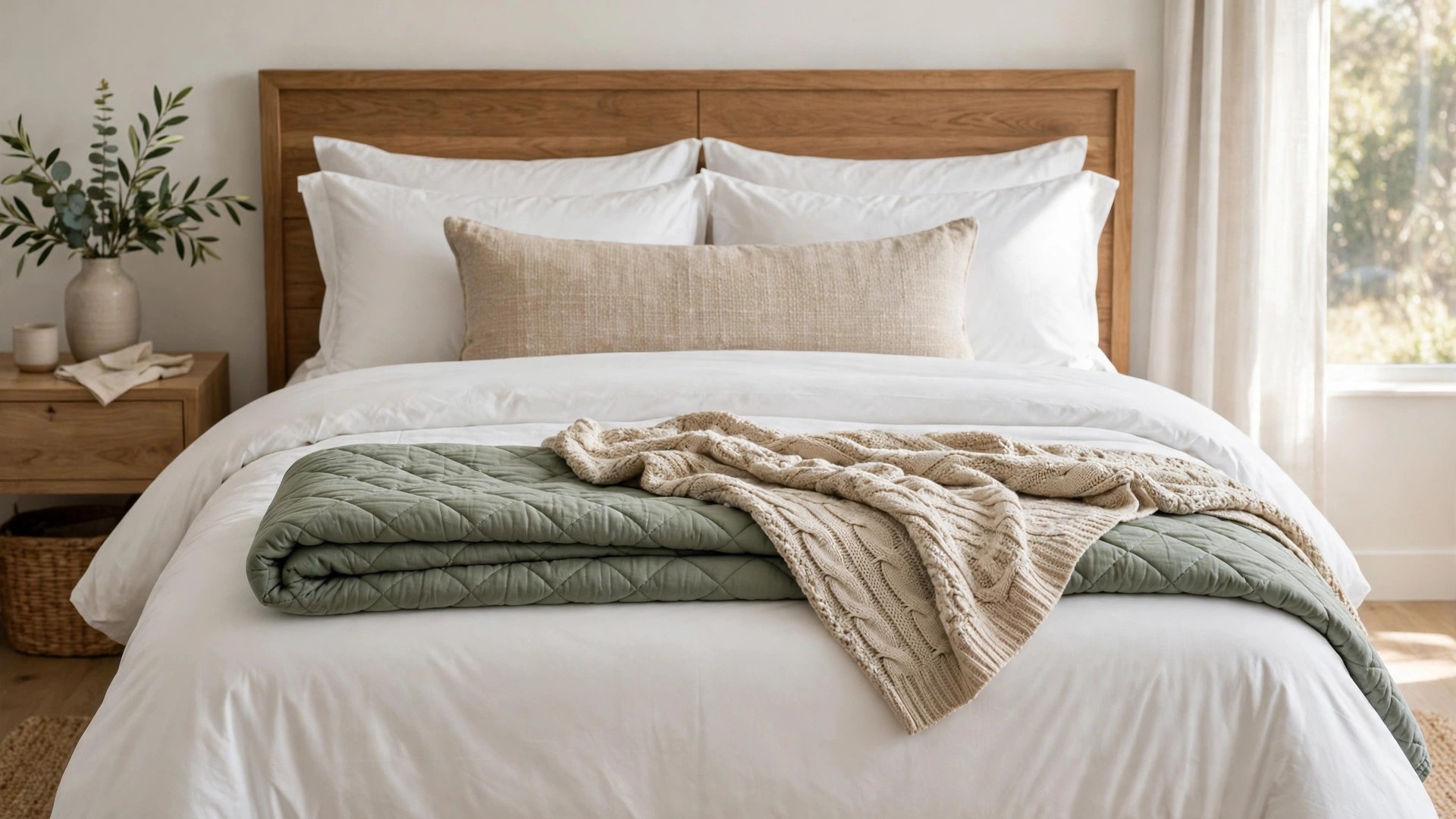

You spend roughly a third of your life in bed, yet most beds are dressed with whatever came in a bag. These bedroom bedding ideas treat the bed as what it is — the room’s largest piece of furniture and your nightly destination — and show you how to layer it like the hotel beds you remember. We will cover the anatomy of a well-made bed, sheet fabrics without the marketing fog, the duvet-quilt-throw formula, pillow math, seasonal swaps, and the care habits that keep good bedding good for years.
The encouraging truth: a luxurious bed is mostly technique, not budget. The same duvet, arranged with intention and layered against the right textures, looks and feels twice as expensive as it is.
The Anatomy of a Well-Made Bed
A made bed is built in order, and each layer has a job. Start with a mattress protector — unglamorous, essential — it guards the mattress against spills and sweat and adds a thin layer of quiet structure. Some people add a mattress topper here for softness or firmness correction; it is the cheapest way to change how a bed feels without replacing the mattress.
Next, the fitted sheet (corners fully seated, seams aligned), then the flat sheet, patterned or finished side down so the folded-back cuff shows its good side. Then the warmth layer — duvet or comforter — and finally the visible styling layers: a quilt or coverlet folded across the foot, a throw, and the pillows.
The difference between a bed that looks made and one that looks styled is in the finishing moves: hospital corners or a clean tuck on the flat sheet, the duvet pulled up and folded back in thirds to show the sheet, pillows fluffed and chopped or squared, and the top layers aligned parallel to the headboard. Two extra minutes, entirely different bed.

Bed Styling Ideas From Hotels and Designers
Hotels style beds for photography every day, and their tricks are copyable. The first is the all-white base: white sheets and a white duvet read as clean and serene in any room, and they let you change the room’s mood entirely with the throw and cushions. There is a reason so many bedding traditions and hotel standards converge on white — it signals freshness and shows at a glance that linens are laundered.
The second trick is the fold-back: pull the duvet up to the pillows, then fold the top third back down to reveal the flat sheet beneath — ideally with the sheet’s cuff or a contrast border showing. It creates the layered horizontal bands that eyes read as “luxury hotel.”
The third is restraint with pillows: hotels rarely use more than the sleeping pillows plus one or two accents. A long lumbar pillow across standard shams is the current designer favorite because it finishes the bed in one gesture instead of a pile you must excavate nightly.
Designer home beds add one more layer hotels skip: personality. A vintage quilt, a patterned throw in the room’s accent color, or a pair of cushions in a fabric repeated from the curtains — the bed becomes part of the room’s story rather than a white island in it. The feminine, layered version of this look is exactly what our ladies bedroom decorating ideas build around.
Sheets: Cotton, Linen, Percale, and Sateen Explained
Sheets are where bedding marketing gets murky, so here is the plain version. Fiber first: long-staple cotton (Egyptian, Pima) makes smoother, stronger fabric than short-staple cotton. Linen breathes beautifully and suits hot sleepers and warm climates; it wrinkles, which is part of its look. Bamboo-derived rayon is silky and cool but varies in durability. Microfiber is inexpensive and soft but can sleep warm and pills sooner.
Weave second: percale is a plain, tight weave with a matte, crisp, cool feel — the classic hotel sheet. Sateen is woven to expose more thread surface, giving a smoother, slightly lustrous, warmer feel. Flannel is brushed for fuzz and winter warmth. The percale-versus-sateen choice is about whether you sleep hot (percale) or like a silky drape (sateen).
Thread count, finally, is the most abused number in bedding. It counts threads per square inch, and beyond roughly 300 to 500 in quality cotton, gains flatten — some very high counts are achieved with multi-ply yarns that add weight rather than softness. Buy the fiber and weave you like from a maker you trust, and let thread count be a tiebreaker, not the headline.
Size honesty matters too: measure your mattress depth before ordering, because modern mattresses with toppers often run 12 to 16 inches deep and standard fitted sheets will pop off the corners nightly. Deep-pocket sheets are not a luxury in that situation — they are the difference between a made bed and a wrestling match. And buy the pillow size that matches your shams (standard pillows in king shams slump sadly); the crisp hotel look starts with fills that actually fill their cases.
The Layering Formula: Duvet, Quilt, and Throw
Layering gives you three things at once: temperature control (add or shed a layer at 3 a.m. without waking fully), visual depth, and seasonal flexibility. The dependable formula has three warmth layers above the sheets, used in combination:
- The duvet — your main warmth, in a washable cover that carries the bed’s main color or pattern. Down or down-alternative fill; choose warmth rating by your climate, not by maximum fluff.
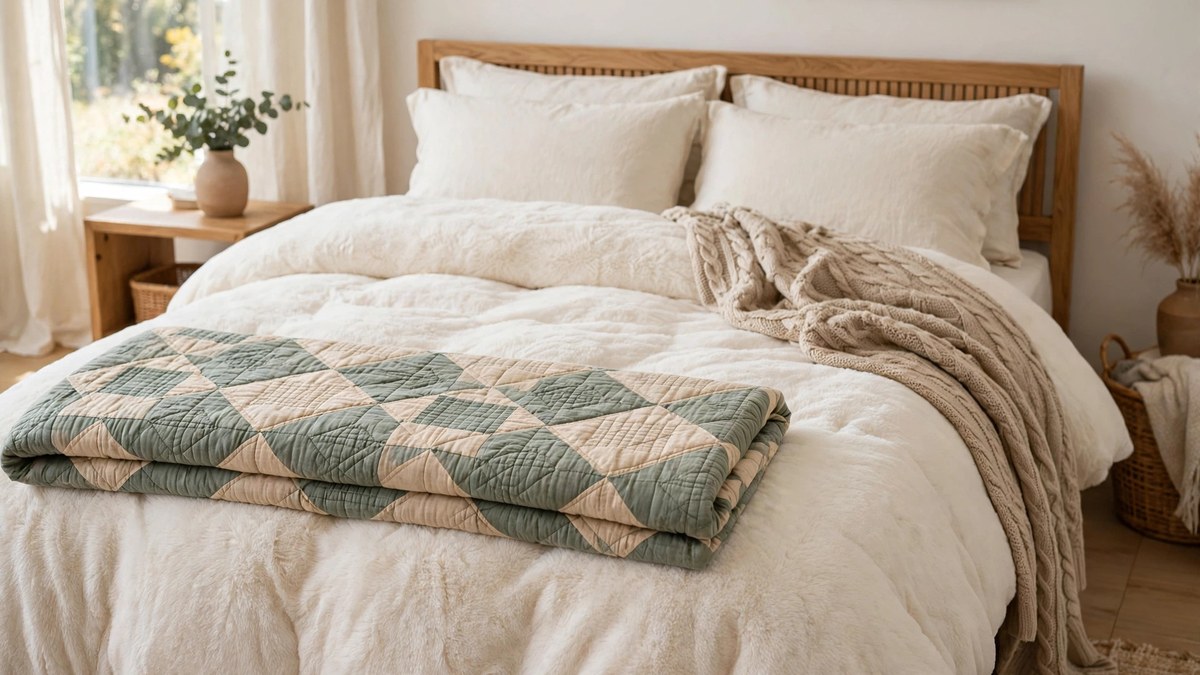
- The quilt or coverlet — a thin, structured layer folded across the foot half of the bed, or spread flat under the duvet in winter for a tailored look. It adds the visual band and the extra weight many sleepers love.
- The throw — the accent: texture and color in one movable piece, draped diagonally, folded lengthwise at the foot, or laid across one corner.
Style the layers with offset folds — duvet folded back a third, quilt visible below it, throw at an angle — and the bed gains the rhythm that makes it look professionally made. Keep the fabrics varied (smooth duvet, quilted middle, nubby throw) because texture contrast is what “layered” actually means to the eye.
The Two-Minute Duvet Cover Method
The one bedding chore people genuinely dread is stuffing the duvet back into its cover after laundry, and struggling with it is optional. The roll method — sometimes called the burrito method — turns it into a two-minute job with no corner-hunting:
- Turn the duvet cover inside out and lay it flat on the bed, opening at the foot.
- Lay the duvet on top of it, edges aligned, and fasten any corner ties if your cover has them.
- Starting at the head end, roll duvet and cover together toward the foot, like a sleeping bag.
- At the opening, reach in and flip the roll through the cover, the way you would turn a sock.
- Unroll it back toward the head, close the buttons or zipper, and shake the bed by the foot corners.
If your cover has no internal ties, add clip-style duvet fasteners at the corners or tie short ribbons inside — a drifting duvet that balls up in one end of the cover is almost always a missing-ties problem, not a duvet problem. Size matters too: a cover more than a couple of inches larger than the duvet will always look slack and shift at night, no matter how well you stuff it.
Make the shake a weekly habit when you change the sheets. Thirty seconds of redistribution keeps the fill even, prevents the thin spots that make a bed sleep cold in patches, and keeps the top of the bed looking as smooth on day six as it did on laundry day.
Pillows: How Many and How to Arrange Them
Pillow math is simple once you know the cast. Sleeping pillows: two per person at most, in standard or king shams that match the sheets or duvet. Decorative pillows: an odd number, usually one, three, or five total, in descending size toward the front.
The current classic arrangement for a queen or king bed: sleeping pillows propped against the headboard, a pair of Euro shams (26-inch squares) in front of them if you like height, then one long lumbar or two smaller cushions in the accent fabric. The bed looks abundant without requiring a nightly excavation project.
Chop or not? The karate-chop crease in the top center of a square cushion is a stylist’s trick that reads tailored; skip it on down-filled sleeping pillows (bad for the fill over time) and on linen, which prefers a softer slouch. Whatever you choose, be consistent across the bed.
Where do the decorative pillows go at night? Decide before buying eleven of them: a bench, a basket, or one chair. If there is no landing spot, cap the decorative count at three — your future sleepy self thanks you.
Fill quality is what separates a styled bed from a lumpy one. Feather-and-down cushions chop and fluff beautifully but need daily re-plumping; down-alternative fills hold their shape with less attention and suit allergy households; cheap polyester inserts flatten within months and make even good covers look tired. When a styled bed in a photo makes you envious, it is usually the inserts, not the covers, doing the work — upgrade inserts before re-covering, and buy inserts one inch larger than the cover for that full, tailored shoulder.
Color and Pattern Combinations That Work
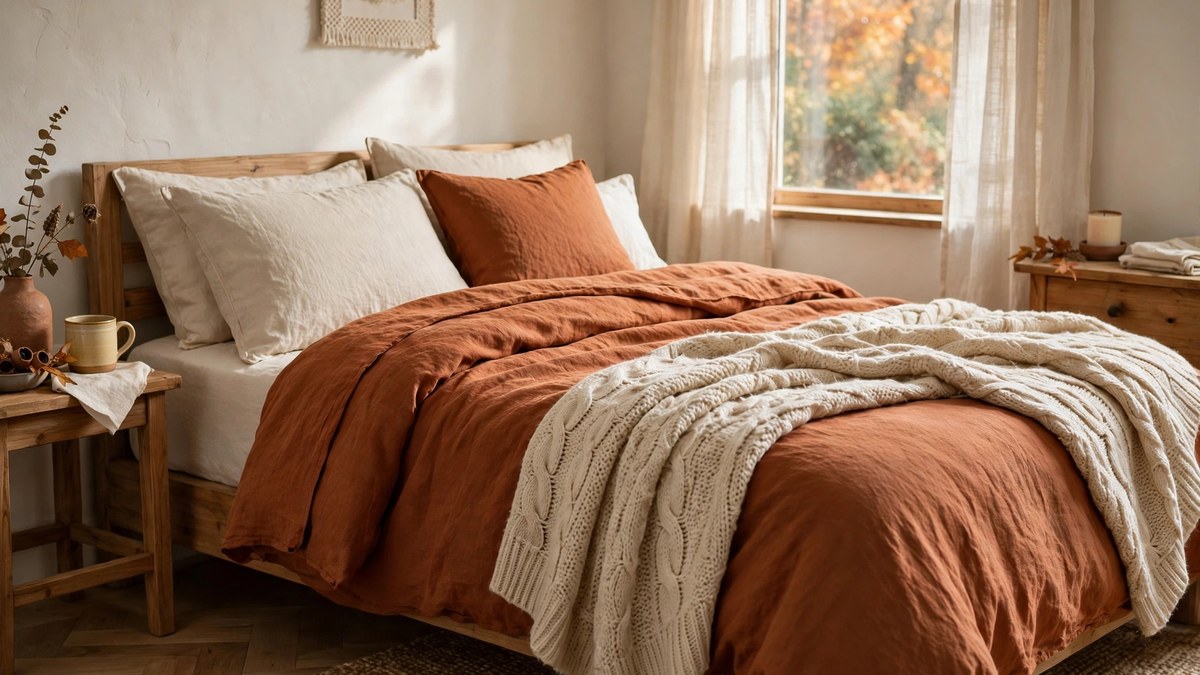
Bedding color is the fastest bedroom refresh there is, because the bed dominates the room. The safest formula is a neutral base (white, ivory, stone) with color carried by the quilt, throw, and cushions — you can re-theme the room for the cost of a folded layer rather than a full set.
From there, three combinations rarely fail. Tonal: several shades of one color (pale gray sheets, mid-gray duvet, charcoal throw) for a calm, tailored look. Contrast: a deep duvet against white sheets, or the reverse, for crisp modern definition. Pattern-plus-solid: one patterned layer (a striped or floral quilt, say) with everything else solid in colors pulled from that pattern.
Scale matters with pattern: one large-scale print and one small-scale print can coexist if a solid separates them and they share colors. Two competing medium patterns side by side usually fight. When in doubt, put the pattern on the smallest layer — the throw or the lumbar cushion — and let solids do the rest.
If the bed serves two people with different tastes, our couple bedroom design ideas cover the palette-negotiation approach; bedding is usually where the truce gets signed.
Seasonal Bedding: Warm in Winter, Cool in Summer
One bedding set worn all year is why so many people sleep badly in July and freeze in January. The fix is a two-weight system: a lighter summer duvet (or just the quilt) and a warmer winter duvet, swapped with the clocks in most climates. Down and wool fills regulate temperature better than most synthetics; modern down-alternatives have narrowed the gap.
Summer configuration: percale or linen sheets, the duvet in its cover alone or just a coverlet, a light cotton throw. Winter configuration: flannel or sateen sheets, the warm duvet, the quilt layered on top, a wool or knit throw within reach.
Store the off-season set clean, fully dry, and loosely packed — vacuum bags are fine for synthetics but can damage down loft over long periods, so breathable cotton storage bags are the kinder default. Wash everything before storing; invisible body oils are what yellow stored linens.
Travelers and shift workers, take note: the seasonal swap matters most at the margins of the day. If your bedroom runs hot in the afternoon (west-facing glass is the usual culprit) and you sleep days, blackout curtains plus the summer configuration — linen sheets, no duvet, just the quilt folded at the foot in case the night cools — can rescue daytime sleep. Your “season” is partly the clock, and bedding that adapts by layer rather than by calendar serves irregular schedules best.
Bedding for Guest Rooms and Couples
Guest bedding should be hotel-simple: white or light neutral sheets (stains visible, bleach forgiving), a mid-weight duvet, two pillow firmness options if you can manage it (one soft, one firmer per side), and a folded extra blanket at the foot. Guests sleep measurably better in beds that do not ask questions.
Skip strong scents and fabric softener in the guest bed — fragrance is the top bedding complaint among guests, and softener residue irks sensitive skin. A small carafe and glass on the nightstand finishes the hotel illusion cheaply.
For couples, the bedding negotiations are warmth and territory. The two-duvet method (identical covers, separate fills) ends both battles at once. If you share one duvet, size up: a king duvet on a queen bed gives each person drape and margin. And agree on the decorative-pillow count before the bench overflows — see the truce terms in the couples’ guide linked above.

Washing and Care Basics That Keep Bedding Fresh
Most bedding dies of laundry, not use. Sheets generally want washing every one to two weeks in warm (not hot) water; duvet covers every few weeks; pillows two to four times a year if washable; duvets and quilts seasonally or as needed, in a large-capacity machine.
Rules that extend life: wash bedding separately from towels and clothing (zippers and hooks snag; towels shed lint onto sheets). Go easy on detergent — excess soap leaves residue that dulls fabric and irritates skin; roughly two tablespoons is enough for most loads. Skip fabric softener on towels-and-bedding loads where absorbency matters, and dry on medium rather than high heat.
Pillow protectors under the cases double pillow life by keeping oils out of the fill. Rotate between two sets of sheets so each rests between uses — the same rotation logic as shoes. White bedding can take an oxygen-based brightener; colors prefer color-safe formulas.
Where to Splurge and Where to Save
Splurge on what touches skin and what you feel nightly: the sheets (fiber and weave you love), the pillow matched to your sleep position, and the duvet fill in the right warmth. These determine sleep quality; everything else is decoration.
Save on the visible-but-untouched: decorative cushion covers (buy covers, reuse inserts), throws (one good one beats three thin ones, but it does not need to be cashmere), duvet covers in trend colors you will tire of, and bed skirts or valances, which are leaving fashion anyway.
The budget formula most designers use: spend 60 percent of the bedding budget on sheets, pillows, and duvet; 25 percent on the coverlet/quilt layer; 15 percent on the decorative pieces. If you are building a calm-first sleep sanctuary, the priorities in our relaxing bedroom design ideas align exactly with this order.
Bed-Making Mistakes to Avoid
The unmade middle: a bed with the duvet simply thrown flat reads unfinished even with beautiful linens. The fold-back and one folded layer take ninety seconds. Second mistake: too many pillows — if making the bed requires choreography and storage, the count is wrong for your life.
Third, the sheet set bought purely on thread count, arriving heavy and hot. Fourth, decorative cushions in fabrics that cannot touch skin or be washed, placed where people actually lean. Fifth, keeping one year-round duvet weight and blaming the mattress for bad sleep.
Finally, forgetting the mattress itself: no bedding arrangement survives a sagging mattress or a lumpy, unprotected one. A protector from day one and a topper as a mid-life correction keep the whole stack honest.
Building Your Bedding Wardrobe: The Starter Kit Checklist
If you are starting from one sad set, here is the order of battle that stylists and hotel housekeepers converge on. Buy in this sequence and the bed improves at every step:
- Two sets of sheets in your chosen fiber and weave (one on the bed, one in the wash) — white or your palette’s lightest neutral.
- One quality duvet in the right warmth for your climate, plus two duvet covers: one neutral, one in the room’s accent.
- One quilt or coverlet in a mid-tone, sized to fold across the foot or layer under the duvet.
- Pillows: your sleeping pillows with protectors, plus two shams and one lumbar or accent cushion.
- One throw with real texture — knit, waffle, or wool-look — in the accent color.
- A mattress protector, unglamorous and non-negotiable, bought before everything else if the mattress is new.
That kit, maintained and rotated, is a complete bedding wardrobe: two full looks (neutral cover weeks, accent cover weeks), seasonal flexibility (quilt on, quilt off), and nothing on the bed that does not earn its place nightly. Everything beyond it — seasonal prints, a second throw, holiday cushions — is garnish, and garnish is where the fun budget goes.
Frequently Asked Questions
How many layers should a well-styled bed have?
Above the sheets: a duvet as the main warmth, a quilt or coverlet as the structured middle band, and a throw as the accent — plus sleeping pillows and one to three decorative pillows. That stack gives temperature options and the layered look without daily fuss.
What is the difference between a duvet, a comforter, and a quilt?
A duvet is a soft filled insert used inside a removable, washable cover. A comforter is a single filled piece with the decorative fabric built in — no cover. A quilt is thinner, stitched in layers, and works as a light cover or a styling layer over a duvet.
Is higher thread count always better?
No. In quality cotton, sheets around 300–500 thread count are typically the sweet spot. Very high counts are often achieved with multi-ply yarns that add heaviness rather than softness. Fiber quality (long-staple cotton) and weave (percale vs. sateen) matter more to feel.
Which sheets are best for hot sleepers?
Percale-weave cotton and linen are the classic choices: both breathe and feel cool against the skin. Linen also absorbs moisture well and softens with washing. Avoid sateen and microfiber if you run warm — they tend to drape closer and trap heat.
How do hotels make their beds look so crisp?
White linens, tight tucks (hospital corners), a duvet folded back a third to show the sheet, and restrained pillows — usually just the sleeping set plus a lumbar. The look is about smoothness and symmetry more than quantity. Pressing or steaming the duvet cover’s visible edge helps too.
How often should I wash my bedding?
Sheets every one to two weeks; pillowcases can go weekly if skin is sensitive. Duvet covers every two to four weeks, pillows a few times a year if washable, and duvets seasonally. Always store off-season sets clean and fully dry, loosely packed.
What size bedding do I need to size up for drape?
If you want generous overhang or share with a blanket-strong partner, size the duvet and flat sheet up one size — a king duvet on a queen bed. Check your mattress depth too: mattresses over about 14 inches deep need deep-pocket fitted sheets to stay put.
Final Thoughts
A great bed is a system: protector and honest sheets below, a layered middle you can adjust at 3 a.m., and a top that looks deliberate in the morning light. Master the fold-back, pick fabrics for how you sleep, and let one throw carry the room’s color.
Do the ninety-second make every morning for a week. It is the cheapest decorating habit there is — and the bed, dressed like it matters, will quietly upgrade the entire room around it.
