
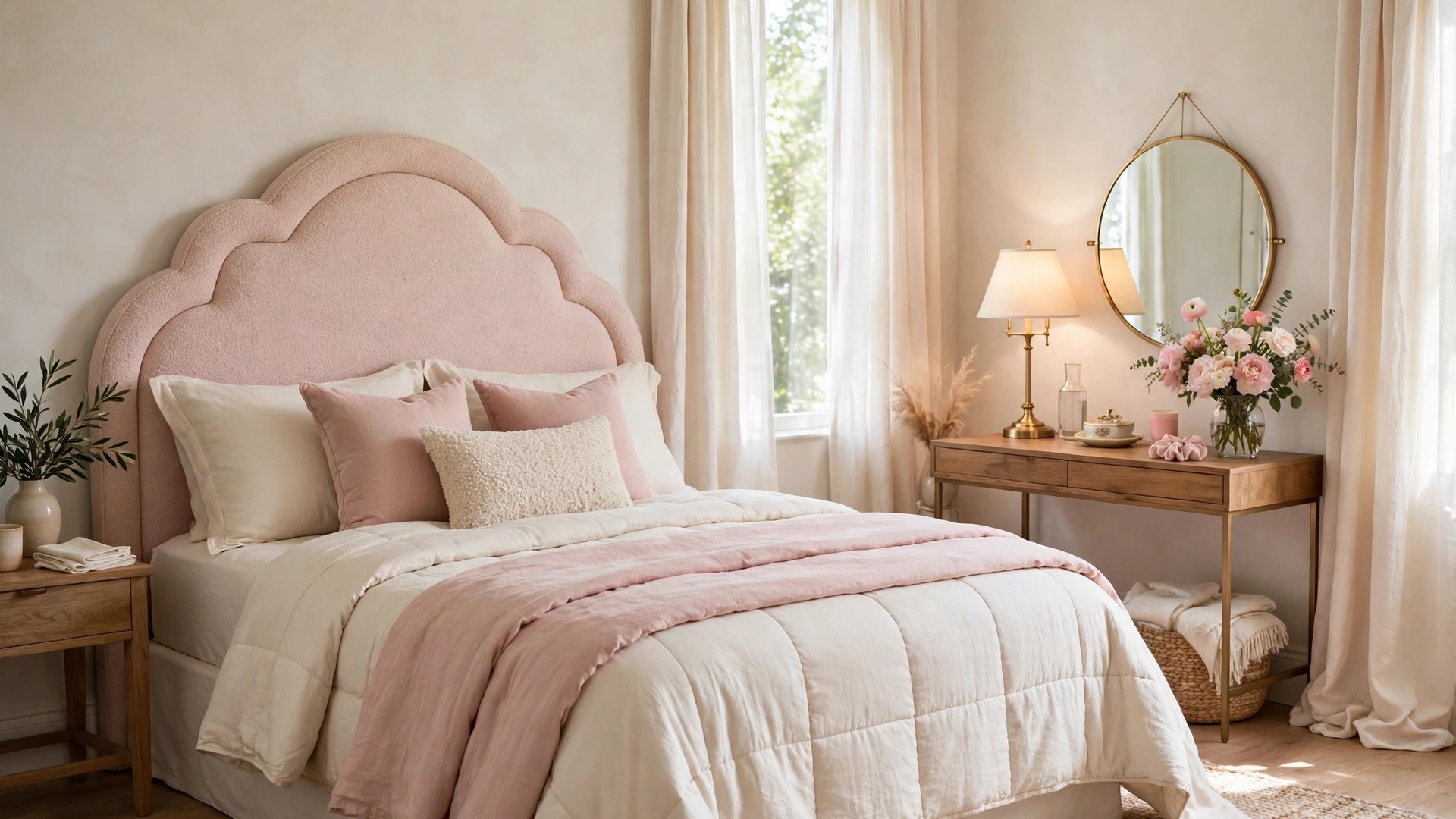

A bedroom of your own — whether it is a primary suite, a spare room reclaimed, or a small apartment’s single room — deserves to be more than where the laundry chair lives. The best ladies bedroom decorating ideas are not about making a room look “girly.” They are about building a space that feels personal, calming, and quietly luxurious: a room that works for sleep, dressing, reading, and recharging. This guide covers palettes, the bed, a vanity corner, textiles, lighting, and the personal details that make the room unmistakably yours, with options for every budget and for renters too.
Start from how you actually live. A room for a woman who reads in bed nightly needs different lighting than a room built around a morning makeup routine. Decorating that follows your habits always looks better — and feels better — than decorating copied from a photo.
What Makes a Bedroom Feel Feminine Without Going Overboard
Feminine style in a bedroom is less about pink and ruffles than about qualities: softness, curves, layered texture, and thoughtful detail. A room can be deep green and tailored and still feel feminine if the bedding is plush, the lines are gentle, and there are personal touches on display.
The balance point is contrast. Pair soft elements (a velvet throw, a curved headboard, a floral print) with structured ones (a tailored bench, black picture frames, a sleek lamp) and the room reads elegant rather than sweet. Too much of one side and it tips into either fussy or stark.
Sensory details matter here more than in any other room: the weight of the duvet, a scented candle on the nightstand, curtains that pool slightly, a rug your feet find first thing. A feminine bedroom is designed for the person in it, not the camera — and paradoxically, that is what makes it photograph beautifully.
Woman’s Bedroom Decorating Ideas for Grown-Up Style
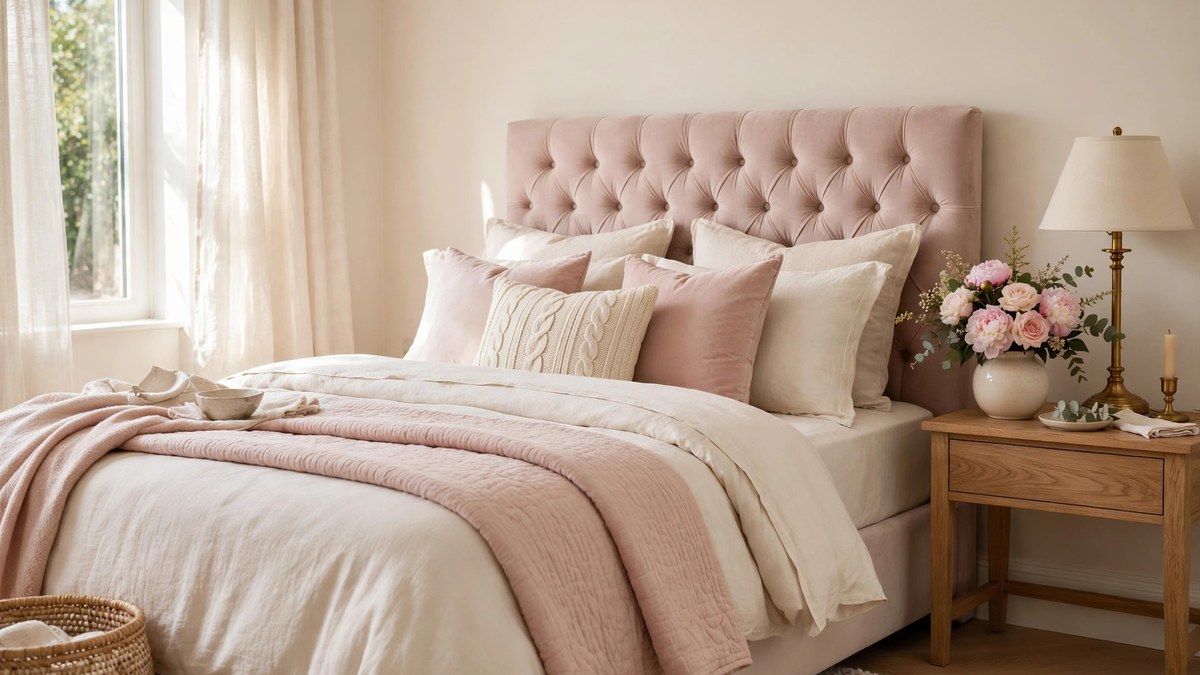
The grown-up version of a feminine bedroom trades theme for mood. Instead of a “shabby chic” or “princess” package, it builds atmosphere with color, texture, and a few well-chosen luxuries: a proper headboard, real art, matching nightstand lamps, and bedding you look forward to touching.
One hallmark of the adult approach is a restrained palette with richness inside it. Think warm white walls, a dusty rose or sage duvet, brass and walnut accents, and one patterned element — a rug or a pair of cushions — doing the expressive work. Nothing matches exactly, but everything belongs to the same family.
Another is editing. A mature room has clear surfaces with a few beautiful things on them, not every beautiful thing you own at once. Covered storage (a lidded box on the dresser, baskets in the wardrobe) keeps the serenity intact while your real life continues behind closed doors.
Finally, invest in the touchpoints: the lamp you switch off nightly, the throw at the foot of the bed, the mirror you use every morning. Grown-up decorating spends where your hands and eyes go every day, and saves on the rest.
Color Palettes That Feel Soft, Warm, and Personal
Color sets the emotional temperature of the room, and feminine palettes are broader than blush. The most livable families are these: warm whites and creams as a base; dusty rose, mauve, and plum for romance; sage and soft olive for calm; powder blue for freshness; and deep accents — burgundy, forest, navy — for drama in small doses.
There is science and culture wrapped up in pink itself — the color pink has carried associations from delicacy to confidence across different eras — but for your room, the only rule that matters is how the shade behaves in your light. Test any pink on the wall; north light can push it gray, warm bulbs can push it peach.
Use the palettes in our bedroom color ideas guide as starting formulas, then personalize with your accent metal and one pattern. A dependable structure: 70 percent soft neutral, 20 percent your main color, 10 percent a deeper or brighter accent that appears in exactly three places.
If you love a dramatic hue, purple is the classic feminine power color — our purple bedroom ideas show how to run it from lavender-soft to aubergine-bold without overwhelming a sleep space.
The Bed as the Centerpiece
In a woman’s bedroom, the bed is the room. It occupies the most space, sets the style, and delivers the comfort the whole room promises. Give it the investment and the styling attention first; everything else can be simpler.
Start with the headboard: upholstered shapes — channel tufting, arches, scallops — instantly soften a room and make sitting up to read comfortable. Then layer the bedding properly: fitted sheet, flat sheet folded back, a duvet with body, a quilt or throw folded at the foot, and pillows arranged sleeping pair, sleeping pair, then one or two decorative ones in front.
The full layering method, fabric choices, and seasonal swaps are covered in our guide to bedroom bedding ideas — the short version is that texture mixing (linen against velvet against a knit throw) is what makes a bed look styled rather than just made.
Finish the composition with symmetry where you can: matching nightstands and lamps calm the eye, and a bench or a pair of poufs at the foot of the bed gives the arrangement a tailored ending (and a place for tomorrow’s outfit that is not the floor).
A canopy or four-poster frame is the maximalist version of the centerpiece bed, and modern slim-profile versions suit even modest rooms surprisingly well: the posts define a room-within-the-room, and sheer panels or a draped throw over one corner soften the architecture. At the other end of the budget, a tall DIY upholstered headboard — foam, fabric, and a sheet of plywood — delivers most of the same presence for the price of a dinner out, and it is the single most-photographed upgrade in renter bedrooms for a reason.
A Vanity Corner You’ll Actually Use
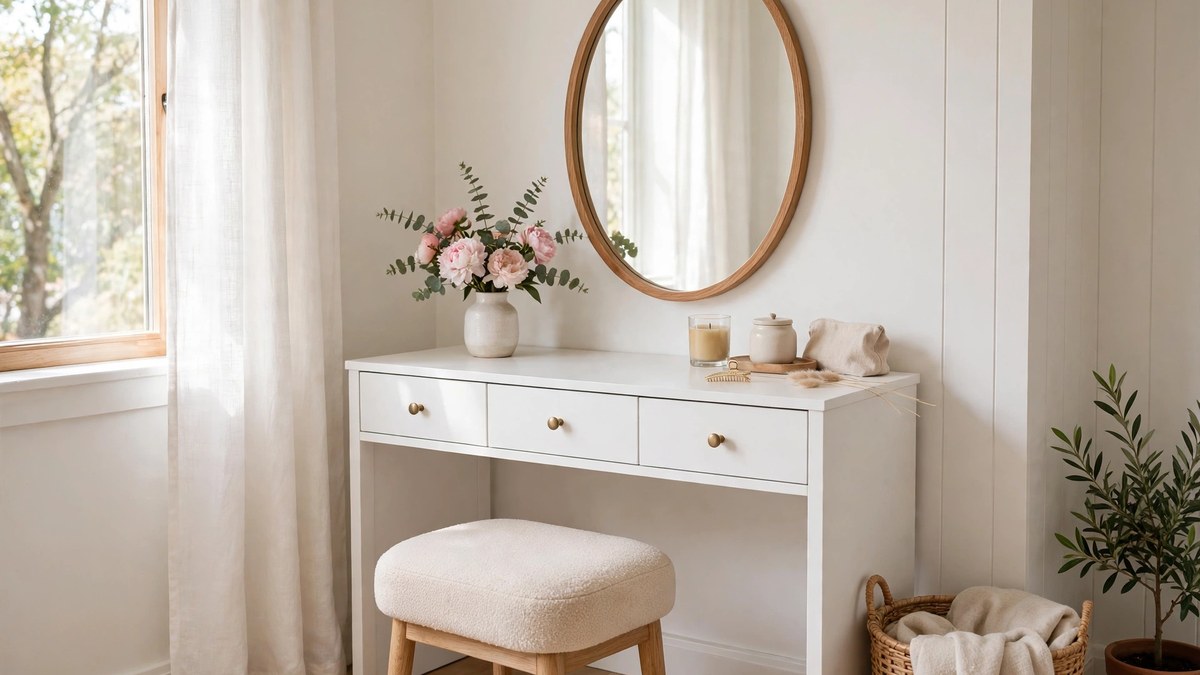
A vanity is the piece women most often dream about and most often skip for space. It needs less room than you think: a 36- to 42-inch desk or console, a mirror, a small stool, and one good light source. A spare corner, a stretch of wall beside a window, or even a wide closet nook can host it.
Light makes or breaks a vanity. Face a window if you can; if not, place light at face level on both sides of the mirror — a pair of small sconces or a backlit mirror — rather than a single overhead bulb, which casts every shadow in the wrong direction. Warm-white bulbs around 2700–3000K are kindest to skin.
Keep the top nearly empty: a tray corralling daily products, a small drawer or organizer for the rest, one pretty object (a bud vase, a framed photo) for pleasure. The vanity that stays clear is the vanity that gets used; the one buried in products becomes another laundry chair.
If a dedicated vanity will not fit, upgrade the bathroom counter zone or the top of your dresser instead — a beautiful mirror and disciplined tray achieve most of the ritual without new furniture.
Seating makes the vanity a place rather than a perch: a small upholstered stool, a vintage chair with a cushion, or even a plush pouf that slides under the desk when not in use. Add a soft throw over the chair back and the corner becomes the room’s most inviting square footage — the spot where morning coffee, journaling, and getting ready all merge into one unhurried ritual. If you work from home occasionally, this corner, with the mirror temporarily angled away, doubles as the prettiest Zoom backdrop in the house.
Bedroom Decor Ideas for Girl Rooms That Grow With Her
Decorating a girl’s bedroom is a moving target: the room that thrills a seven-year-old can embarrass a thirteen-year-old. The smart strategy is an age-proof shell with swappable personality — neutral walls and furniture, with theme delivered through bedding, art, decals, and accessories that cost little to replace.
For younger girls, lean into wonder: a reading nook with cushions, a gallery of her own artwork in real frames, fairy lights she can switch herself, and storage at her height so tidiness is possible. Let her choose the accent color; ownership makes kids care for a room.
For tweens and teens, the priorities flip to identity and hangout-worthiness: a proper desk, a mirror with good light, a cozy corner for friends (floor cushions, a small loveseat if space allows), and wall space for posters and photos that can change monthly. Photo ledges and cork boards channel the collage instinct without wrecking the paint.
Furniture that survives the whole arc: a full or queen bed rather than a twin once she is ten or so, a real dresser, and a desk with drawers. Buy these in classic shapes and finishes, and let the cheap layers carry each phase’s personality.
Textiles and Layers: Curtains, Throws, and Rugs
Textiles are where a feminine bedroom gets its softness — and where a tight budget goes furthest. Curtains hung high and wide, grazing the floor, instantly make a room feel taller and more finished. Sheers layered under heavier panels give you privacy, filtered daylight, and the option of darkness, all in one window.
A rug under the bed should extend at least 18 to 24 inches beyond the sides and foot so your feet land on it; in most bedrooms that means an 8×10 rug under a queen, placed with the top third tucked under the nightstands’ line. Choose a low, dense pile for under-bed duty and save the plush shag for a reading corner.
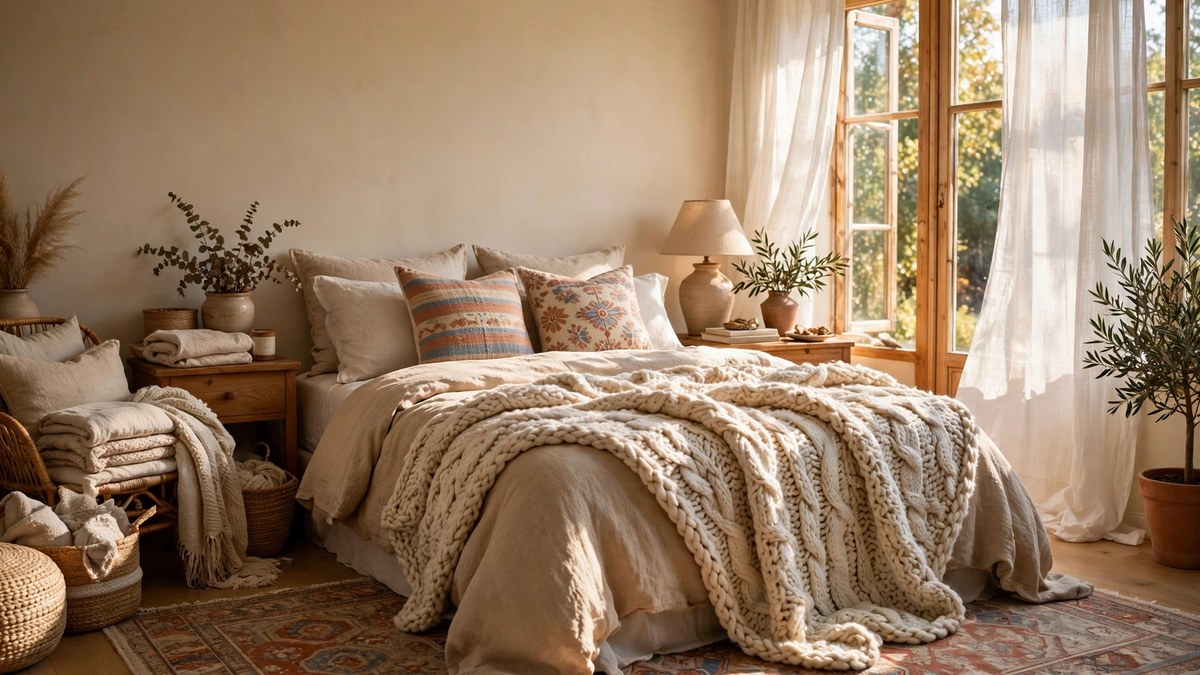
Layer the rest by touch: a knit or faux-fur throw across the bed’s foot, cushion covers in two textures (say linen and velvet), a soft robe hook by the door, even a fabric-covered storage box. If every textile in the room invites touch, the room will feel luxurious regardless of what each piece cost.
Lighting That Flatters the Whole Room
Good bedroom lighting has three layers, and feminine rooms benefit from all of them: ambient (a ceiling fixture or soft uplight), task (reading lamps, vanity light), and accent (a candle-like glow, fairy lights, a lit picture). On dimmers where possible, because a bedroom at full brightness should still feel gentle.
Bulb temperature does quiet magic here. Warm white, roughly 2700K, mimics candlelight and flatters skin and fabric; daylight bulbs (5000K) make the same room feel like a dentist’s office. Consistency matters — mismatched bulb temperatures in one room read as a mistake.
Feminine styling details: fabric or rattan shades that diffuse rather than expose the bulb, metallic bases (brass, brushed gold, antique bronze) that echo your other accents, and at least one light you can reach from bed without getting up. Reading in bed should be a pleasure, not an expedition.
Personal Touches: Art, Photos, and Collections
The difference between a styled room and your room is the personal layer. Art you chose because you love it — not because it matched — framed photos beyond the phone screen, a shelf of books you reread, a collection displayed with intention: these are what make guests say the room feels like you.
Display collections with restraint: group similar objects together, give the group one home, and let it be the only collection on that surface. A stack of art books with a small sculpture on top; perfume bottles on a mirrored tray; hats on a row of hooks as functional wall art.
Rotate occasionally. Swapping art between rooms, changing the nightstand photo, bringing out a seasonal throw — a room that evolves in small ways stays fresh without redecorating. Keep a small storage box of off-duty decor pieces for exactly this purpose.
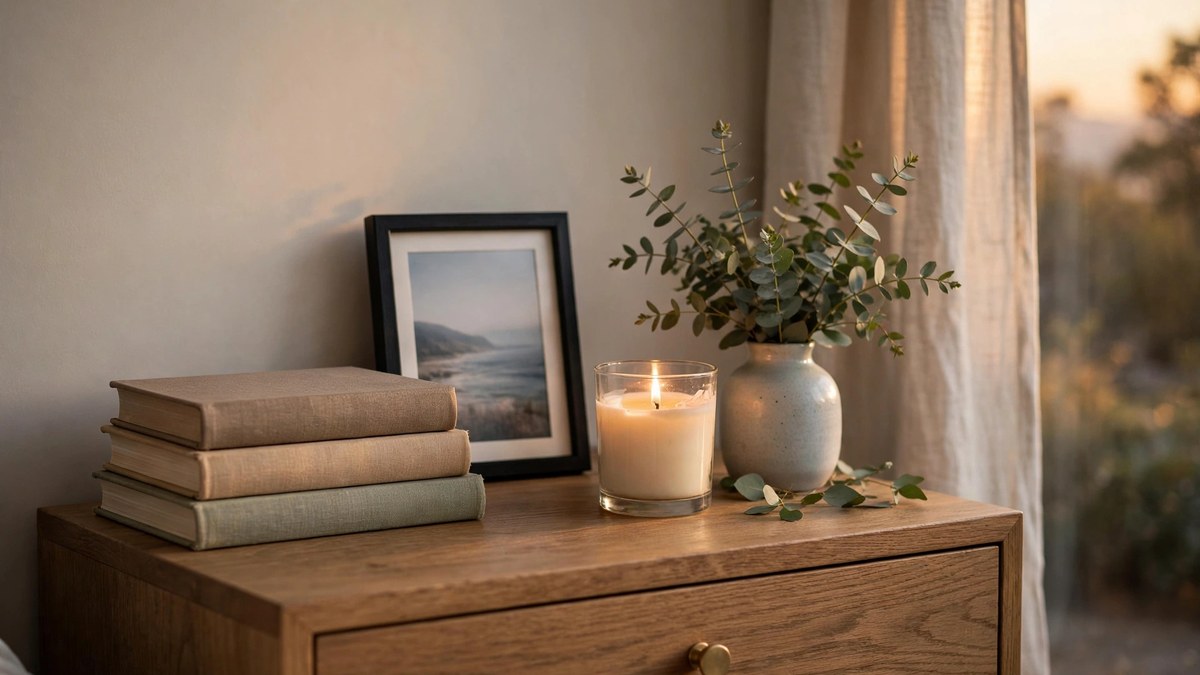
Books deserve a special word, because a woman’s nightstand stack is decor whether you plan it or not. Style it lightly: three to five current reads with covers you like the look of, a small object on top — reading glasses case, a candle, a tiny vase — and permission for the stack to be genuinely in progress. Guests read nightstands like personality tests, and the honest, curated-but-lived-in stack always wins over the untouched display pile. The same applies to a reading chair corner: one good lamp, one throw, and the book you are actually reading say more about the room’s owner than any purchased ornament.
Small Budgets and Rentals: Pretty Without Permanent Changes
A beautiful feminine bedroom does not require ownership or a big spend. The highest-impact cheap moves are bedding (a fresh duvet cover transforms the room’s largest surface), curtains (high, wide, floor-length), matching lamps (secondhand pairs are plentiful), and art (large-scale prints in real frames from thrift stores).
Renters should lean on what leaves no trace: peel-and-stick anything with caution and a test patch, tension-rod curtain layers inside window frames, furniture placement that creates zones, and textiles in your palette repeated until the room looks coordinated.
Spend-save rule of thumb: spend on the pillow you sleep on, the lamp beside you, and the rug under your feet. Save on trend pieces, decorative objects, and anything whose only job is to be looked at — those are thrift-store and sale-rack territory, and the hunt is half the fun.
Common Mistakes to Avoid
The most common mistake is letting one style word run the whole room — all-pink everything, all-shabby everything — until it reads as a theme park. Keep any single motif under about a third of the room’s elements, and mix in contrasting structure.
Second, skimping on the bed. A gorgeous room with a flat, sad bed fails at its main job. Third, overhead-only lighting; it flattens everything and everyone. Fourth, decorating for an imaginary life — a vanity you will not sit at, a chaise that becomes storage — instead of your actual routines.
Finally, ignoring comfort logistics: a blackout solution if streetlights hit your window, a reachable charger, a place for the book and the water glass. Pretty that ignores function quietly stops feeling pretty within a month.
Scent, Greenery, and the Finishing Five Percent
The last layer of a feminine bedroom is invisible in photos and unforgettable in person: how it smells and breathes. Choose one scent family and keep it consistent — a lavender linen spray, a cedar candle, a small vase of eucalyptus on the dresser. Scent used only in this room becomes a signal to your brain that the day is over; rotate it seasonally if you like, but never layer three competing fragrances at once.
Greenery does similar quiet work. One plant with presence — a potted olive, a full pothos trailing from a shelf, branches in a tall vase — softens every corner it touches and gives the eye somewhere gentle to rest. Fresh flowers are the luxury version: even a five-dollar grocery bunch, split between the nightstand and the vanity, makes the room feel tended. Tended is the operative word in this whole style — the finishing five percent is mostly small acts of care, repeated.
Finish with the bedside ritual arranged in advance: water carafe, book, hand cream, charger tucked behind the lamp, a small dish for jewelry. A room prepared for its owner’s evening is the most feminine thing of all — not because of how it looks, but because of who it was considered for.
Frequently Asked Questions
How can I make my bedroom look feminine without using pink?
Use the qualities rather than the color: curved lines, layered soft textures, warm metallics, fresh flowers or greenery, and personal art. A sage, cream, and brass room with velvet and linen feels deeply feminine with no pink anywhere.
What is the first thing to buy for a woman’s bedroom makeover?
Bedding — specifically a duvet cover set in your chosen palette, plus two good pillows. The bed is the largest surface in the room, and changing it first makes every later decision easier because the palette is suddenly real.
How do I fit a vanity into a small bedroom?
You need roughly a 36-inch width: a slim desk or console, a wall mirror, and a stool that tucks underneath. Corners and the wall beside a window work well. Plug-in sconces on either side of the mirror give proper light without new wiring.
What bedding colors feel most feminine and timeless?
Warm whites and ivory as the base, with dusty rose, sage, lavender, or soft gold as the layer on top. White reads crisp rather than plain when you mix textures — linen, cotton percale, a knit throw — instead of matching everything flat.
How can a teen girl’s room grow with her?
Build an age-proof shell: neutral walls, classic full or queen furniture, and real storage. Let bedding, decals, art, and accessories carry each phase’s personality, and give her a ledge or board where changing photos and posters is expected rather than wall damage.
Are matching furniture sets a good idea for a woman’s bedroom?
A full matching suite usually looks less designed than coordinated-but-mixed pieces. Aim for harmony in finish family and scale instead: a wooden bed with painted nightstands, or vice versa, looks collected and personal rather than showroom-issued.
How much should I budget for a noticeable bedroom refresh?
A visible transformation is realistic in the range of a few hundred dollars if you prioritize bedding, curtains, lamps, and one art piece, especially shopping secondhand for furniture. Paint, if your lease and energy allow, delivers the biggest change per dollar of anything.
Final Thoughts
A woman’s bedroom should be a portrait of its owner: soft where she wants softness, bold where she wants confidence, and organized around the routines that start and end her day. Choose a palette with a point of view, make the bed the star, carve out one corner that is purely for pleasure — and edit ruthlessly.
Start with the bedding and the lamps. Once the bed looks loved and the light is kind, the rest of the room knows what it is supposed to become.
