
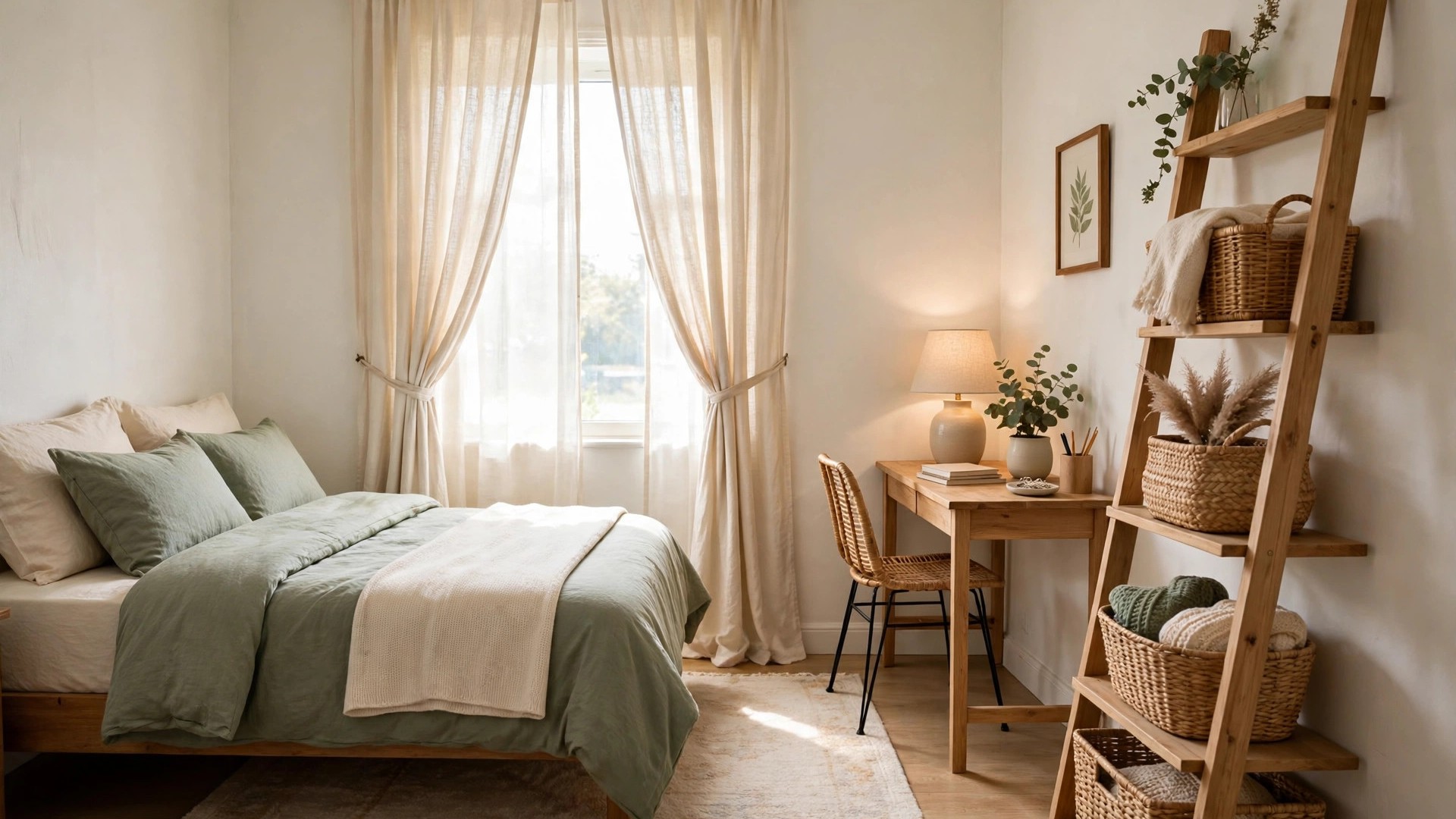

Rental bedrooms come with a familiar list of frustrations: walls you cannot paint, a landlord’s beige everything, odd dimensions, one closet, and a lease quietly ticking toward move-out day. These apartment bedroom decorating ideas work inside those limits. The strategy is layering — textiles, lighting, furniture placement, and removable decor that build a room which looks completely yours and can be completely undone in a weekend. Everything here respects the deposit: no paint without permission, no holes beyond a few patchable pinpricks, nothing you cannot take with you.
The mindset shift that helps: you are not decorating less than a homeowner. You are decorating differently — investing in portable pieces that will serve you in the next three apartments too.
Decorating a Rental Bedroom: The Ground Rules
Before buying anything, read your lease for the clauses that matter: painting, picture hanging, window treatments, and any rules about fixtures. Many landlords allow more than tenants assume — a written email asking about painting one wall, with an agreement to restore it, succeeds surprisingly often. Keep any permission in writing.
An apartment bedroom also has a structural reality: you will leave. So measure your doorways and stairwell before ordering furniture, keep boxes for fragile decor until you know what fits, and mentally subtract anything that only works in this one quirky room.
The no-regret toolkit for every rental bedroom: removable adhesive hooks and strips rated above your loads, tension rods, painter’s tape for planning layouts, a small tub of spackle and a putty knife for move-out day, and touch-up paint matched to the wall if the landlord leaves a can. With those, almost every idea in this guide is on the table.
Bedroom Decorating Ideas Young Adults Actually Use
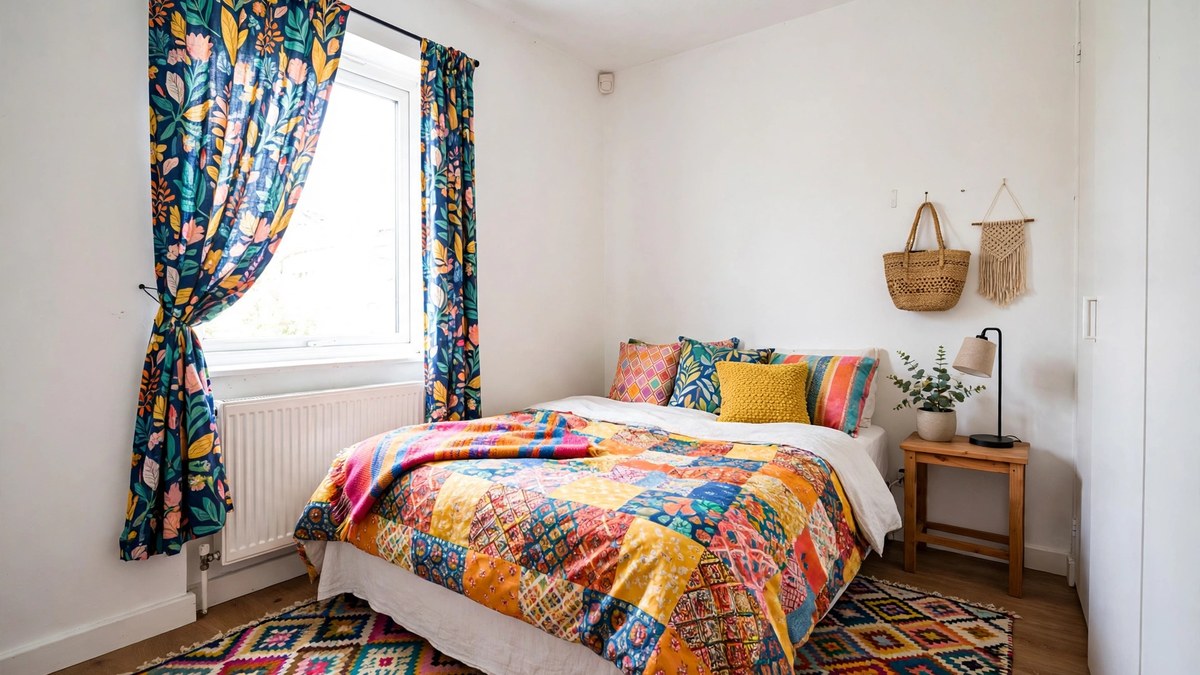
The first solo bedroom — post-college, post-roommate, or first job — runs on three constraints: small budget, small space, and furniture inherited from three different sources. The young-adult rooms that look pulled-together share a formula: one unifying palette, one upgraded anchor piece, and ruthless coordination of the cheap layers.
Pick the palette first (two colors plus a neutral) and let it discipline every purchase, from the duvet cover to the desk lamp. Nothing elevates a mixed-furniture room faster than color agreement — a wooden dresser, a metal bed frame, and a plastic storage tower look intentional the moment their accessories share a scheme.
Upgrade one anchor: usually the bedding, because it is the room’s largest surface and the thing you touch most. Then let lighting do the second transformation — a proper lamp with a warm bulb instead of the overhead light changes the room’s entire personality at night, when you actually live in it.
Skip the “someday” purchases. The floor cushion, the plant stand, the string lights — buy the small joys now, secondhand where possible, and let the expensive furniture wait for a bigger room and budget.
Paint-Free Color: Bedding, Curtains, and Rugs
When walls must stay beige, color moves into the textiles — and in a bedroom, textiles cover more visual territory than walls do. The bed alone is a third of the room. Build your scheme there: a duvet cover in your main color, a throw and cushions carrying the accents, sheets in a coordinating neutral.
Curtains are the second color wall. Hang them at ceiling height (a tension rod inside the frame, or a rod on removable brackets where allowed) in a color drawn from your palette, and the wall they cover effectively becomes that color. Floor-length panels in a solid or subtle pattern make the biggest statement per dollar in most rental bedrooms.
A rug completes the trio and solves a rental problem at the same time: it covers flooring you did not choose. Size up — a rug that reaches beyond the bed’s sides and foot (an 8×10 under most queens) makes a small room feel larger and more finished than a small rug floating in the middle. Layer a smaller patterned rug over a big cheap neutral one if budget is tight.
Do not overlook the door and the closet doors — in a small rental bedroom they are significant wall area. A full-length mirror on the back of the door (over-door hooks, no screws) adds function and light without a single hole, and a curtain on a tension rod inside a doorless closet turns visual clutter into a calm textile panel in your palette. Even the humble radiator or baseboard can be visually quieted with the room’s textiles nearby; the eye forgives any fixture surrounded by intention.
Layouts for Small and Awkward Rooms
Apartment bedrooms are often barely wider than the bed. The classic fix is also the most satisfying: push the bed against the longest wall, center it where possible, and keep at least a slim walking path on the side you use most. Our dedicated small bedroom ideas go deeper on dimensions, but the principle is simple — the bed arrangement rules everything else.
If two people share, a bed centered with two narrow nightstands (even mismatched, if heights align) beats a bed shoved into a corner, which makes one partner climb over the other and resent it nightly. In a truly tiny room, consider a full instead of a queen: those extra six inches of floor can be the difference between a dresser and no dresser.
Awkward features — the radiator, the weird nook, the closet with no doors — should be assigned jobs rather than fought. The nook becomes the desk or the dresser alcove. The doorless closet gets a tension rod and a curtain in your palette. Every apartment bedroom has one oddity; the decorated ones have made it a feature.
One more layout lever renters underuse: the bed’s orientation. Rotating the bed 90 degrees — headboard on the long wall instead of the short one — can free an entire wall for a dresser and desk that the default layout fragments. Sketch both arrangements to scale on paper (or with painter’s tape on the floor) before moving anything heavy; ten minutes of taping has saved many Saturday afternoons of furniture regret. If the room has a single good window, give the bed the wall that lets you see it — waking to the window, rather than to the closet doors, quietly upgrades every morning of the lease.
Storage That Doubles as Decor
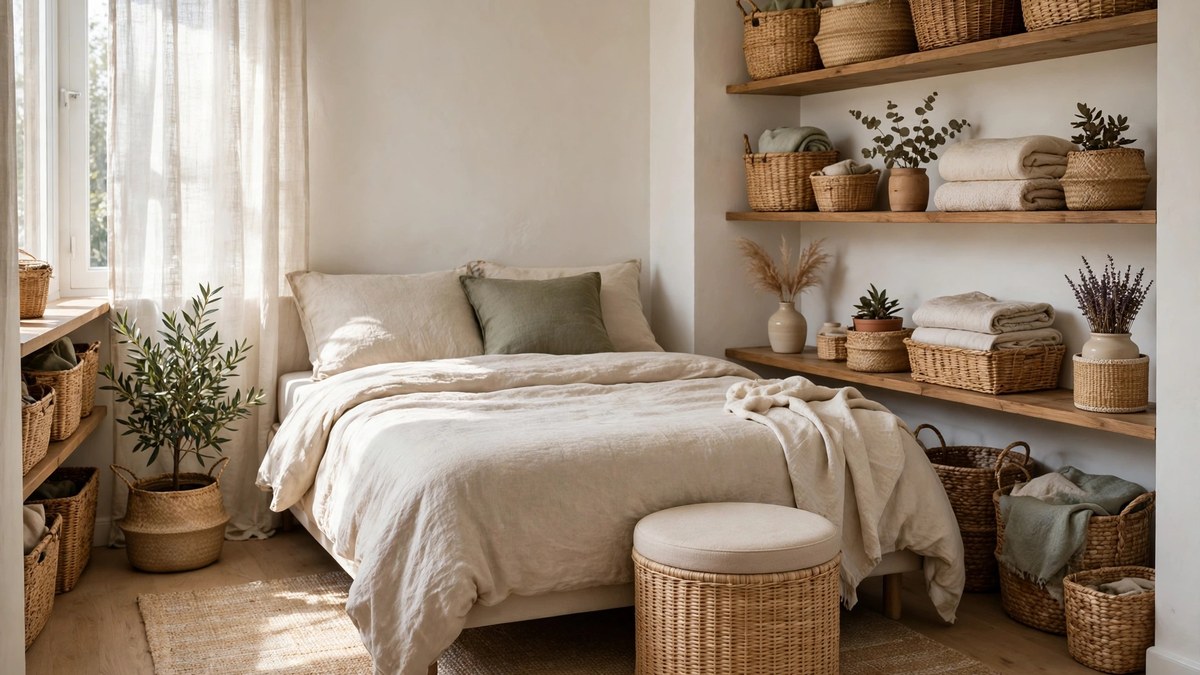
In a rental bedroom, storage that hides is good, but storage that displays is better — because you have no spare room to banish things to. Open, organized, and color-coordinated storage reads as decor; closed chaos reads as clutter the moment a door opens.
Workhorses that earn their floor space: a storage ottoman or bench at the bed’s foot (blankets inside, seating and a surface outside), under-bed boxes for off-season clothes (the space under a bed is typically 10-plus cubic feet of free storage), a leaning ladder shelf that needs no mounting, and over-door organizers on the closet.
Make visible storage obey the palette: baskets in one material, boxes in one color family, books arranged loosely by size rather than rainbow order. The same objects, coordinated, look styled. And keep one surface — the dresser top, say — mostly clear, so the organized storage reads as calm rather than as a warehouse with good intentions.
Vertical space is the rental storage frontier: the wall above the dresser, the strip above the door, the tall narrow gap beside the wardrobe. A high shelf on removable brackets (or a tall bookcase, which needs no brackets at all) holds the rarely used suitcases, spare linens, and the decor rotation box. Measure the ceiling height before buying tall pieces — older apartments surprise you both ways — and anchor tall bookcases to the wall with the landlord-approved method if kids or earthquakes are in your life; most leases permit a single safety anchor, and it is always worth asking.
A Desk Corner for Work or Study
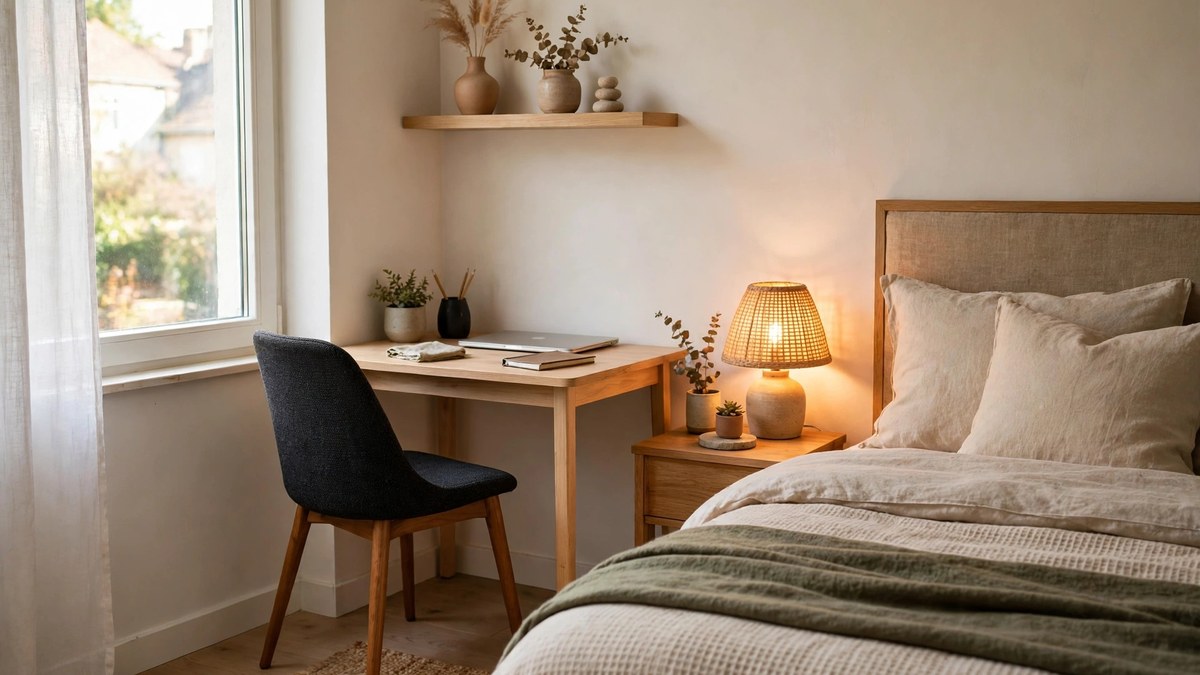
Many apartment bedrooms double as offices now. The desk corner works best as a deliberate zone: a compact desk (36 to 48 inches wide is enough for a laptop setup), a chair that does not scream “office,” a lamp, and one shelf or rail above for supplies — placed in the corner farthest from the bed, so work does not visually sit on your sleep.
Define the zone with a small rug under the desk or a poster-sized piece of art above it. Keep the kit minimal and closed where possible: a lidded box for chargers and cables, a drawer unit that rolls under the desk at night. The goal is a corner you can mentally close at 6 p.m.
If the bedroom is also your full-time office, the ideas in our DIY room decor for small apartments guide extend this zoning approach to the whole unit, including studio layouts where the bed and desk share one room entirely.
Chair choice quietly decides whether the desk corner gets used: a dining chair or upholstered side chair keeps the corner looking like bedroom furniture, while a rolling task chair imports the office wholesale. If you sit eight hours, health wins — choose the real chair and soften it with a cushion and a throw that match the bed. Either way, give the desk a closing ritual like the bedroom-office workers use: laptop down, papers in the box, lamp off. In a room that is both office and refuge, rituals are walls.
Lighting Without Wiring Anything
Rental lighting is usually a single overhead fixture doing its worst. You cannot rewire, but you can route around it: the bedroom that runs on lamps is a different room at night. A bedside lamp for reading, a second lamp or light strip at the desk, and something low and warm — a small table lamp on the dresser, plug-in fairy lights — and the overhead becomes emergency-only.
Plug-in sconces are the renter’s secret weapon: they mount with two small screws (often tolerated, always patchable) or even heavy-duty strips for light models, need no electrician, and give that tailored hotel look beside the bed. Swag a pendant over a nightstand with a ceiling hook and a long cord for the same effect.
Bulbs matter as much as fixtures. Choose warm white around 2700K, and consider smart bulbs in the lamps: dimming, timers, and warm-to-cool adjustment from your phone, in fixtures you own and take with you. One smart bulb in the bedside lamp can replace an alarm clock’s harshness with a gradual sunrise setting.
Height tricks with light deserve a mention in low-ceiling rentals: a torchiere floor lamp that throws light up to bounce off the ceiling makes the room feel taller and softer at once, while a lamp with the shade at seated eye level keeps glare out of your face in bed. Avoid the single bright point at ceiling center — it is the lighting equivalent of a waiting room. Two modest lamps, placed diagonally across the room from each other, will outperform it for less money than one statement fixture you would have to leave behind anyway.
Wall Decor That Leaves No Holes
The modern renter’s wall toolkit is genuinely good now. Large art can hang from removable strips rated for its weight (follow the rating honestly, and double up). Picture ledges lean against the wall on a dresser’s surface instead — no, better: a leaning floor mirror and leaning oversized frames on the floor or on furniture need zero attachment at all.
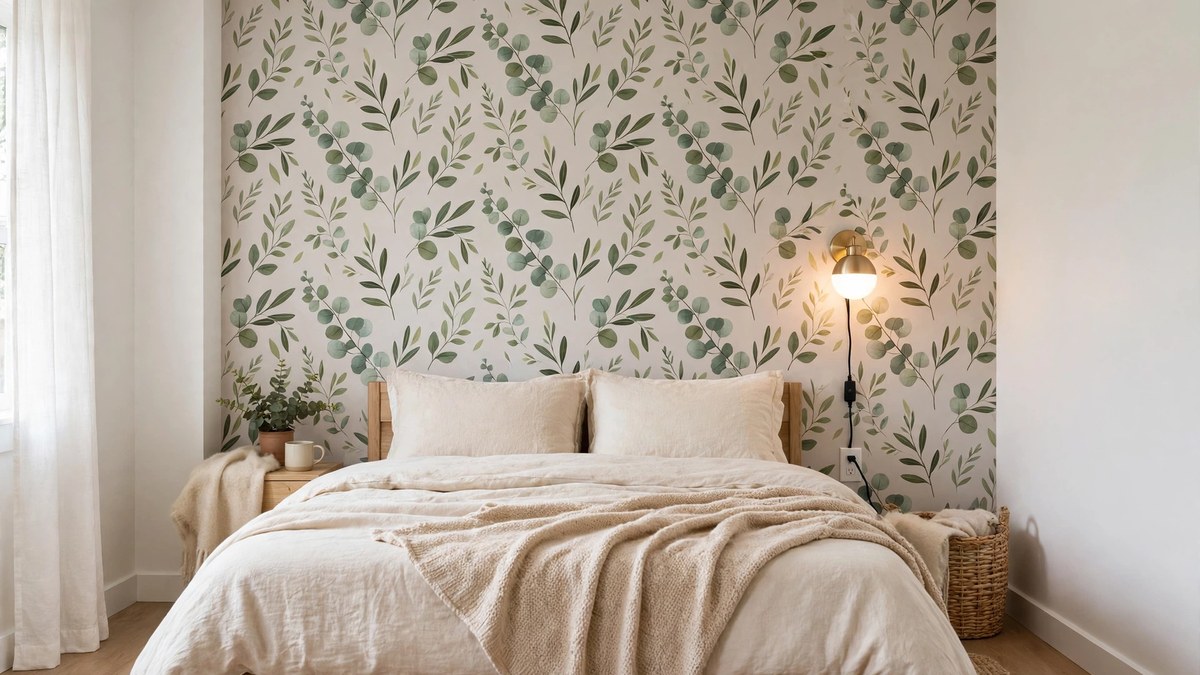
Washi tape and painter’s tape grids hold unframed prints, photos, and postcards in clean geometric arrangements that peel away tracelessly. Removable decals and peel-and-stick wallpaper can work, but respect the caveats: fresh or cheap paint can peel with them, so test behind the door, get written permission for full walls, and keep expectations honest.
A tapestry or fabric hanging from a tension rod covers a whole wall section — color, pattern, and sound softening in one move, especially good behind the bed. When in doubt, go bigger with fewer pieces: one large leaning artwork looks more deliberate than six small frames on strips.
Budget Shopping: Where the Money Should Go
In a rental, every purchase should pass the portability test: will this serve me in the next place too? Furniture that disassembles, textiles in a palette you love, lamps, and storage pass easily. The piece custom-fitted to this room’s weird nook fails, however cute it is.
Shopping order that works: bedding first, curtains second, lamps third, rug fourth, art fifth — each step transforms the room and clarifies what the next step needs. Secondhand is the young renter’s superpower for everything except the mattress and pillows: solid-wood dressers, real lamps, and frames are abundant and cheap.
For the detailed spend plan, our decorating a bedroom on a budget guide breaks down what to buy at each price level and which splurges actually pay you back nightly (spoiler: the pillow).
Making It Feel Grown-Up, Not Dorm-Like
The difference between a dorm room and a young adult’s bedroom is rarely money — it is editing and coordination. Dorm signals: unframed posters at random heights, a futon doing three jobs badly, visible plastic storage, lighting from one bare overhead bulb, and bedding that is a single flat layer.
The grown-up counters are all cheap: frame the art (or use one consistent style of frame), hang things at a consistent eye level (center around 57 inches), make the bed with layers — duvet folded, throw, two pillow sets — and hide the plastic storage behind a curtain, under the bed, or in a closet.
Add one plant, one object with history, and clear one surface completely. Adulthood, decoratively speaking, is mostly clear surfaces and things hung at the same height.
Quieting the Room: Sound, Light, and Roommate Realities
An apartment bedroom is rarely a sealed box. It shares walls with neighbors, a ceiling with someone’s living room, and a door with a hallway where roommates live on a different schedule. Decor cannot rebuild the walls, but the right soft, heavy, well-placed pieces can take the edge off all three — noise, light, and traffic — without touching anything permanent.
Start with the door, usually the biggest leak for both sound and light. A removable draft stopper or a slide-on door sweep (no screws, no adhesive on the frame) closes the gap at the bottom, and it blocks the stripe of hallway light that lands across the floor at 1 a.m. just as effectively. For heavier noise, a thick curtain panel hung inside the room over the door on a tension rod adds a surprising amount of muffling for its cost.
Work the shared wall next. Whatever sits against it becomes a sound buffer, so give that wall the bookcase filled with books, the upholstered headboard, or the dresser — dense and soft beats hollow and hard. If late-night television bleeds through from the other side, a small white-noise machine on the nightstand smooths the peaks into something your brain can ignore; pick one whose look you do not mind seeing daily.
Light deserves the same treatment as sound. If your decorative curtains are thin, add an inexpensive blackout liner behind them on the same rod — the palette stays, the streetlight goes. Shift workers and light-sensitive sleepers benefit most, but anyone whose room faces a parking lot or a busy street will feel the difference the first night.
Finally, privacy. Many leases allow swapping the bedroom’s passage knob for a keyed or push-button locking knob, provided you keep the original and restore it at move-out — ask in writing first. Combined with a household agreement on quiet hours, a lockable, darkened, muffled room stops feeling like a pass-through and starts feeling like yours.
Mistakes That Shrink an Apartment Bedroom
Pushing every piece against the wall in a tiny room actually shrinks it — a rug and bed properly placed with even a few inches of breathing room read larger. Another shrinker: small-scale everything. One substantial piece (a big mirror, an oversized art print, a full-length curtain) gives the eye a rest and makes the room feel intentional.
Skipping curtains because the blinds “work” wastes the cheapest volume trick available. Leaving the overhead light as your only light flattens everything. And buying storage before measuring guarantees the classic rental sculpture: the too-big dresser blocking half the closet door.
Finally, treating the lease as a countdown rather than a home. You may live here two or three years — that is a significant slice of your life to spend in an undecorated box. Decorate for now, portably.
The Move-Out Audit: Leaving the Room (and Deposit) Intact
Decorating portably includes an exit plan. In your last month, walk the room with your move-in photos and a checklist: every adhesive strip removed slowly and parallel to the wall (pulling tabs straight down, as the makers instruct — yanking outward is what tears paint), every pin hole spackled, sanded flush, and dabbed with the matched touch-up paint, tension-rod marks on window frames wiped or touched, and felt pads checked under furniture for the floor scratches they were preventing all along.
Most deposit deductions for decor come from a handful of preventable marks, and landlords generally distinguish between “lived here, cared” and “did not care.” The renter who returns a room cleaner and smoother than move-in rarely argues about a nail hole.
Keep the kit together from day one — spackle, putty knife, touch-up paint, spare strips, the lease, and your landlord’s written permissions in one folder — and the audit is a one-afternoon job rather than a panic. Decorate boldly all lease long; just keep the receipts of reversibility.
Frequently Asked Questions
How can I decorate a rental bedroom without losing my deposit?
Stick to reversible changes: textiles for color, lamps for lighting, removable strips for light art, tension rods for curtains, and leaning mirrors and frames. Keep spackle for move-out day, photograph walls at move-in, and get any paint permission in writing.
What should a young adult buy first for their bedroom?
A proper bedding set in a chosen palette, then a bedside lamp with a warm bulb. The bed is the room’s largest surface and the lamp fixes the room’s worst feature (the overhead light). Those two purchases transform the room for the least money.
How do I hang curtains without drilling in a rental?
Use a tension rod inside the window frame for panels, or a wrap-around rod on removable adhesive brackets rated for the weight. For the high-and-wide look without hardware, hang panels from a tension rod placed as close to the ceiling as the frame allows, or drape from a secured ledge.
What size rug fits a small apartment bedroom?
An 8×10-foot rug under a queen bed is the workhorse size, extending past both sides and the foot. In very small rooms, a 5×8 placed under the lower two-thirds of the bed still works. Avoid small rugs floating in the center — they shrink the room visually.
How can I add storage without a closet?
Under-bed boxes for clothes, a storage bench at the foot of the bed, a leaning ladder shelf, over-door organizers, and a garment rack in a corner styled deliberately (matching hangers, palette-coordinated clothes) turn necessities into decor.
Is peel-and-stick wallpaper safe for rentals?
It depends on the paint underneath. On sound, cured paint it usually removes cleanly; on fresh, flat, or cheap paint it can peel the finish. Test a square behind furniture, keep the backing paper, and get landlord permission in writing before doing a full wall.
How do I make a small bedroom feel bigger with decor?
Use a continuous light palette in textiles, hang curtains high, add a large mirror, choose one or two substantial pieces over many small ones, and keep surfaces partly clear. Lighting the corners with lamps also pushes the walls outward visually.
Final Thoughts
A rental bedroom is not a waiting room for your real life — it is where your real life sleeps. Layer color through textiles, light it with lamps, assign every awkward feature a job, and buy only what can move with you.
Start with the bed and one lamp this weekend. The room will already feel different by Sunday night, and everything after that is momentum.
