
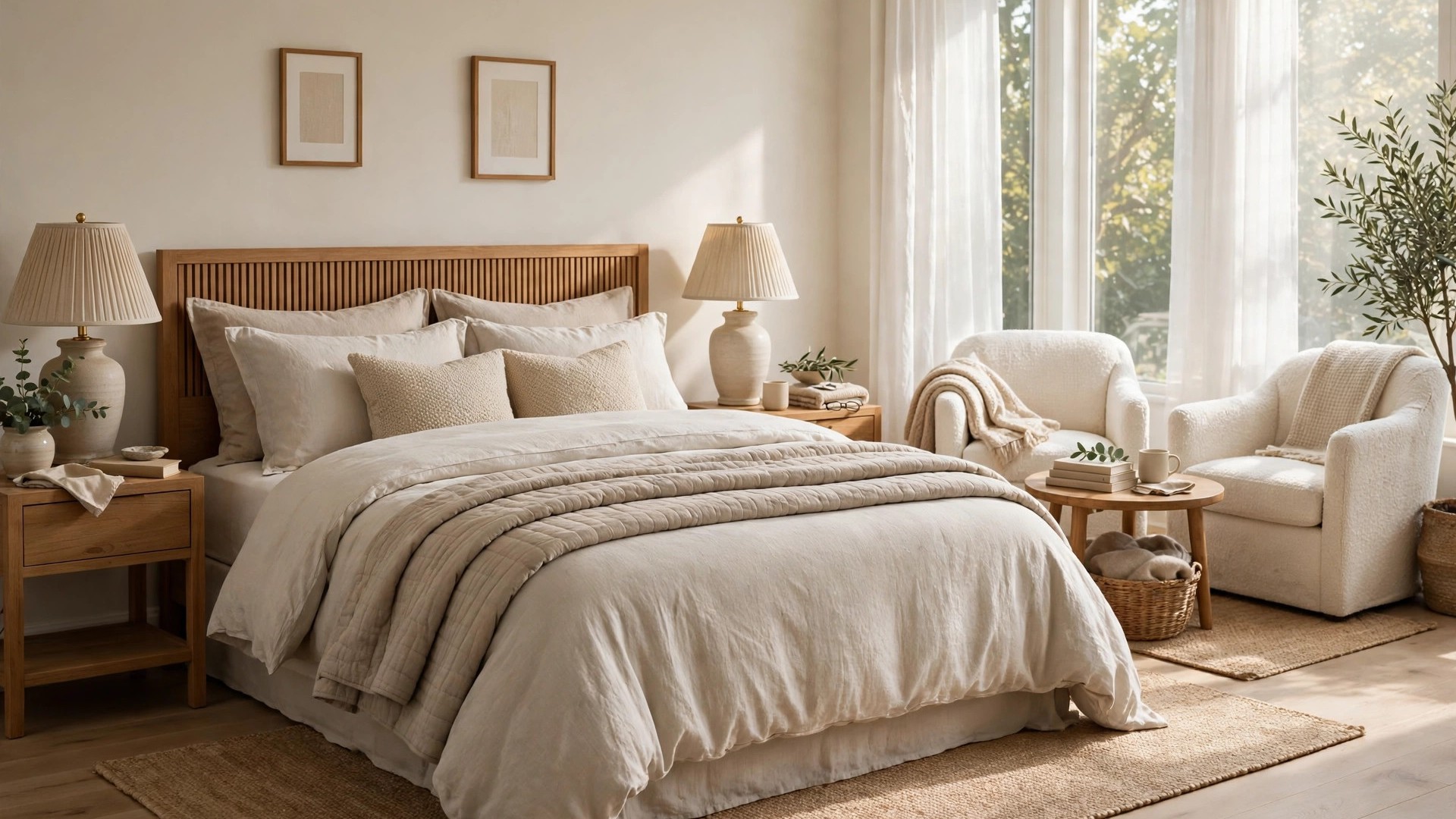

A shared bedroom has two clients, and they rarely arrive with the same taste, sleep schedule, or relationship with clutter. One loves crisp hotel minimalism; the other has a collection, a pile of books, and strong feelings about throw pillows. The couple bedroom design ideas that actually work are not about one person winning — they are about a room designed deliberately for two: two sides of the bed, two lighting needs, two styles negotiated into one coherent look. This guide walks through the bed, storage, lighting, and style compromises that make a shared room feel like a retreat for both people in it.
Start with the mindset: every decision gets asked twice — does it work for me, and does it work for them? That single habit prevents 90 percent of shared-bedroom friction before it starts.
The Golden Rule: Design for Two People, Not One Taste
Most shared-bedroom arguments are not really about color. They are about one person feeling the room reflects only the other. The fix is procedural, before it is decorative: both partners pick the palette together, both get veto power on anything big, and both get at least one element in the room that is unmistakably theirs.
A useful exercise is the two-list method. Each person lists three things they must have (blackout curtains, a firm mattress, a reading light) and three things they cannot stand. Design starts from the shared ground, and the must-haves get protected in the plan rather than litigated piece by piece.
Compromise lands best on a spectrum: if one loves modern and the other loves traditional, warm modern — clean lines in warm wood, traditional shapes in simple fabrics — is a real style, not a surrender.
Budget votes work the same way. Agree the total first, then let each partner champion the splurge they care about — one fights for the mattress, the other for the blackout curtains and the good lamps — while the uncontested basics get bought sensibly. The room then contains two people’s priorities at full quality, rather than everything at half quality. And set a small “no veto” allowance each: a modest sum either partner can spend on one thing the other merely tolerates. Every long-shared bedroom contains one beloved, inexplicable object; the allowance just makes it official.
One more procedural tool worth stealing from project management: the cooling-off shelf. Any contested item — the neon sign, the enormous mirror, the taxidermy-adjacent lamp — lives in a closet for two weeks before the final vote. Half of all contested objects lose their charge entirely out of sight; the other half have a genuinely committed owner whose case deserves hearing. Couples who adopt the shelf report fewer and shorter decor debates, because nobody has to win an argument today about an object they may not care about next month. Our modern bedroom ideas guide shows how flexible that middle ground can be.
Decorating a Master Bedroom Ideas That Balance Both Styles
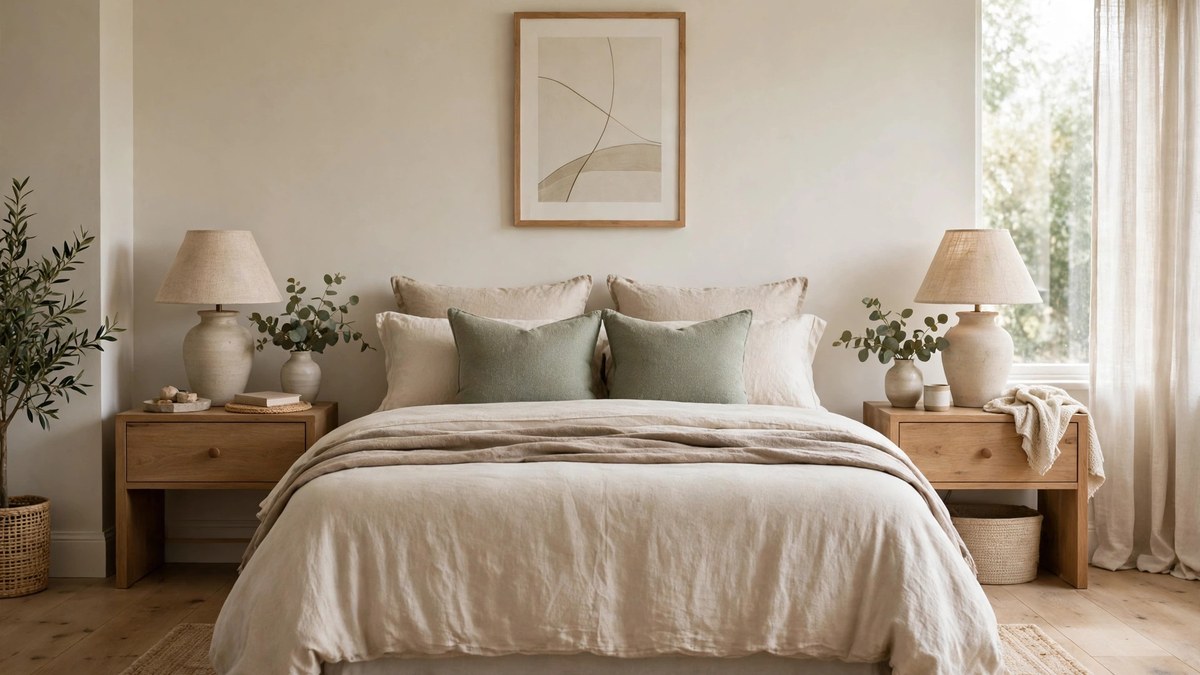
The primary bedroom — the room long called the master bedroom, a term that simply refers to the home’s main sleeping room — should read as one room, not two half-rooms stitched together. Balance does not mean matching everything; it means every bold choice gets a counterweight. Her floral art over the bed, his leather bench at the foot. A feminine vanity on one wall, a tailored reading chair on the other.
The concept of the bedroom as a private retreat for rest (rather than a showroom) actually dates to relatively recent housing history, and the modern version doubles as office, gym, and dressing room for many couples. Naming the room’s jobs — sleep, dress, decompress, maybe work — stops style debates from hiding functional ones.
Balance the visual weight across the room’s centerline. The bed is the axis: identical or coordinating nightstands and lamps on each side create instant symmetry and fairness — nobody gets the good side. From that symmetric base, asymmetry in art, objects, and textiles feels relaxed rather than lopsided.
If styles truly clash, divide by layer rather than by side: choose the architecture (furniture shapes, wall color) together in a neutral shared style, then let each person’s taste live in the removable layers on their side — their art stack, their throw, their nightstand objects.
A Neutral Base With Shared Accents
The safest and most elegant shared palette is a neutral base — warm white, greige, soft taupe, pale sage — with accents added in textiles and art that either partner can love or swap. Neutrals do not mean boring; they mean the room’s big, expensive surfaces stay out of the argument entirely.
Against that base, pick two accent colors you both genuinely like (test: would each of you wear that color?). Deep green and brass, navy and cognac, charcoal and blush — any pairing works if both signatures are on it. Repeat the accents in cushions, a throw, art, and lamp bases so the color story looks planned.
The neutral-base strategy also makes seasonal refreshes peaceful: swapping accent textiles twice a year lets both tastes rotate through without a repaint or a debate. When a trend tempts one partner, it enters as a cushion cover, not a commitment.
The Bed: Size, Bedding, and the Two-Blanket Trick
The bed is where sharing gets physical. If either partner is tall, restless, or a blanket hog, size up: a king (about 76 inches wide) gives each person the width of a twin bed; a queen (about 60 inches) gives each person 30 inches, which is less than a crib mattress is long. Test in a store, lying down together, before deciding.
The mattress compromise is easier than ever: split-firmness models, and two twin XL mattresses on a king frame, let each side have its own feel while presenting as one bed. At minimum, agree on firmness by testing together rather than ordering the average of two wrong guesses.
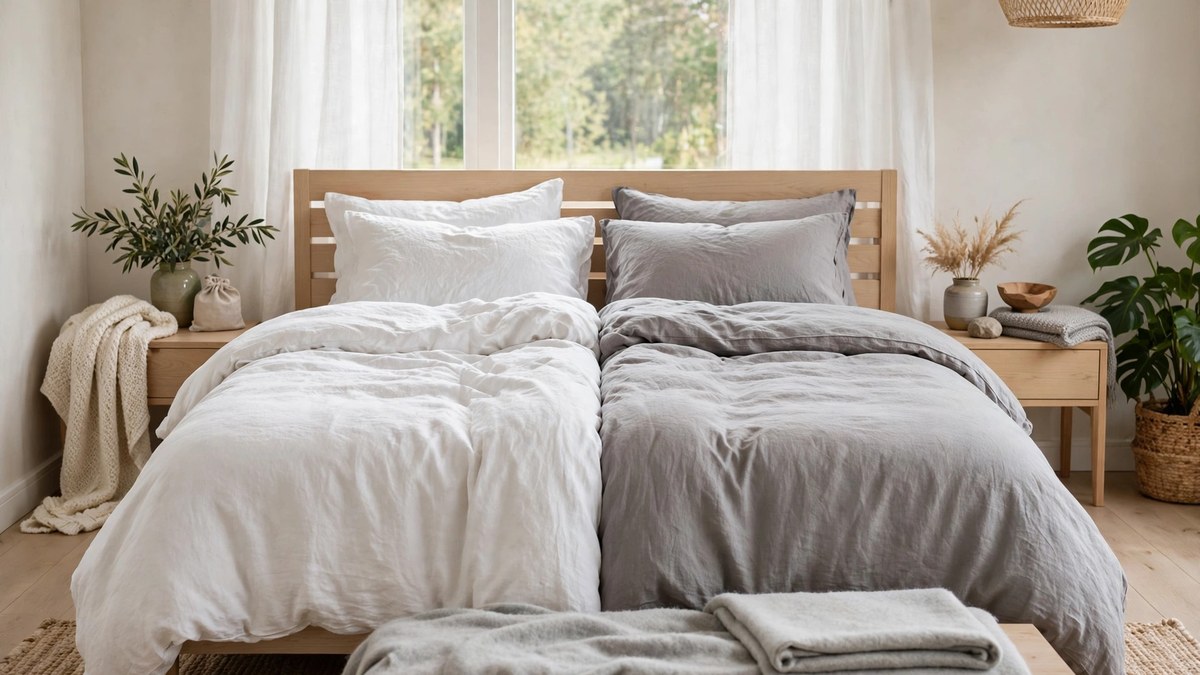
Then the famous Scandinavian fix: two separate duvets on one bed. It looks slightly unconventional for the first day and ends blanket warfare forever. Style them identically so the made bed looks cohesive, and fold both down in the evening. Many couples who try it never go back.
Layering the bed so it looks like one designed unit — rather than two camps — is covered step by step in our bedroom bedding ideas guide, including how to make a two-duvet bed look tidy.
Two Nightstands, Two Lamps, Zero Arguments
Nothing says “my room, your corner” like one partner getting a proper nightstand and the other getting a wobbly stool. Both sides deserve a surface at mattress height (roughly 24 to 28 inches tall), a drawer or shelf for the pile of life, and light they control themselves.
The nightstands do not need to match, but they should match in height and visual weight. A chunky wooden one pairs fine with a slimmer metal one of the same height; a tall one beside a short one looks like a mistake. Lamps, similarly, can differ in shape but should put light at the same height for reading — about at your shoulder when sitting up.
Give each side its own charging solution (a small tray or a drawer with a cable hole ends cord sprawl), its own reachable switch, and ideally dimmers. A partner who reads late with a focused, shaded lamp disturbs a sleeping partner far less than one who uses the overhead light or a phone flashlight.
Storage That Keeps the Peace
In shared bedrooms, clutter is rarely about messiness — it is about unspecified storage. Clothes land on the chair because the chair is the only assigned place. The peace-keeping move is to assign everything a home, with equality of capacity as the design principle.
Split the wardrobe deliberately: equal hanging lengths, equal drawers, equal shelf counts where possible. If one partner has more stuff (it happens), the overflow lives in a closed dresser, not on shared surfaces. Closed storage is the couple’s best friend; the room reads calm even when the drawers are not.
Add the small peace treaties: a lidded basket each for the in-between clothes (worn once, not dirty), a valet tray or hooks for the nightly pocket dump, and a laundry hamper big enough that it never becomes a volcano. A bench with hidden storage at the foot of the bed quietly swallows the extra blankets and the argument about where they go.
The dresser deserves the same treaty treatment as the closet. Divide drawers by person, not by garment type, when habits differ — the folder and the stuffer can coexist peacefully in separate drawers, while shared drawers become archaeological sites of resentment. On top, one tray per partner for the daily carry (watch, wallet, earrings) keeps the surface fair and visibly even. If one partner’s collection of anything — sneakers, handbags, vinyl — outgrows its allocation, display it properly in the room (a shelf, a lit cabinet) rather than letting it colonize shared zones by stealth; a collection with a home is decor, and a collection without one is clutter with a fan club.
A Sitting Corner or Reading Nook for Two
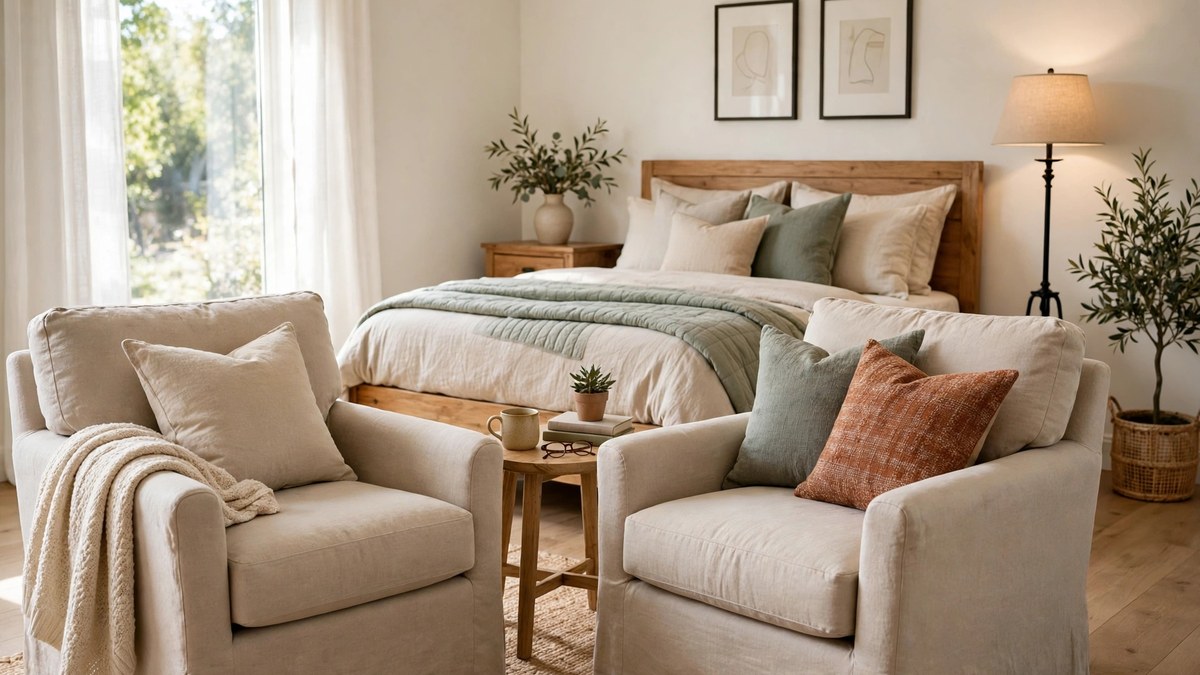
If floor space allows — and in a primary bedroom it often does once furniture is scaled right — a sitting corner transforms how a couple uses the room. Two comfortable chairs and a small table, or a single loveseat, create the place for morning coffee, evening conversation, and the “I need ten quiet minutes” retreat that keeps small apartments and busy houses sane.
Face the chairs toward each other or angled at a window rather than at the bed; the nook should feel like its own destination. A small rug under the chairs defines the zone, a floor lamp or wall sconce makes it usable after dark, and a side table each (or one shared) holds the book and the cup.
Singles-to-couples wisdom applies here too: this corner is the room’s pressure valve. When one partner sleeps early and the other reads, the nook plus a shaded lamp beats exile to the living room. Our relaxing bedroom design ideas go deeper on building this kind of calm into the room’s layout.
Lighting and Blackout Basics for Different Schedules
Couples rarely share a circadian rhythm. Design the lighting in independent zones: each side of the bed on its own switch and dimmer, the sitting corner separate, and the dressing area separate again. Nobody should have to cross a bright room to find socks at 5 a.m. while their partner sleeps.
For the early riser, a low, warm light path — a dimmable nightstand lamp, a motion-sensor strip under the bed frame or in the wardrobe — is a genuine act of love. For the night owl, a focused reading light with a shade that blocks spill protects the sleeper.
Blackout is a joint decision: true blackout liners behind your decorative curtains serve the lighter sleeper; the partner who loves morning sun gets it everywhere except the bedroom. Compromise position: blackout roller blind behind sheer curtains — darkness at night, glow by day, no argument either way.
Romantic Without Being Cheesy
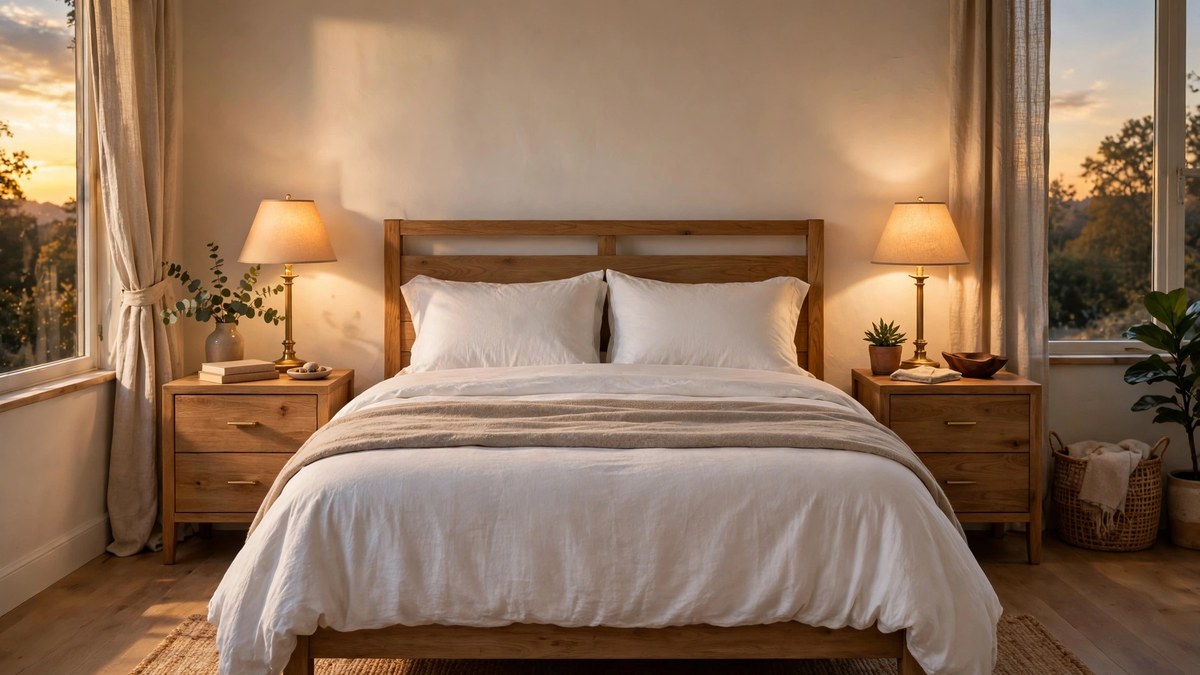
Romance in a bedroom is mostly atmosphere: low warm light, soft textures, a room that smells pleasant, and surfaces clear enough to feel like a boutique hotel for a moment. Candles (real ones safely placed, or high-quality flameless on a timer) do more for mood than any heart-shaped object ever made.
Touch is the second channel: a throw with real weight, high-quality sheets you both chose, a rug beside the bed so mornings start soft. Sound is the third — a small speaker for music instead of the TV changes the room’s evening register.
Keep symbols personal rather than generic: framed photos from trips you actually took, the art print you bought together, a plant you have somehow kept alive as a team. Sentiment that is specific to your story reads romantic; sentiment bought as a “romance kit” reads staged.
Time is a romantic material too, and design can protect it: a room that encourages lingering — the sitting corner stocked with the current book, a small drinks tray, blackout curtains that let weekend mornings stretch — gives a couple unhurried hours together that busy houses otherwise steal. When you plan the room, plan one ritual into it deliberately: Saturday coffee in the armchairs, a Sunday crossword in bed with the good pillows. The furniture that serves a ritual gets used for years; the furniture that merely fills a corner becomes the thing you vacuum around.
Music deserves one practical upgrade in shared rooms: a small speaker with a physical volume knob and no screen, kept on a shared shelf with a standing playlist for evenings. It sounds minor, but removing the phone-as-DJ ritual removes the phone — and the phone is the single most common romance-killer modern bedrooms contain. Couples who park devices outside the door, with an alarm clock and the speaker inside, consistently describe the room as feeling like a different, earlier, calmer era of their relationship.
Technology Rules: TVs, Phones, and Chargers
Decide the tech treaty before the furniture arrives. The TV question splits couples like no other: if it stays, mount it at a comfortable height for both (center roughly at eye level when propped up in bed, commonly around 40 to 48 inches from the floor to screen center, depending on bed height), and put it on a sleep timer as a nod to the anti-TV partner.
Phones are easier: charge them outside the bedroom or in a closed drawer station, and most couples report the room feels calmer within a week. If phones must stay (alarms, on-call work), a charging tray with a lid on the dresser — not the nightstand — is a workable middle ground.
Sound deserves one line in the treaty too: earbuds for the podcast listener, a white-noise app or machine for the light sleeper. Small devices, bought deliberately, prevent the recurring 11 p.m. negotiation that no one enjoys.
Common Couples’ Bedroom Mistakes to Avoid
The classic mistake is one partner decorating alone and presenting a finished room. Even a beautiful result breeds resistance, because the room announces whose home it is. Shop the big pieces together, or at least from a shared shortlist.
Second: unequal sides — one full nightstand setup, one chair. Audit the room from the doorway and ask whether both occupants look equally hosted. Third: storage allocated by who complains loudest instead of by actual inventory; do a honest count before assigning drawers.
Fourth: the bed bought for looks — a beautiful frame with a mattress only one of you can sleep on is a nightly tax on the relationship. And finally, ignoring schedules: most “style” friction is actually light, sound, and temperature friction wearing a disguise. Solve those three and the pillow-count debate mysteriously calms down.
Temperature, Snoring, and Other Night-Time Negotiations
Design can settle arguments that willpower cannot. The thermostat war, for instance, is usually a bedding problem in disguise: a shared duvet forces one temperature on two bodies. Beyond the two-duvet fix, consider a dual-zone approach to the whole bed — a cooling mattress pad on one side, an extra throw folded on the other — and a small, quiet fan aimed at the warm sleeper, which also produces sleep-friendly white noise.
Snoring and restless sleep have design answers too, partial but real: a larger bed so motion travels less, separate mattresses on one frame to isolate movement, a headboard with upholstery that absorbs sound, and heavy curtains that damp the room’s echo. Earplugs and white-noise machines finish what furniture starts; a small shelf or drawer on each side keeps them at hand rather than debated.
The honest conclusion is that comfort compromises are the relationship, expressed in furniture. Couples who treat the bedroom as a joint engineering project — two sleepers, one room, every variable negotiable — report the room becoming a refuge instead of a recurring agenda item. That, more than any style choice, is what makes a shared bedroom feel designed.
Frequently Asked Questions
How do we compromise when our bedroom styles clash?
Build the room in layers. Choose furniture shapes and wall color together in a shared neutral style, then let each partner’s taste show in their own textiles, art, and nightstand objects. Each person gets veto power on big pieces and one guaranteed “theirs” element.
Is a king bed worth it for couples?
For most couples, yes if the room fits it with walking space on both sides (at least about 24 inches, ideally 30). A king gives each partner roughly a twin bed’s width. If the room is small, a queen with two separate duvets solves most comfort issues instead.
What is the two-duvet method?
Each partner sleeps under their own duvet on the same bed — a Scandinavian standard. It ends blanket stealing and lets each person pick their preferred warmth. Choose two identical duvet covers so the made bed still looks like one styled unit.
How can one partner read late without disturbing the other?
Use a focused, shaded reading lamp on the reader’s side with a warm, dimmable bulb, or a clip-on book light. Blackout curtains help the reverse problem in the morning. Some couples also add a reading nook so late reading leaves the bed entirely.
Should nightstands and lamps match in a couple’s bedroom?
They do not need to match exactly, but they should match in height and visual weight so neither side looks like an afterthought. Coordinating lamp heights matters most for reading comfort and for the room looking balanced from the door.
How do we split closet and dresser space fairly?
Count actual wardrobes first, then split hanging space, drawers, and shelves as evenly as the count allows. Overflow belongs in closed storage, not on shared surfaces. Each partner also gets a lidded basket for in-between clothes to keep chairs clear.
Is a TV in the bedroom a bad idea for couples?
It is a preference, not a rule — the key is agreeing on it together. If it stays, mount it at a height comfortable from bed, use a sleep timer, and keep phones charging elsewhere so the TV is a choice, not the room’s default state.
Final Thoughts
A couple’s bedroom succeeds when both people walk in and feel the room is theirs. Symmetry at the bed, a neutral shared base, storage assigned with genuine fairness, and lighting that respects two schedules — these unglamorous decisions are what make the romance possible.
Start with the bed and the nightstands. Get the shared core right together, and the style layers become the fun part instead of the fight.
