
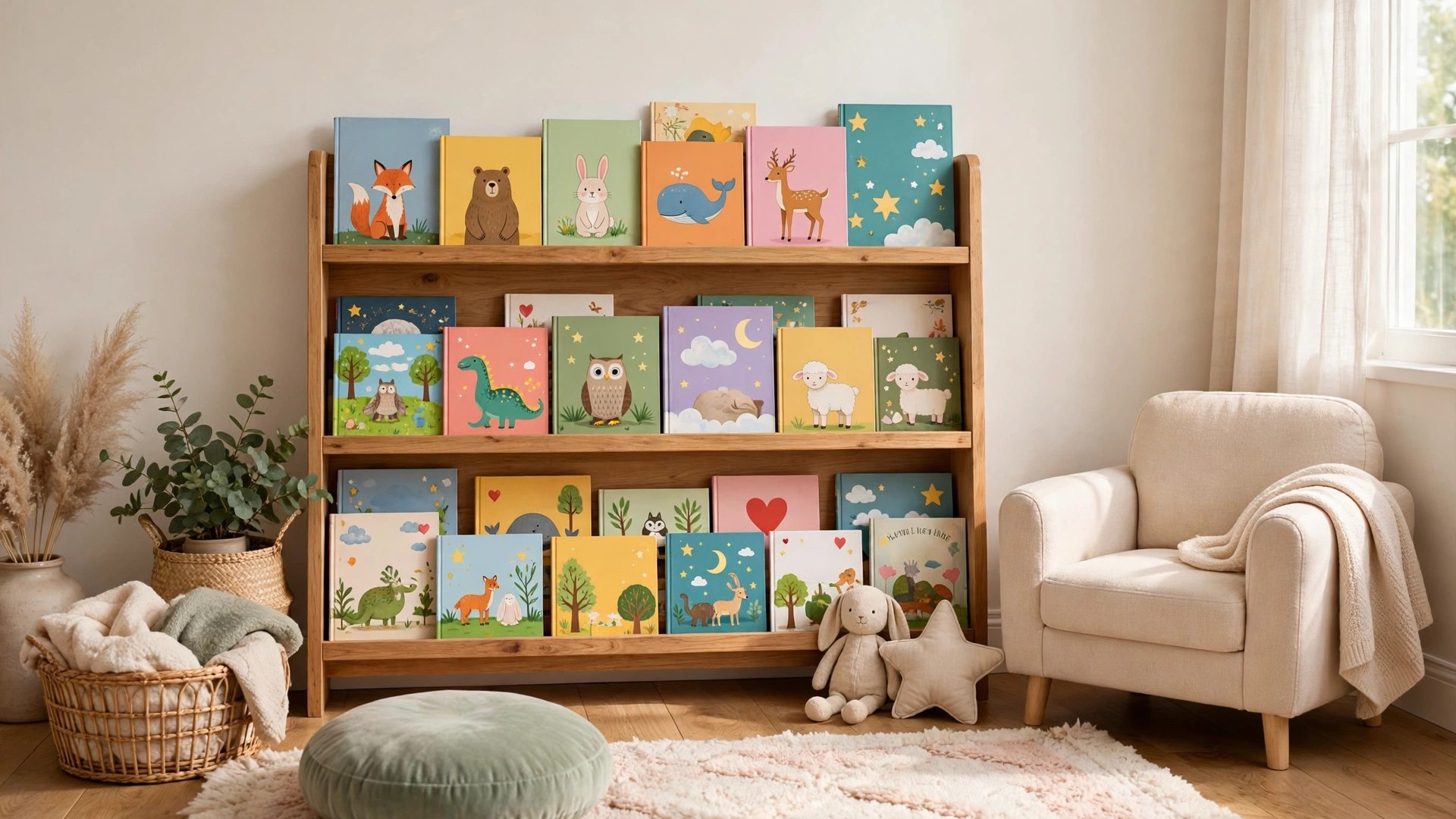

Long before a baby can read a word, books are already doing quiet work: high-contrast pages for newborn eyes, sturdy board books for teething hands, and the nightly ritual that tells a small body it is safe to sleep. The right nursery book shelves put those books where they belong — visible, reachable, and beautiful — instead of buried in a basket or stacked on the dresser.
This guide compares the main shelf styles (forward-facing displays, ledges, and classic bookcases), covers the safety rules that matter around climbing toddlers, and shows how to organize and style a growing library from the first board book to the first chapter book.
Why Book Shelves Belong in the Nursery From Day One
It is tempting to delay book storage until the baby “actually reads,” but the shelves earn their place immediately. Newborns study book covers during tummy time, babies mouth and bang board books with great seriousness, and the bedtime-story habit — the single most recommended ritual in early literacy — needs books stored where the routine happens.
Shelves also protect the investment. Board books are surprisingly expensive and surprisingly destroyable; a book with a home survives, while a book in a toy pile gets sat on, soaked, and separated from its dignity within a week. A dedicated shelf teaches the earliest version of “things have places,” years before chore charts.
And visually, books are the nursery’s easiest decor. Covers are art — colorful, varied, personal — arranged on a shelf they give the room a lived-in warmth that no purchased decor matches. Start the shelves early and the library grows up with the room.
There is a habit-forming reason, too: children reach for what they can see. Research and common sense agree that books stored visibly, at child level, get handled, carried, and requested far more than books boxed away — and early book handling is the soil that reading grows in. The shelf is not furniture; it is an invitation your child accepts daily.
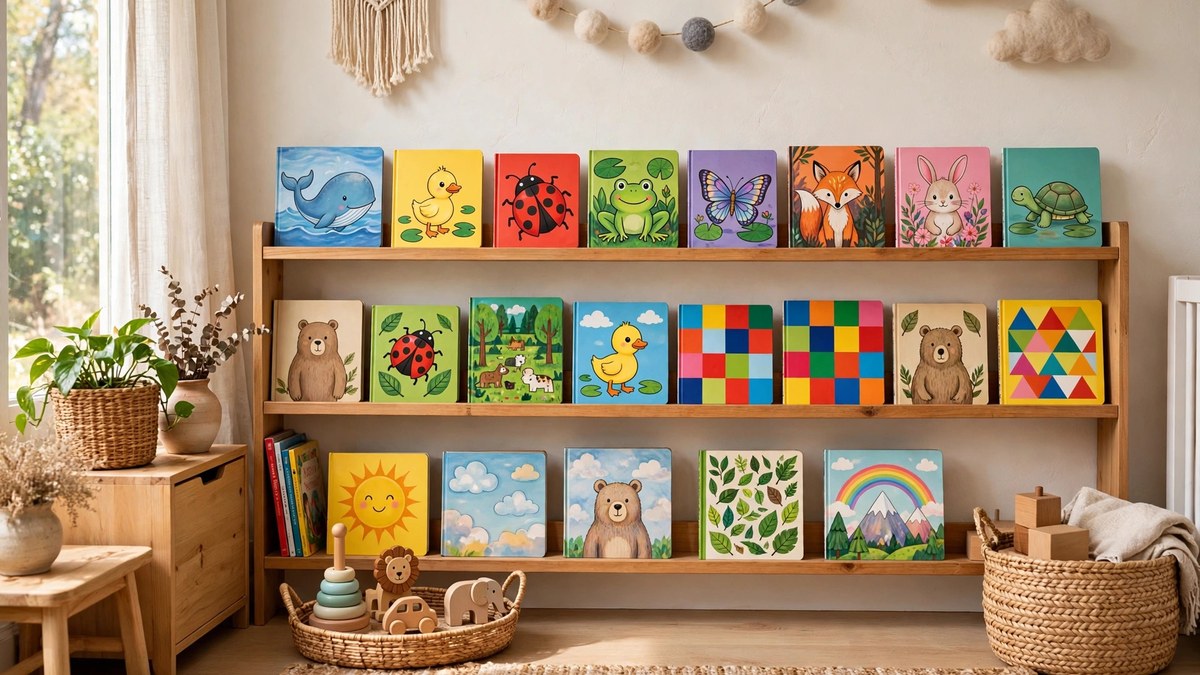
Forward-Facing Book Displays: The Montessori Favorite
Forward-facing displays store books cover-out, like a bookshop’s front table, and they have become the nursery standard for good reason. A baby or toddler cannot read titles on spines, but they recognize covers instantly — the bunny book, the truck book — which means they can choose their own story, the first delicious taste of reading independence.
These displays hold fewer books than a bookcase — typically 8 to 15 in a toddler-sized unit — and that limitation is a feature. A small, rotating selection prevents the overwhelm of forty choices and keeps every offered book fresh. The rest of the library waits in reserve, swapped in weekly.
Choose a sturdy, low unit with a lip or rail deep enough for thick board books, and check that slats or rails cannot pinch small fingers. Floor-standing book slings and bins in this style suit toddlers well; wall-mounted forward-facing ledges (covered below) suit smaller rooms. Either way, the covers become a rotating art gallery above the reading spot — especially charming beside the art ideas in our nursery wall art guide.
Traditional Bookcases and Spines-Out Shelves
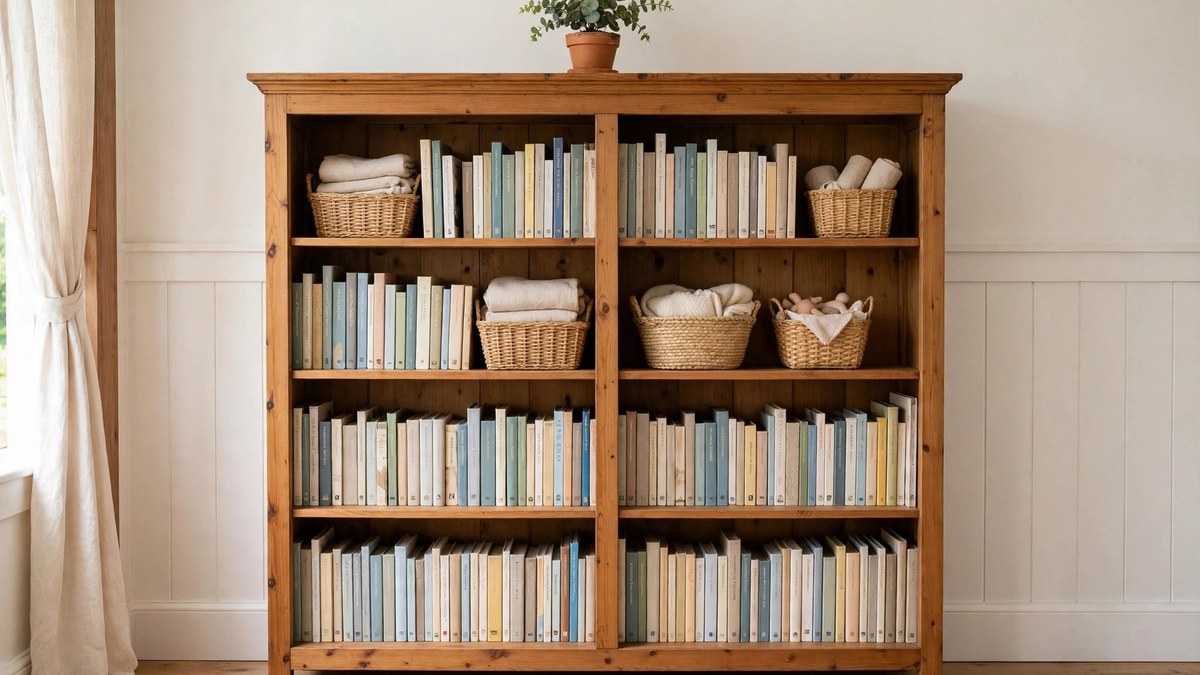
The classic bookcase still has its place — usually the parents’ place. A standard case stores the full library spines-out: the read-aloud novels and picture books an adult selects from, the reference and keepsake books, and the reserve collection that feeds the forward-facing rotation. The Wikipedia history of the bookcase shows how long this furniture form has served readers; the nursery version simply scales it down.
In a nursery, a bookcase should be short and wide rather than tall and narrow — two or three shelves, stable proportions — and anchored to the wall without exception, because a bookcase is effectively a ladder to a determined toddler. Glass doors and spinning designs belong in studies, not nurseries.
The hybrid arrangement works best in most rooms: a low bookcase for the main library plus one forward-facing display at child height for self-service. Adults keep order; the child gets autonomy; the books survive to be argued over at bedtime for years.
If budget or space forces one choice only, choose by age. For babies and toddlers, the forward-facing display wins, because access is everything at that stage. For preschoolers upward, whose picture books are slimmer and whose choosing can involve an adult nearby, a good low bookcase stores three times the library in the same footprint.
Wall-Mounted Ledges and Picture Shelves
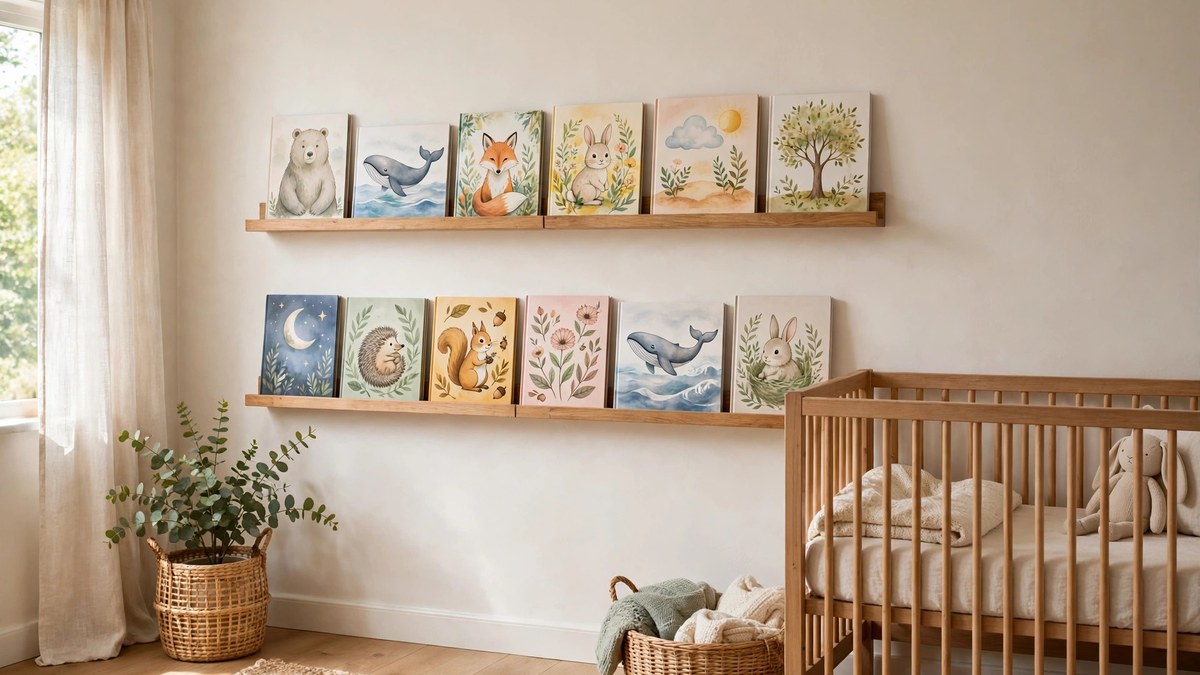
Picture ledges — shallow shelves with a front lip, sold everywhere as spice racks or photo ledges — are the small nursery’s best friend. Mounted at toddler height, two or three ledges hold a forward-facing library on almost no floor space, and the covers turn the wall into storybook wallpaper that changes with every rotation.
They also grow gracefully. Today’s book ledge becomes tomorrow’s art display, trophy shelf, or chapter-book row, and the holes in the wall never change. In rented nurseries, ledges concentrate the damage into a few fixable screw holes instead of the footprint of furniture.
Mounting is the whole job: into studs or with proper wall anchors, at a height the child reaches without climbing on anything, with the ledge’s lip up to keep books from sliding. Check the weight rating — picture books are heavier than they look, and a full ledge of them adds up quickly.
Think about the wall’s future, too. A neat column of three ledges above a changing table later becomes the display beside a desk; a horizontal run at toddler height becomes the big kid’s trophy and art row. Ledges installed once, thoughtfully placed, quietly serve the room for a decade — few nursery purchases can say the same.
Nursery Shelf Decor: Styling Shelves Beyond the Books
Once the books are housed, a little nursery shelf decor turns storage into a styled moment. The formula is simple: mostly books, one soft element, one meaningful object. A small plush of the room’s animal character, a framed photo, a tiny plant (faux or non-toxic, out of reach) — placed on the top shelf where little hands cannot grab yet eyes can enjoy.
Leave air in the arrangement. A shelf packed edge to edge reads as storage; a shelf with a small gap and one styled cluster reads as decor. Books themselves style beautifully when grouped — a short horizontal stack with a small object on top, beside a vertical run, gives a bookcase the same rhythm stylists use everywhere.
Coordinate loosely with the room’s theme without buying matching sets: if you are building the forest look from our woodland nursery ideas, a wooden animal figure and a leaf-toned book bin do the job. The shelves should whisper the theme, not shout it.
Rotate the styling with the seasons if you enjoy it: a small pumpkin and autumn-toned books in October, a snowflake garland (hung high, out of reach) in winter. Because the decor footprint is tiny — one object, one cluster — refreshing it takes five minutes and makes the whole corner feel newly considered.
Heights and Placement by Age
Placement follows the child’s reach, and the reach changes fast. For babies, all books live at adult convenience: near the nursing chair and changing table, where board books serve tummy time and story feeds. Nothing needs to be child-height until the child can get to it independently.
For crawlers and new walkers, bring one display down low — a floor book bin or the bottom ledge at their eye level when sitting. This is the age of pulling books out and mouthing them, so the low shelf holds only indestructible board books, and everything precious migrates upward.
For toddlers and preschoolers, the library splits: their own low shelves for independent choosing (and the nightly ritual of “tidying” them), plus adult-height shelves for read-aloud treasuries and fragile pop-ups. By school age, a standard bookcase beside the bed completes the progression, with a small lamp for the reader who begs for five more minutes.
A practical measuring habit: crouch to your child’s eye level in front of the shelves, in the morning and at dusk. What they see — and whether they can see it happily in story-time light — is what the shelves actually offer. Adults design from standing height and wonder why the low shelf gets ignored.
Safety: Anchoring, Materials, and Reach Rules
Book storage concentrates weight at exactly the height toddlers climb, so safety here is engineering, not vibes. Every bookcase gets anchored to a wall stud with proper anti-tip hardware — no exceptions, no “it’s heavy enough.” Wall ledges mount into studs or rated anchors, and their weight limits get respected, because books are deceptively heavy.
Materials matter at mouthing age. Low shelves within reach should be solid, splinter-free, and finished with non-toxic paint or sealant; vintage painted pieces with unknown finishes stay out of the nursery. Check forward-facing units for pinch points, sharp rail ends, and slat spacing that could trap fingers.
Reach rules protect both child and books: anything fragile, valuable, or choking-hazard-adjacent lives high; anything at child height must be safe to pull down onto a small head — because eventually, it will be pulled down onto a small head. Soft books and light board books at the bottom; hardcovers graduate down only when the child is older.
Do a quarterly safety pass as your child grows, because yesterday’s safe setup is today’s climbing challenge. The month they learn to stand in the crib, drag furniture, or stack cushions into stairs, every shelf height and anchor in the room deserves a fresh, honest look.
Organizing the Collection: Rotation and Categories
A nursery library organizes itself around rotation. Keep the active collection small — a forward-facing display of 8 to 12 books plus a shelf of current favorites — and store the rest in a closet bin or the adult bookcase. Swap a few books every week or two, and old friends return like new releases; this single habit stretches a modest library for years.
Categories help adults, not children: bedtime stories together (reachable in the dark, mid-routine), board books for independent time, special or fragile books on the adult shelf, and a small stack by the chair for feeds. When grandparents ask what to gift, “books for the rotation” beats a sixth stuffed animal every time.
Weed kindly and often. Torn, mouthed-to-death, or simply outgrown books can be donated, recycled into craft paper, or boxed as keepsakes if they carry memories. The shelf that only holds loved, intact books is the shelf a child learns to love books from — the same principle that organizes the whole room in our baby room decor guide.
Building the Reading Nook Around the Shelves
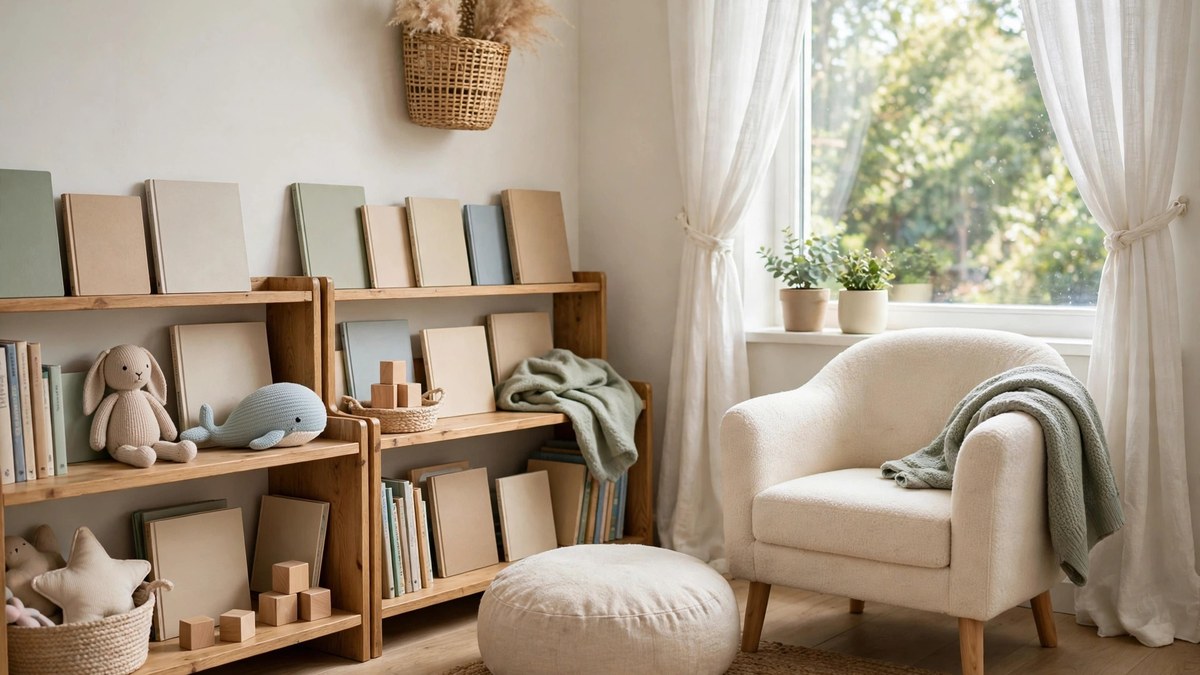
Shelves plus a soft place to land equals a reading nook, and the nook is where the library turns into a habit. Place the forward-facing display beside a floor cushion, a small armchair, or the corner of the rug with a couple of pillows — the books and the sitting spot must be within the same small orbit, or the ritual leaks away.
Light the nook properly: a warm lamp nearby (secured, cord out of reach) or a wall sconce above the chair. Stories happen at dusk more than noon, and a nook that goes dim at story time quietly fails at its job. A small basket beside the seat holds tonight’s chosen stack and the inevitable lovey.
Keep the nook slightly sacred. Toys live elsewhere; the nook is for books, blankets, and laps. Children defend the boundary themselves once the ritual sets — “that’s the reading corner” — and you will have built the room’s most beloved square meter for the price of a cushion.
Size the nook for two. The reader is rarely alone: a parent, a sibling, a stuffed audience of four. A cushion or chair that fits an adult and a child together — even snugly — is the difference between a nook that hosts the ritual and one that gets admired and abandoned.
Budget and DIY Book Storage Ideas
Some of the best nursery book storage costs almost nothing. Wooden spice racks from budget stores, painted and mounted upside-down-style as forward-facing ledges, are the classic hack — the rail that held jars holds board books perfectly. Dish racks, magazine files turned on their sides, and sturdy fabric bins all moonlight as book homes.
Secondhand bookcases refinish beautifully for nurseries: sand, paint in the room’s accent color, anchor properly, and a five-dollar case looks bespoke. Gutters — yes, clean vinyl rain gutters with end caps — are a beloved DIY bookshelf along playroom walls: cheap, rounded, and exactly book-depth, though they belong to the toddler years rather than the baby stage.
Where not to save: anchoring hardware and the floor-level bin a baby will pull up on. Spend the few dollars on proper anti-tip straps and a bin that cannot tip or splinter; thrift everything else with a clear conscience.
Fabric book slings — canvas pockets on a low wooden frame — deserve an honorable mention for the toddler stage: soft, silent, un-climbable, and machine-washable after the inevitable juice incident. They hold a dozen board books beautifully and fold away flat when the season of life changes.
Growing the Library: From Board Books to Chapter Books
The library’s shape changes on a predictable arc. Year one is board books — few pages, thick everything. Years two and three explode into picture books, which are larger, thinner, and arrive as gifts at a rate no shelf anticipates; this is when the reserve bin and rotation system earn their keep.
Preschool brings the first series loyalty — one character, twenty books — and early readers with slim spines that vanish in a picture-book shelf. A magazine file or a small divider keeps skinny books findable. Chapter books around school age finally make the classic spines-out bookcase the right tool, closing the loop that began with cover-out displays.
Through every stage, the constant is the ritual, not the furniture: books within reach, a cozy seat, an adult’s voice. Shelves that serve the ritual at each age — low, higher, classic — are the whole strategy, and it scales from a corner bin to a wall of cases.
Keep a tiny “hospital bag” mindset for books as well: a small tote of three or four favorites that travels to grandparents’ houses and waiting rooms. Children anchored by familiar stories settle anywhere, and the rotating shelf at home makes choosing the travel cast a thirty-second job.
Common Mistakes to Avoid With Nursery Book Shelves
- Skipping the anchor. An unanchored bookcase in a toddler’s room is a genuine hazard. Strap every case to a stud, every time.
- All books out at once. Forty visible books overwhelm a toddler and bury favorites. Rotate a small selection and store the rest.
- Spines-out for toddlers. Young children choose by covers. Forward-facing displays at their height are what actually gets books read.
- Fragile books at grab height. Pop-ups and keepsakes live high until hands are gentle. Low shelves hold only the indestructible.
- Shelves far from the seat. Books stored across the room from the chair and rug rarely join story time. Keep the library inside the nook.
- Overfilling ledges. Picture ledges have real weight limits, and books are heavy. Respect the rating and check fixings as the collection grows.
Each mistake is cheap to prevent and annoying to fix after the first toppled stack — or worse. Set the shelves up safely once, and they serve quietly for years.
Frequently Asked Questions
What type of book shelf is best for a nursery?
A combination works best: a low forward-facing display at child height for independent choosing, plus a short anchored bookcase for the main library and adult selections. In small rooms, wall-mounted picture ledges can replace the floor-standing display entirely.
How many books should be out at once for a baby or toddler?
Roughly 8 to 15 in the child-accessible display is the sweet spot — enough for real choice, few enough to stay fresh and tidy. Keep the rest of the library in reserve and rotate a few titles every week or two.
Are forward-facing book displays worth it?
Yes, especially for children under four, who recognize books by their covers rather than spines. Cover-out displays measurably increase independent book handling and choosing, and they double as rotating wall art for the nursery.
How do I keep nursery book shelves safe?
Anchor bookcases to wall studs with anti-tip hardware, mount ledges into studs or rated anchors, respect weight limits, keep fragile and heavy books high, and use only smooth, non-toxic finishes at mouthing height. Re-check fixings as your child starts climbing.
Where should book shelves go in a nursery?
Beside the reading spot — the nursing chair, rug corner, or floor cushion — so books and laps are never far apart. Put the child-height display where your toddler plays, and the adult bookcase near the door or chair for easy rotation swaps.
Can I use spice racks as nursery book shelves?
Yes — sturdy wooden spice racks mounted on the wall are a popular, inexpensive forward-facing book display. Choose solidly built racks, sand any rough edges, mount into studs, and respect sensible weight limits.
When do children switch to a regular bookcase?
Gradually, as picture books give way to early readers and chapter books around school age. Most families keep a small forward-facing display for favorites even then, because choosing by cover never really stops being pleasant.
Conclusion
Great nursery book storage is a system, not a piece of furniture: a forward-facing display a small child can use alone, a safe anchored case for the growing library, rotation to keep it all fresh, and a cozy nook where the stories actually happen. Set it up with anchoring and reach in mind, and your nursery book shelves will quietly build a reader — one bedtime story, one self-chosen bunny book, at a time.
Begin this weekend with whatever you have: one ledge, one bin, eight beloved books at your baby’s eye level. The library habit starts with visibility, and every grand collection in every grown-up home began exactly that small.
