

It is the wall everyone sees and nobody designs. The wall behind and around the toilet is usually the visual center of a powder room and the supporting actor in a full bath, yet it typically holds nothing but a flush, a roll holder, and our collective indifference. That is a missed opportunity measured in square feet: a run of shelving, a bold paint color, or a tiled feature treatment can transform the whole room. These toilet walls ideas treat that overlooked surface as the design feature it quietly is.
This guide covers the practical treatments first, paint, wallpaper, tile, and wainscoting, then the decorative layer of shelves, art, and storage, with honest notes on moisture, cleaning, and the clearances that keep a pretty wall working properly.
Why the Toilet Wall Deserves a Plan
Start with the constraints, because they shape the design. Plumbing codes commonly call for at least 15 inches from the toilet’s centerline to any side wall and about 21 inches of clear floor space in front of the bowl, with the fixture itself set on a standard 12-inch rough-in from the finished wall, dimensions you can confirm in any overview of the modern toilet. Within those tight clearances, every wall addition must be shallow, secure, and cleanable.
Moisture and hygiene set the material rules. The toilet wall sits in the room’s splash and humidity zone, and it gets cleaned more often than any other bathroom surface. Finishes here should be scrubbable, sealed, and indifferent to disinfectant: satin or semi-gloss paint, tile, sealed paneling, and washable wallpaper all pass.
Then there is the view. In a powder room, the toilet wall is often what you face from the door, and it is what guests contemplate, so it earns the room’s best treatment. In a shared bath, it shares attention with the vanity, but it still anchors the room’s far end. Either way, designing it deliberately beats leaving it as the blank afterthought it starts as.
Paint Ideas for the Wall Behind the Toilet
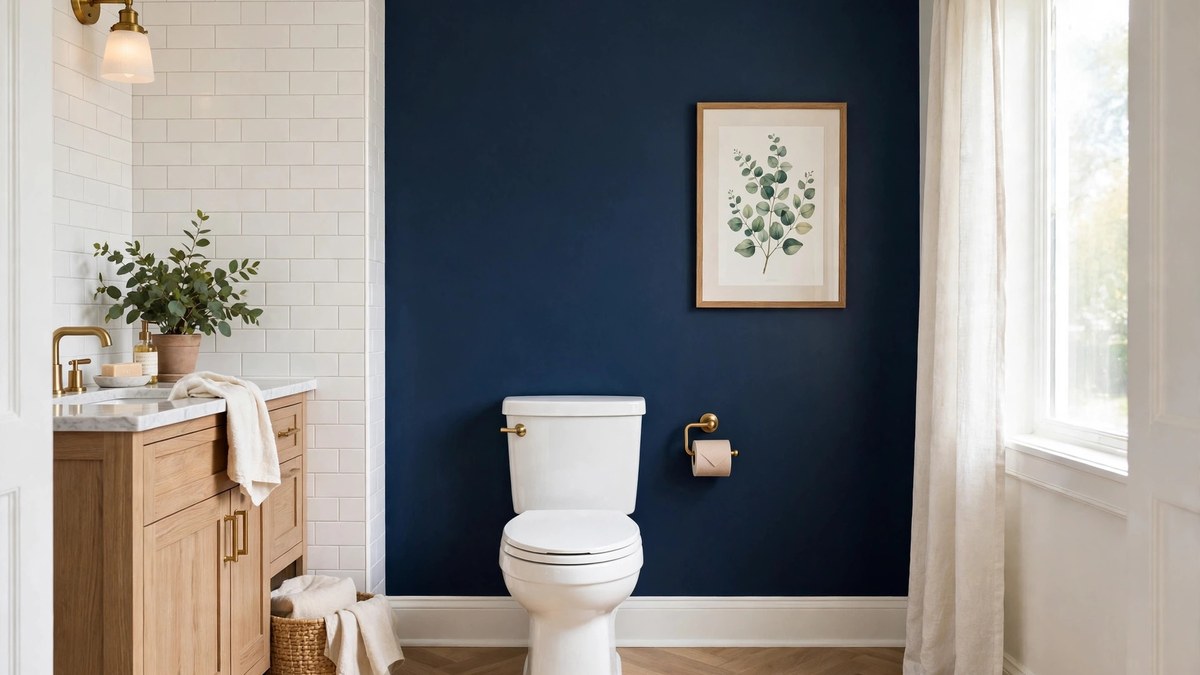
Paint is the fastest toilet wall upgrade and the easiest to reverse. A single saturated color behind the toilet, navy, forest, charcoal, oxblood, turns the fixture’s white porcelain into a deliberate contrast and makes a small room feel designed rather than leftover. In windowless powder rooms, deep color wraps the space and hides the fact that the wall is small.
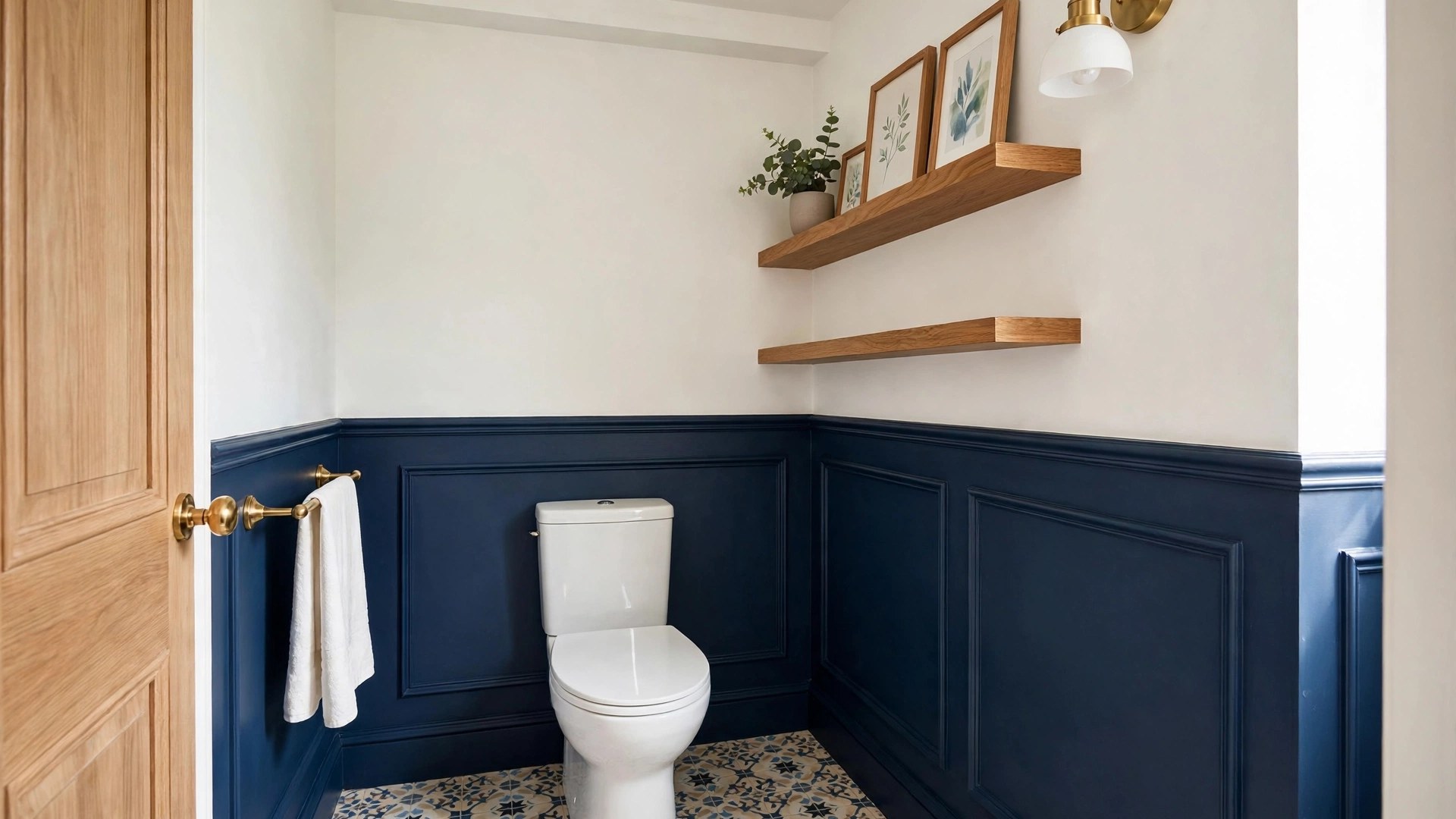
Two-tone treatments add architecture where none exists. Painting the lower portion of the wall, to about 40 or 48 inches, in a deeper shade and the upper in a soft white or pale tint mimics wainscoting at the cost of a roll of painter’s tape. A crisp horizontal line behind the toilet looks tailored, and the darker lower band hides scuffs and splashes better than any other finish per dollar.
Finish choice matters more than color. Choose satin or semi-gloss in a bathroom-rated formula for the toilet wall; flat and matte paints mark, absorb moisture, and resent scrubbing. Keep the leftover paint: this wall takes more bumps, from tank lids, cleaning bottles, and plunger handles, than any other in the room, and touch-ups are a fact of its life.
Do not overlook the ceiling’s gift: painting the toilet wall and ceiling the same deep color creates a cocoon effect that powder room guests find unexpectedly glamorous. It is the boldest paint move in this guide and, gallon for gallon, the cheapest drama in home decorating.
Wallpaper That Survives Bathroom Humidity
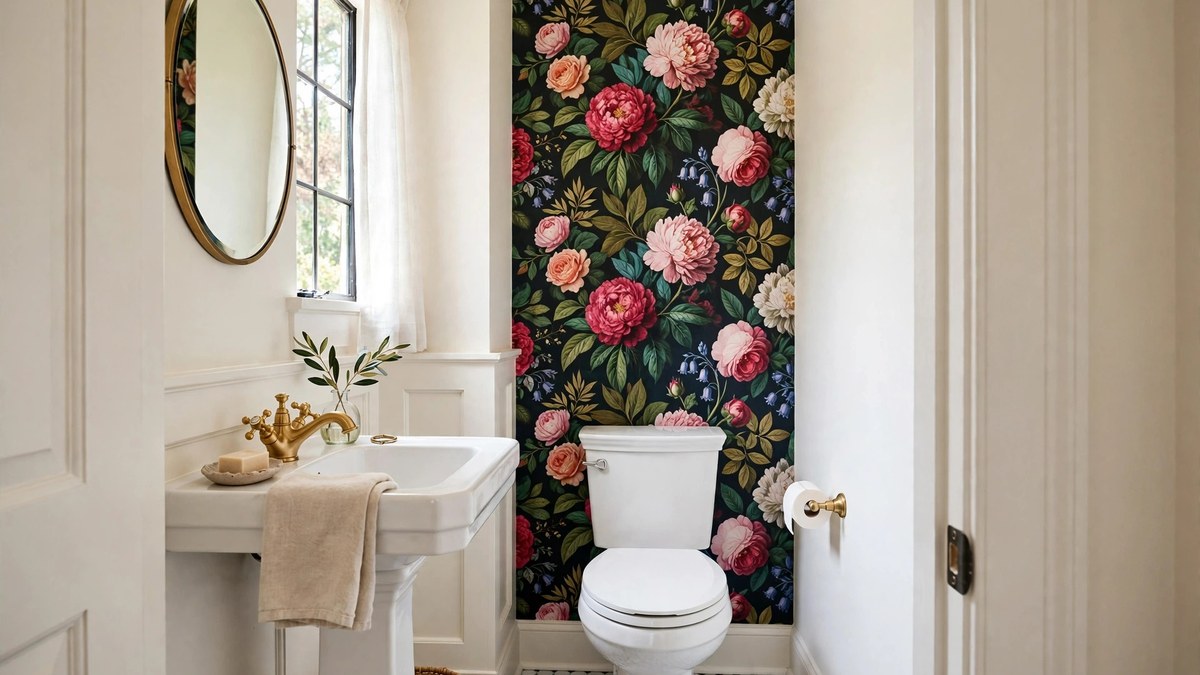
Wallpaper turns the toilet wall into pattern, and pattern is what small, fixture-dominated walls need most. A bold botanical, geometric, or scenic print behind the toilet gives the eye a destination and makes the porcelain fixture recede, which is the whole trick of powder room design.
Material selection is where bathroom wallpaper succeeds or peels. Solid vinyl and vinyl-coated papers tolerate humidity and wipe clean, making them the safe default. Traditional papers can work in a powder room without a shower, especially with good ventilation, but in a full bath with daily showers, choose vinyl or a washable peel-and-stick rated for bathrooms, and seal the edges near the tank and floor where moisture creeps.
Scale the pattern to the wall. Large repeats need room to breathe; on a narrow toilet wall, a large print may show only a fragment, which can look striking or accidental depending on the motif. Order a sample and tape it behind the tank for a few days, viewing it by day and by lamplight, before committing to rolls.
Installation around a toilet is fussy but doable: most people remove the tank lid, not the toilet, and cut carefully around the supply line. If the wall is your first paper project, the toilet wall is actually a kind assignment, small area, few outlets, and a fixture that hides the seams at the bottom where beginners struggle.
For pattern-forward inspiration across the whole room, our guide to bathroom wallpaper ideas covers prints, placements, and finishes in depth.
Tile and Wainscoting: The Durable Feature Wall
Where paint decorates and paper patterns, tile armors. A tiled toilet wall, full height or wainscot height, is the premium answer: waterproof, scrub-proof, and permanent in the best way. Extending the shower or floor tile onto the toilet wall unifies the room; choosing a contrasting tile makes the wall the feature. Either direction beats the standard drywall shrug.
Wainscot-height tile, typically 36 to 48 inches high with a chair-rail or pencil trim cap, protects the splash zone and leaves the upper wall free for paint or paper. It is the classic powder room formula for a reason: durable below, decorative above, and the horizontal line gives art and mirrors a natural place to sit.
Beadboard and shiplap wainscoting deliver the same structure in a warmer, less expensive material. In a bathroom, install PVC or properly sealed and painted wood products, caulk every joint, and use semi-gloss paint so the grooves can be wiped. The look suits farmhouse, cottage, and traditional rooms especially well.
Stone and large-format slabs are the luxury end of the spectrum: a single porcelain slab behind the toilet reads as architecture, eliminates grout lines where cleaning is hardest, and pairs beautifully with a wall-hung fixture. If budget forces a choice, tile only the toilet wall and paint the rest; no rule says every wall must match. The tile patterns in our bathroom wall tile guide translate directly to this smaller canvas.
Shelves Above the Toilet That Look Built-In
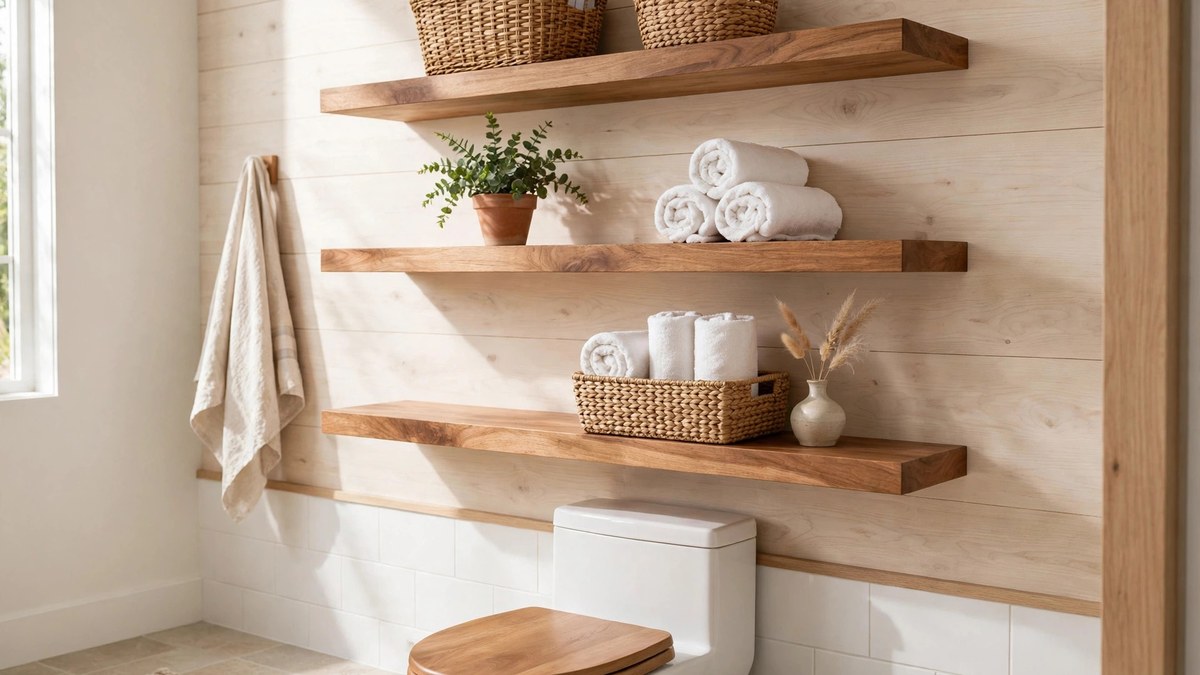
The space above the tank is the most wasted vertical real estate in the bathroom, and shelving is its obvious destiny. Two or three floating shelves, starting roughly a foot above the tank lid so the lid can be lifted off for repairs, turn dead air into storage and display in a single afternoon.
Depth is the discipline: shelves of 6 to 8 inches hold towels, baskets, and plants without looming over a seated user. Mount them into studs or with rated anchors, because a shelf of rolled towels and ceramics is heavier than it looks, and its contents sit above porcelain and people.
Style shelves like you mean it. A working formula: one stack of folded towels, one basket or lidded box for supplies, one living or faux plant, and one pretty object, a candle, a small framed print, a ceramic vessel. Keep the palette to the room’s colors and leave breathing room; a shelf crammed edge to edge reads as storage overflow, not decor.
For a built-in look, run shelves wall to wall, paint them the wall color or match them to the vanity, and use hidden brackets. Open shelves in a contrasting wood warm up a white room, while glass shelves nearly disappear in a small one, letting the objects supply the color.
Toilet Decor That Works in the Tightest Spaces
Once the wall treatment is set, the decorative layer is small but mighty. This is toilet decor in its purest form: a framed print or two, a small plant, a beautiful roll holder, objects chosen because this wall is looked at closely and often.
Art belongs here. A single framed piece centered above the tank at eye level, or a tight pair stacked vertically, gives the room its focal point. Choose pieces behind glass that tolerate humidity, and repeat a color from the towels or paper so the wall feels composed. In powder rooms, humor is permitted and even welcome; this is the one room where a witty print earns its keep.
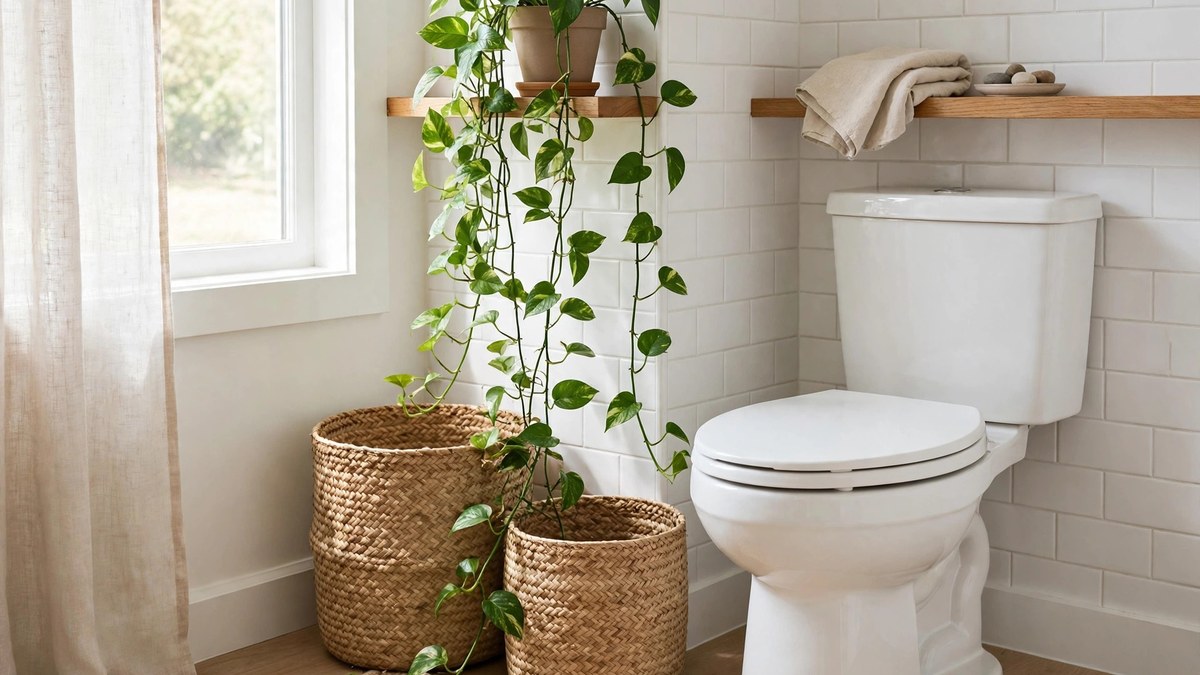
Plants earn their place by softening all that porcelain and tile. Trailing pothos from the top shelf, a small fern, or eucalyptus in a bud vase on the tank tray all thrive in bathroom humidity and ask little light. If your room has no window, good faux stems are the honest alternative; no one inspects them from the throne.
Finish with the functional jewelry: a roll holder that matches your metals, a covered spare-roll holder styled like an accessory, and a small tray on the tank corralling a candle, matches, and a room spray. When the useful things are beautiful, the wall needs nothing else.
Cabinets and Hidden Storage on the Toilet Wall
Shelves display; cabinets conceal. An over-toilet cabinet, the classic étagère or a wall-mounted cupboard with doors, hides the bathroom’s visual noise: spare rolls, cleaning supplies, personal items, and the plunger-adjacent realities. If your household’s bathroom always looks almost tidy, a doored cabinet is usually the missing piece.
Freestanding over-toilet racks are the renter’s version: they straddle the tank, need no drilling, and come in wood, metal, and bamboo finishes that can match your room. Choose one with at least one closed or basket-fitted shelf so not everything is on display, and check its height against your flush lever and supply line before ordering.
The elegant option is a recessed niche built between studs during a renovation, tiled or painted inside, with two or three shelves. It takes nothing from the room’s footprint and looks architectural rather than added. Even a shallow 4-inch recess swallows bottles and rolls completely.
Whatever you choose, respect the tank. Leave clearance to remove the lid and reach the fill valve, because the day you cannot service the toilet is the day the storage reveals its price. Design storage around the plumbing, never against it.
Plants, Baskets, and Natural Texture
Bathrooms are hard-edged rooms: porcelain, tile, glass, chrome. The toilet wall is where texture does its softening, and natural materials do it best. A woven basket holding spare rolls looks better than any plastic holder; a seagrass tray on the tank warms the porcelain; a wooden shelf or stool introduces the grain the room lacks.
Baskets also solve the spare-roll problem with grace. One attractive basket on the floor beside the toilet or on a shelf keeps extras visible, which guests appreciate, while looking like decor instead of inventory. Lidded baskets hide less lovely supplies while keeping the same texture story.
Layer textures in a tight palette: natural fibers in tan and cream, one wood tone repeated twice, a plant for green. Against a painted or tiled wall, this organic layer keeps the room from feeling clinical and photographs beautifully, which is why every styled bathroom you have ever saved includes exactly these elements.
In very small powder rooms, texture may be the entire decor strategy: a grasscloth-look washable paper, a woven shade, baskets, and a wood-framed mirror. No art required; the surfaces themselves do the decorating.
Small Powder Rooms: Make the Toilet Wall the Star
In a powder room, the toilet wall shares the stage with a small vanity, and the winning strategy is commitment: give one wall the drama. Because the room is tiny, the cost of drama is tiny too, one or two rolls of paper, a gallon of paint, a few tiles. This is why designers treat powder rooms as the home’s jewelry box.
Our collection of small bathroom ideas returns often to the same principle for compact baths: a single confident gesture beats five timid ones. Apply it here. Choose the boldest wallpaper, the deepest paint, or the richest tile for the toilet wall, keep the other walls quiet, and let the vanity wall stay simple with a good mirror and light.
Scale tricks help the star shine. A large mirror or print on the toilet wall reads as intentional in a way small scattered pieces cannot. Floating the vanity and choosing a wall-mounted faucet free visual floor space, making the room feel less tight around its feature wall.
Do not forget scent and sound in the tiniest rooms: a candle or diffuser and a soft-close seat are small kindnesses guests register. The powder room is a thirty-second experience; design all thirty seconds.
Lighting and Mirrors Near the Toilet Wall
Light decides whether your beautiful toilet wall looks moody or murky. Most bathrooms light the vanity and leave the toilet wall in the fixture’s shadow, so check yours at night: if the feature wall is the darkest surface in the room, the design is fighting the lighting.
Fixes range from free to modest. A brighter, warmer bulb in the main fixture, around 2700 to 3000 Kelvin, flatters paint colors. A small picture light above art over the toilet, battery models exist that need no wiring, turns the wall into a gallery. In full baths, a dedicated recessed light or a sconce on the toilet wall balances the vanity’s brightness so the room reads evenly.
Mirrors are not just for vanities. A round or oval mirror on the toilet wall of a powder room, hung above a small shelf, creates a secondary grooming spot and doubles the light. In windowless rooms, any mirror earns its place; on this wall it also gives guests a discreet check-in point away from the main vanity.
Whatever you add, keep switches and sightlines sensible: art lit like a museum piece beside a toilet is charming; a spotlight that interrogates the seated is not.
Budget Toilet Wall Makeovers: A Weekend Ladder
This wall is the cheapest room-makeover in the house because the canvas is so small. At the lowest rung, a quart of deep paint and a new framed print, often thrifted, transform the wall for about the cost of a pizza night. Paint only the toilet wall, keep the others as they are, and the room gains a focal point in an afternoon.
The middle rung adds one material: peel-and-stick wallpaper or tile on the toilet wall, or a pair of floating shelves with baskets and a plant. Each lands in the range of a modest grocery run and installs in a few hours, and each can come with you or come down when tastes change, which makes them perfect experiments.
The top rung, real tile or wainscoting on this one wall, stays surprisingly contained because the area is perhaps 20 to 30 square feet. Materials that would be extravagant across a whole bathroom become affordable here, which is precisely why the toilet wall is the smart place to buy the tile you actually love.
Common Toilet Wall Mistakes
The first mistake is the leaning shelf of doom: decor perched on the tank lid that must be moved for every repair and rattles at every flush. Style the wall, not the tank, and keep the lid clear or limit it to one stable tray. Second is shelves mounted too low or too deep, hovering over the user; keep them shallow and start them well above the tank.
Third is ignoring moisture ratings: unsealed paper art, raw MDF shelves, and ordinary wallpaper paste all fail slowly in a steamy bath. Fourth is the gallery explosion, a dozen tiny frames scattered across the wall, which reads as clutter at this viewing distance. One strong piece beats many small ones.
Fifth is forgetting the practical kit: no visible spare roll, no plunger access, nowhere for a guest’s phone or handbag. A hook on the side wall and a basket of spares are decor-adjacent necessities. And sixth is drilling blind: supply lines and vents hide in this wall, so find studs and pipes before the drill comes out.
Frequently Asked Questions
What should I put on the wall behind my toilet?
Choose one strong treatment, bold paint, washable wallpaper, tile, or wainscoting, then add a shallow shelf or two with towels, a plant, and a framed print. Keep everything within 6 to 8 inches of depth and washable.
How much space should I leave above the toilet tank for shelves?
Start the first shelf about 12 inches above the tank lid so the lid lifts off easily for repairs, and keep shelf depth around 6 to 8 inches so nothing looms over the user.
Can I use regular wallpaper behind a toilet?
In a powder room without a shower, usually yes with good ventilation. In a full bathroom, choose vinyl or washable peel-and-stick paper rated for humidity, and seal edges near the floor and tank.
What colors make a toilet wall look good?
Deep colors, navy, forest, charcoal, make white porcelain look crisp and deliberate in small rooms. Soft whites and pale tints suit bright, airy baths. Either way, use a satin or semi-gloss bathroom paint for scrubbability.
How do I decorate above the toilet in a rental?
Use a freestanding over-toilet rack, peel-and-stick wallpaper or tile, adhesive hooks rated for the weight, and framed prints on removable strips. All the look, none of the holes.
Is it okay to hang art over a toilet?
Yes, it is the classic focal point of the powder room. Choose pieces framed behind glass that tolerate humidity, hang them securely, and center them over the tank at roughly eye level.
How do I hide toilet supplies stylishly?
Baskets, lidded boxes, and a doored over-toilet cabinet. Keep one or two spare rolls visible in an attractive holder for guests, and conceal cleaning supplies and backstock behind doors.
Final Thoughts
The toilet wall asks so little: one confident finish, a shallow shelf or two, something green, something framed, and the supplies guests need kept gracefully in reach. Give it that much and the smallest wall in the bathroom becomes the one people photograph, compliment, and copy. Start with paint or paper this weekend, add the shelf next month, and enjoy a room that finally looks designed on purpose.
