
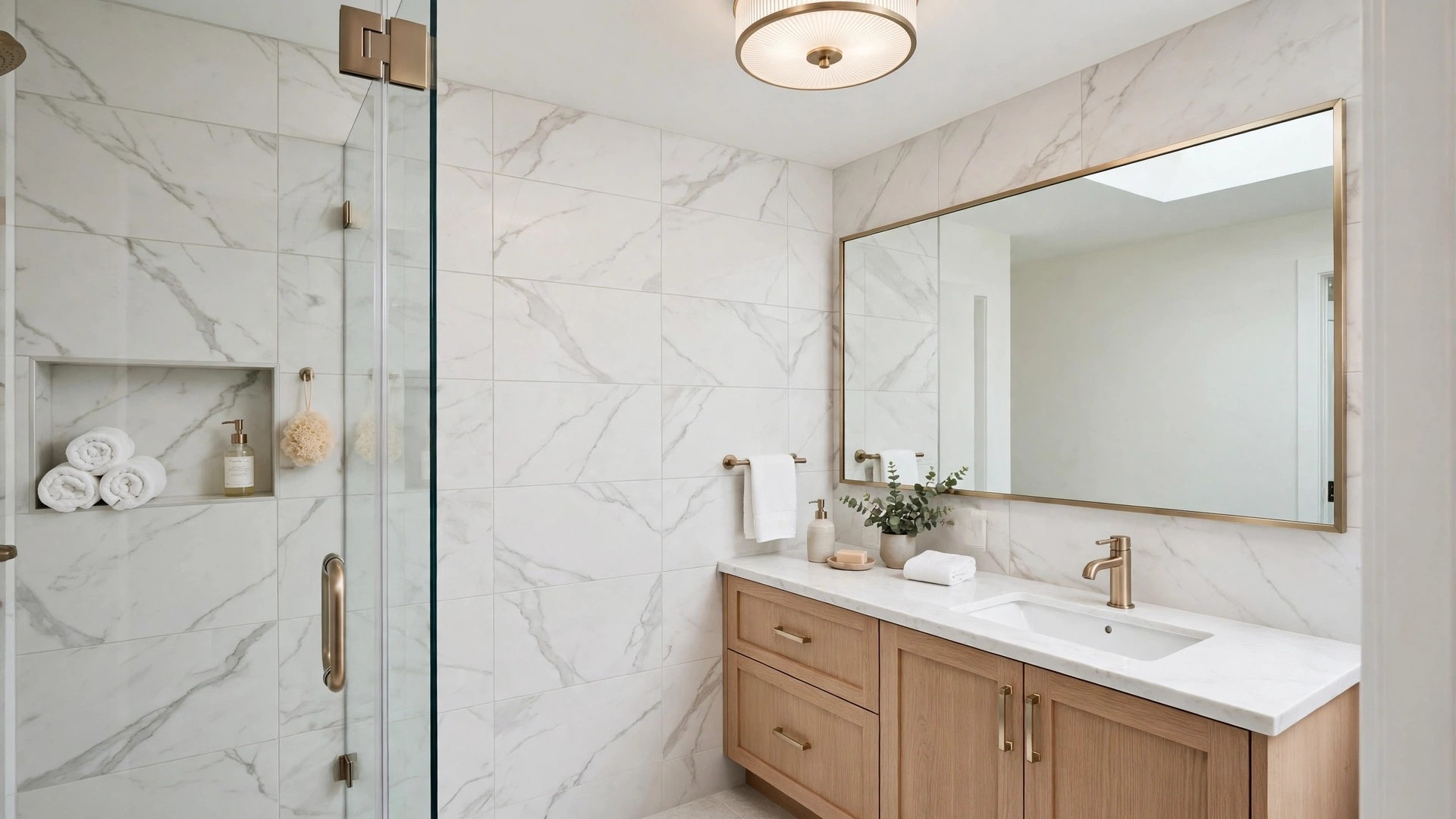

Most bathrooms have exactly one ceiling light, chosen in a hurry, and it shows. Harsh shadows at the mirror, a gloomy shower corner, and a room that feels smaller than it is usually trace back to that single fixture. The good news: bathroom ceiling lights ideas have come a long way from the dreaded frosted dome, and the right choice brightens the whole room while making mornings noticeably easier.
This guide covers every main fixture type, the safety ratings that actually matter in a wet room, how bright your ceiling light should be, and the placement tricks designers use to keep faces shadow-free. Whether you are swapping one fixture or planning a full remodel, you will find a ceiling light that fits your bathroom and your budget.
Why Bathroom Ceiling Lighting Deserves More Thought
The bathroom is the hardest-working small room in the house. You apply makeup, shave, check a child’s temperature, clean, and unwind in the tub — often within the same few square feet. Ceiling light has to support all of that without glare, shadows, or safety risks from steam and splashes.
Ceiling fixtures also carry the room’s style almost single-handedly. Bathrooms have few decorative elements, so the light you choose becomes the jewelry of the space. A thoughtful fixture can make a plain white bathroom look designed; a dated one quietly ages everything around it.
Finally, there is the moisture factor. No other room combines electricity, water, and bare feet so closely, which is why bathroom fixtures carry location ratings and why “any ceiling light will do” is genuinely bad advice here. The sections below explain what to look for before you fall for a pretty fixture.
There is also a resale and rental reality to consider. Updated lighting is one of the first things buyers and tenants register in a bathroom, because it changes how clean and modern the room feels in the first five seconds. A thirty-year-old dome light whispers “deferred maintenance” even over new tile. A crisp, intentional fixture says the opposite — and it costs a fraction of any other bathroom update.
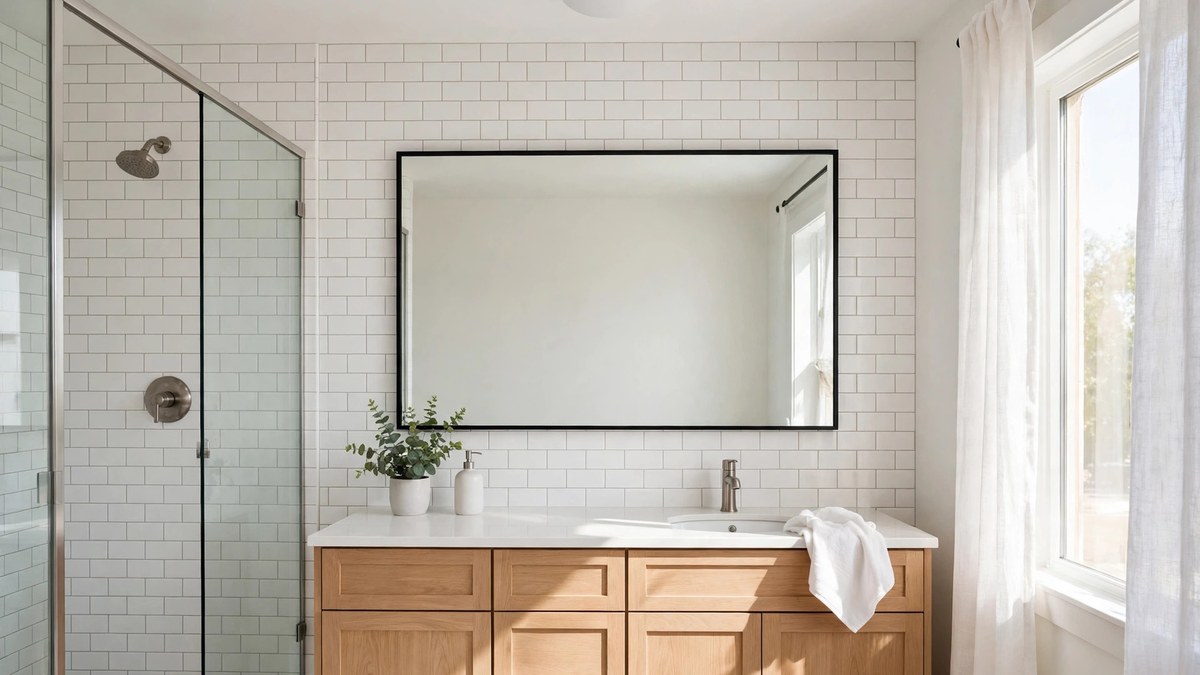
Flush Mount Lights: The Reliable Classic
The flush mount sits tight against the ceiling, making it the default choice for low ceilings and small bathrooms. Modern versions have left the plain glass dome far behind: look for drum shades in linen-look fabric, opal glass with metal trim, and low-profile LED designs that read more like sculpture than hardware.
Because they hug the ceiling, flush mounts spread light widely and evenly, which is exactly what a small bathroom needs. A single well-chosen flush mount can handle the ambient light for a powder room or compact family bath on its own.
Choose a sealed or damp-rated design so steam does not creep inside the fixture over time. Integrated LED models are especially good here — no bulb gaps for moisture, a slimmer profile, and lifespans measured in years rather than months. If your bathroom leans traditional, a flush mount with a frosted dome and brushed nickel ring still looks right at home among the modern bathroom ideas trending now.
Sizing a flush mount is forgiving: fixtures roughly 12 to 16 inches across suit powder rooms and small baths, while 16 to 24 inches works better in a primary bathroom. When the ceiling is very low and the room is wide, two smaller flush mounts spaced evenly often light the room better than one large center fixture, and they look deliberate rather than sparse.
Semi-Flush Mounts for Higher Ceilings
A semi-flush mount hangs a few inches below the ceiling on a short stem, and that small gap buys you a lot of style. The space lets light bounce off the ceiling as well as down into the room, softening shadows and making the ceiling feel higher than it is.
With ceilings of 9 feet or more, semi-flush designs open up a catalog of prettier fixtures: small drum pendants, mini chandeliers, lantern shapes, and sculptural glass pieces that a flush mount cannot accommodate. They are the sweet spot between practical and decorative.
Watch the overall drop in doorways and above tubs. As a typical guideline, keep the bottom of any ceiling fixture at least 7 feet above the floor in walk-through areas, and check your local code for clearances above a bathtub, where rules are stricter. When in doubt, measure twice and hang once.
Recessed Lights for a Clean Ceiling Line
Recessed lights — can lights or downlights — disappear into the ceiling, leaving a clean, uncluttered surface. In bathrooms they excel as part of a team: a grid or pair of recessed lights for general brightness, plus dedicated lighting at the vanity and in the shower.
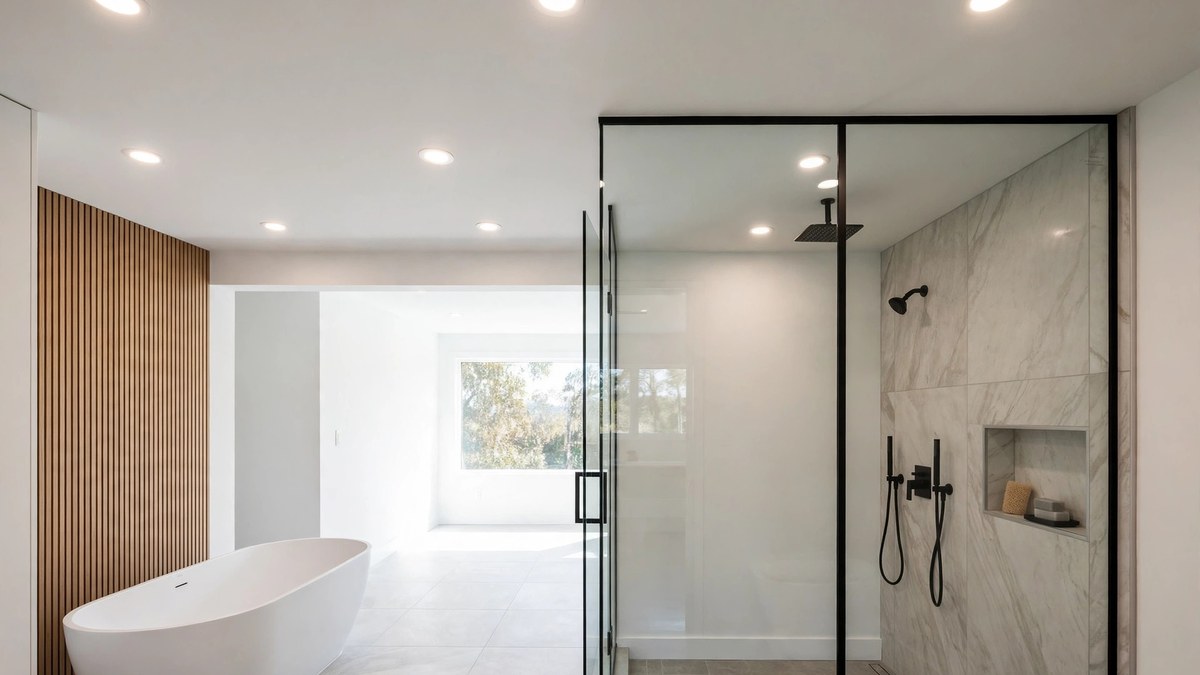
Modern LED recessed trims are slim, sealed, and often rated for wet locations, which makes them one of the few fixtures approved inside a shower enclosure. A wet-rated recessed light over the shower transforms the darkest corner of most bathrooms into a bright, spa-like zone, an effect you can see throughout these spa bathroom ideas.
Recessed lights demand planning. Each one needs ceiling access, correct spacing — often roughly 4 to 6 feet apart as a typical range — and a decision about beam angle before the ceiling closes. They reward that planning with the most even, shadow-light ambient glow of any fixture type.
Trim choice is the hidden style lever. A plain white baffle trim nearly disappears; a black or metal trim adds a deliberate design note that can echo your faucets. Gimbal trims that tilt are worth considering near mirrors and artwork, since they let you wash a wall with light instead of pointing everything straight down at the floor.
Bathroom-Safe Chandeliers and Pendants: Yes, Really
A small chandelier or pendant over the tub is the bathroom splurge all over social media — and it can be done safely and legally. The rules are the gatekeepers: fixtures above a tub must be out of reach from the water and rated appropriately, and many jurisdictions restrict hanging fixtures in the zone directly over the tub unless they meet clearance requirements.
The safe way to get the look is placement. Hang the statement fixture over the dry center of a larger bathroom, or choose a damp-rated mini chandelier designed and listed for bathroom use. Beaded, rattan, and small crystal designs all exist in damp-rated versions now, because demand created them.
If your bathroom is small or your ceiling is low, borrow the glamour at a smaller scale: an elegant semi-flush with glass drops gives the same sparkle without the hang height. The goal is a focal point, not a clearance violation.
Pendants follow the same logic. A pair of small pendants centered over a wide double vanity zone — hung from the ceiling rather than mounted at the mirror — can look stunning, but they belong over dry floor or counter, never where a bather could reach them from the tub. When the layout makes that impossible, admire the photo, then choose the semi-flush. Style never outranks the electrical code.
Wet Ratings Explained: Damp-Rated vs Wet-Rated Fixtures
Every bathroom fixture decision runs through one question: how much water will reach it? The lighting industry answers with location ratings, and the Wikipedia guide to light fixtures outlines the basic fixture types these ratings apply to. Here is the plain-English version.
Dry-rated fixtures are for rooms without moisture — never use them in a bathroom. Damp-rated fixtures tolerate humidity and indirect moisture, which covers most of the bathroom: above the vanity, in the center of the room, anywhere steam reaches but splashes do not. The majority of bathroom ceiling lights are damp-rated, and correctly so.
Wet-rated fixtures can handle direct water contact and are required inside shower enclosures and in the splash zone around tubs. When shopping, the rating appears in the product specifications as “UL Damp” or “UL Wet” (or an IP rating on some imports). Never install a damp-rated fixture where a wet-rated one is required — this is the one rule in this guide with no flexibility.
How Bright Should Bathroom Ceiling Lights Be?
Brightness confusion usually comes from watts, so think in lumens instead. For general ambient light in a bathroom, a common planning target is roughly 50 to 75 lumens per square foot across all light sources combined — ceiling light, vanity lights, and any shower light together. A small 40-square-foot bathroom therefore lands around 2,000 to 3,000 total lumens.
The ceiling fixture does not need to supply all of that alone. In fact, rooms lit by ceiling light plus vanity fixtures look better than one blazing overhead source, because light arriving from several directions cancels shadows. Let the ceiling light carry the ambient share and give the vanity its own brighter, focused fixtures.
Dimmability is worth insisting on, especially in a primary bathroom. Full brightness for cleaning and grooming, low glow for a midnight visit or a long soak — the same fixture serves both only if it dims. Choose dimmer-compatible LEDs and a matching wall dimmer to avoid flicker.
One brightness trap catches almost everyone: judging a fixture by its showroom look. A light that seemed gentle among fifty others in a bright store can feel like an interrogation lamp in your small, tile-surfaced bathroom, where every surface bounces light back. When possible, buy from retailers with easy returns, install the fixture, and judge it at night with the door closed before committing to a matching second one.
Placement: Centering Light Without Casting Shadows
The classic bathroom complaint — “the light makes me look terrible” — is a placement problem. A single ceiling light behind you while you face the mirror throws your face into shadow. That is why ceiling fixtures work best centered on the room or slightly toward the vanity, always supported by light at the mirror itself.
In larger bathrooms, think in zones rather than one center point: a fixture or recessed pair over the general floor area, a wet-rated light in the shower, and vanity lighting handled separately. Each zone on its own switch or dimmer lets you light only what you are using.
Symmetry helps in traditional layouts. A centered flush mount aligned with the tub, or recessed lights balanced either side of a skylight, read as deliberate. Off-center fixtures read as accidents, even when the light level is identical.
Before finalizing placement in a remodel, do the painter’s-tape test: mark the proposed fixture positions on the ceiling, stand at the mirror, and have someone move a work light between the marks. Five minutes of pretending reveals shadow problems that five hundred dollars of fixtures cannot fix afterward. Electricians are used to this request — it is far cheaper than relocating a junction box in a finished ceiling.
Ceiling Lights for Small Bathrooms
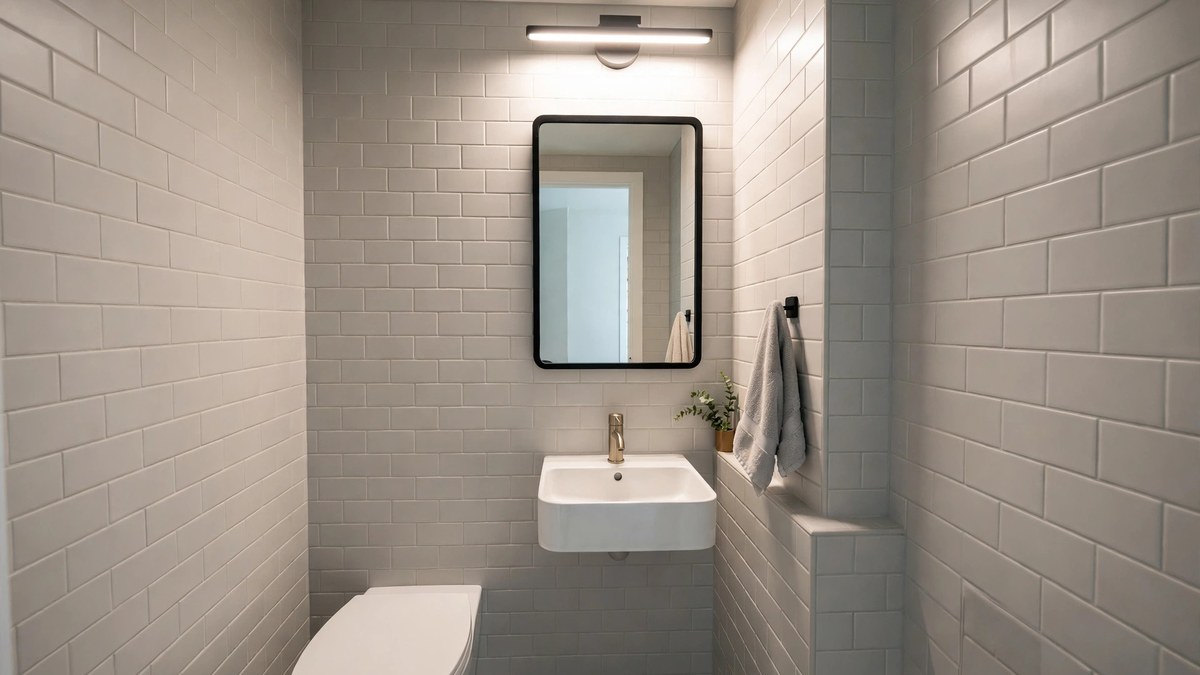
Small bathrooms punish bulky fixtures, so think low-profile and bright. A slim integrated-LED flush mount gives maximum light for minimum visual weight, and its sealed design shrugs off the steam that small rooms concentrate.
Light color on the ceiling and walls multiplies your fixture’s work. Pale, semi-gloss ceiling paint reflects noticeably more light than the same color in flat finish, effectively upgrading your fixture for the price of a paint roller. Mirrors help too — a ceiling light positioned so its glow reflects in the vanity mirror doubles its reach.
Avoid the temptation of a tiny fixture to match the tiny room. Small bathrooms actually need proportionally more light, because every surface is close and shadows crowd in. One good 16-to-20-inch flush mount or a pair of recessed lights will serve you better than a mini fixture chosen for cuteness.
Renters in small bathrooms have one more trick: swap the existing fixture’s bulbs, not the fixture. A pair of bright, high-CRI LED bulbs at the right color temperature can double the usable light of an old dome fixture for a few dollars, and the original bulbs go back in the box for moving day. It is the smallest possible version of this entire guide, and it works.
Exhaust Fan and Light Combos: Practical Two-in-One
In many bathrooms the ceiling’s most important fixture is the exhaust fan, and modern fan-light combos have become genuinely good-looking. A combined unit clears steam, fights mold, and lights the room from a single ceiling cutout — ideal for small bathrooms with no room for multiple fixtures.
Shop by two numbers: airflow (CFM), matched to your room size — roughly 1 CFM per square foot is a common rule of thumb — and noise (sones), where lower is quieter and anything around 1 sone or below feels premium. Many combos now add a night-light mode and humidity sensors that run the fan automatically after showers.
If you are planning a remodel, this combo is one of the smartest budget lines in it, as any bathroom remodel ideas checklist will confirm. Just keep a separate, prettier fixture in the plan if the fan sits off-center — fan placement follows the moisture, not the mirror.
Bulbs and Color Temperature for True Mirror Colors
Color temperature decides whether your bathroom feels like a spa or a dentist’s office. For ceiling lights, the comfortable bathroom range is typically 2,700K to 3,500K: warm enough to flatter, cool enough to see clearly. Many designers aim near 3,000K as the balance point for grooming accuracy and relaxation.
Equally important is color rendering. A CRI of 90 or higher means makeup, hair color, and skin tones look the way they will in daylight. Cheap LEDs with low CRI are the hidden reason colors look “off” in many bathrooms, no matter how good the fixtures are.
If your ceiling fixture uses replaceable bulbs, buy all of them at once from the same batch so color matches across the fixture, and keep one spare. Mixed bulbs in one fixture — one warm, one cool — is a small detail everyone notices and nobody can un-see.
Frosted versus clear bulbs is the last decision, and in a bathroom frosted almost always wins. Bare clear bulbs create pinpoint glare that reflects off mirrors, tile, and water — the three surfaces this room is made of. A frosted bulb or an opal shade spreads the same light softly, which is why hotel bathrooms, designed by people who test these things, nearly always diffuse.

Common Mistakes to Avoid With Bathroom Ceiling Lights
- Ignoring the location rating. A dry-rated fixture in a steamy bathroom corrodes, flickers, and can become unsafe. Match the rating to the zone, every time.
- One light, one shadow. Relying on the ceiling light alone guarantees a shadowed face at the mirror. Pair it with vanity lighting.
- Buying by watts. Watts measure energy, not brightness. Compare lumens, and add up all the room’s fixtures to hit your target.
- Forgetting the shower. The shower is part of the room. A wet-rated recessed light there is one of the highest-impact upgrades in any bathroom.
- Choosing cool-blue light. Bulbs at 5,000K and above make bathrooms feel clinical and skin look grey. Stay in the warm-to-neutral range.
- Skipping the dimmer. Bright-or-dark is a false choice. A dimmer turns one fixture into morning light, cleaning light, and bath-soak light.
Avoid these six and your ceiling light will quietly do its job for a decade — which is exactly what great bathroom lighting should do.
Frequently Asked Questions
What type of ceiling light is best for a bathroom?
For most bathrooms, a damp-rated flush mount or semi-flush mount with diffused light is the best all-round choice. Layer it with vanity lighting for grooming and a wet-rated recessed light in the shower if you want the full designer result.
Can I put a regular ceiling light in a bathroom?
Only if it carries at least a damp-location rating. Ordinary dry-rated fixtures are not made for humidity and will degrade quickly in a bathroom. Inside a shower or over a tub’s splash zone, the fixture must be wet-rated, no exceptions.
How many lumens does a bathroom ceiling light need?
Plan the whole room’s lighting at roughly 50 to 75 lumens per square foot from all fixtures combined. The ceiling light typically supplies the ambient portion of that total, with vanity fixtures adding focused brightness where you groom.
Are recessed lights good for bathrooms?
Yes, especially modern LED trims that are sealed and wet-rated. They give even, shadow-soft light and a clean ceiling line. They work best in pairs or grids planned before installation, paired with separate vanity lighting for close-up tasks.
What color temperature is best for bathroom ceiling lights?
Most people are happiest between 2,700K and 3,500K, with about 3,000K a popular balance of warmth and clarity. Pair that with a high CRI (90+) so skin tones and makeup colors read accurately at the mirror.
Can I hang a chandelier in the bathroom?
In many cases, yes — a small damp-rated chandelier over the dry center of a larger bathroom is a beautiful focal point. Directly over a tub, clearance and rating rules apply and vary by local code, so check before installing or choose a semi-flush “glam” fixture instead.
Do bathroom ceiling lights need to be on a GFCI circuit?
Bathroom electrical work is governed by local code, and GFCI protection is standard for bathroom receptacles; lighting requirements vary by jurisdiction and fixture location. When in doubt — and especially for fixtures near water — have a licensed electrician confirm your circuit and fixture choice.
Conclusion
The right bathroom ceiling light is equal parts safety decision and style decision. Choose the correct wet or damp rating for its zone, size the brightness to the room rather than the fixture aisle, and support it with vanity and shower lighting so no corner sulks in shadow. Do that, and one of these bathroom ceiling lights ideas will make your bathroom feel brighter, bigger, and far more polished every single day.
Start with the fixture you notice most — usually the main ceiling light — and let the improvement convince you to finish the layers. Bathrooms reward good light more than almost any room in the house, because everything you do there happens in the mirror.
