
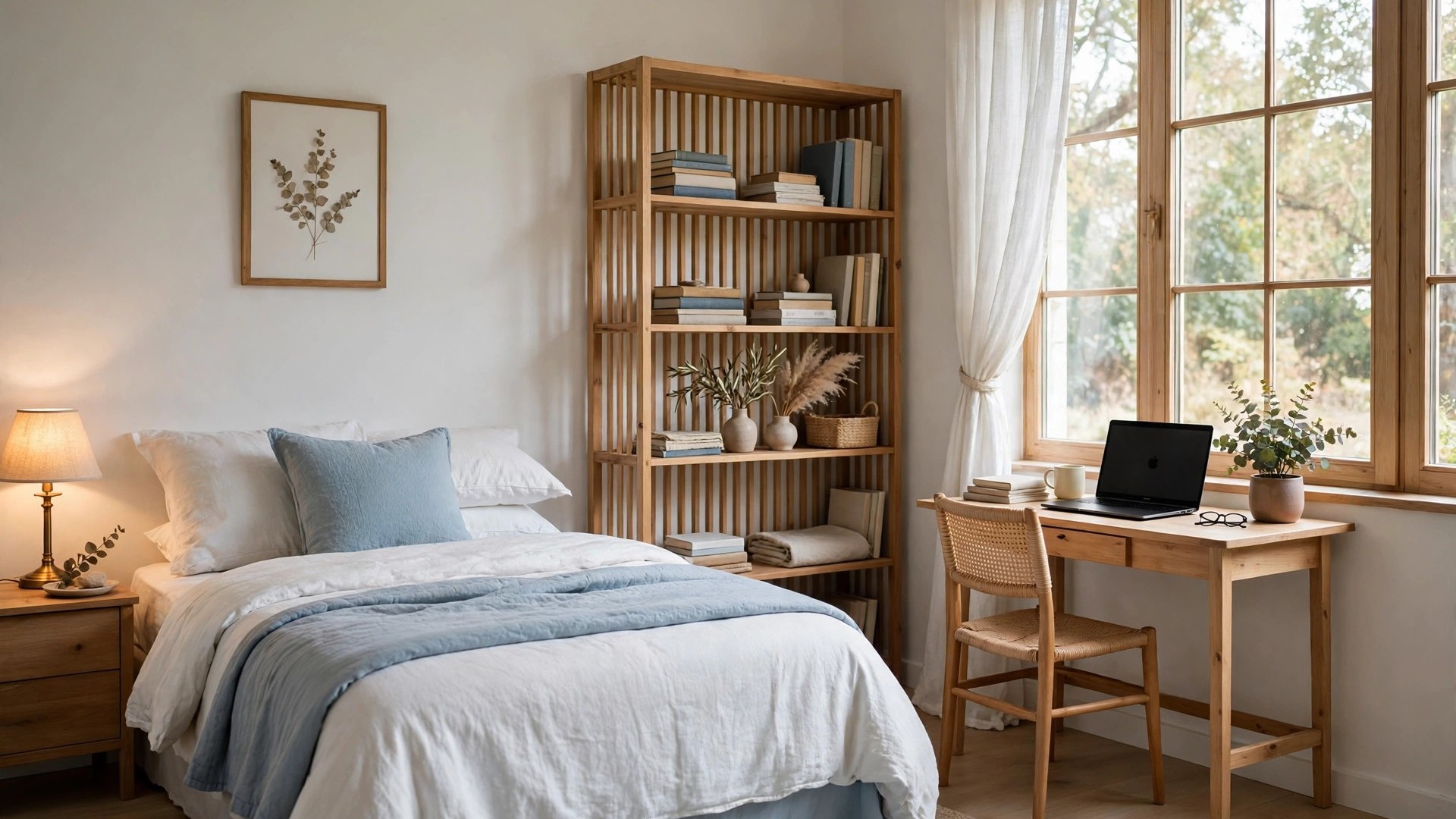

For millions of people, the spare room does not exist. The office goes where there is space, and very often that space is the bedroom. Done carelessly, the arrangement poisons both activities: you answer emails in sight of your unmade bed, then lie awake at night staring at the monitor’s standby light. Done thoughtfully, a bedroom office can be focused by day and genuinely restful by night.
The difference is not expensive furniture. It is separation — visual, physical, and mental — between the place you work and the place you sleep. The office bedroom ideas in this guide are built around that single principle: how to zone the room, where the desk should go, which furniture can serve both jobs, and the small nightly ritual that tells your brain the workday is over. Whether your bedroom is a spacious primary suite or a small apartment room, there is a version here that fits.
Start by Zoning: One Room, Two Clear Jobs
Every successful bedroom office begins with two zones, even if the boundary is invisible. The sleep zone holds the bed, nightstands, and soft lighting. The work zone holds the desk, chair, and task lighting. Your goal is that from the bed, the office is barely visible — and from the desk, the bed is out of your eyeline.
You can draw the line with a rug under the desk area, a bookshelf or open shelving unit placed perpendicular to the wall as a soft divider, a curtain on a ceiling track, or even a change of wall color behind the desk. In small rooms, the divider may be nothing more than positioning: desk in the corner farthest from the bed, chair facing away from the pillows.
Test your zoning from the pillow before you commit to it. Lie in bed and look around: whatever work equipment you can see from there is what your brain will chew on at midnight. Then sit at the desk and check the reverse view. Adjust placements until both sightlines feel right — this five-minute test predicts your satisfaction with the room better than any measurement.
This idea has a long pedigree. The traditional study was a room set apart for reading, writing, and work — the zoning instinct is the same, compressed into one room. Once the zones are set, every other decision gets easier, because each object clearly belongs to one side of the line. For broader desk-placement options, our home office layout ideas guide shows how these zones translate into full floor plans.
Bedroom to Office Design Ideas That Keep Sleep Sacred
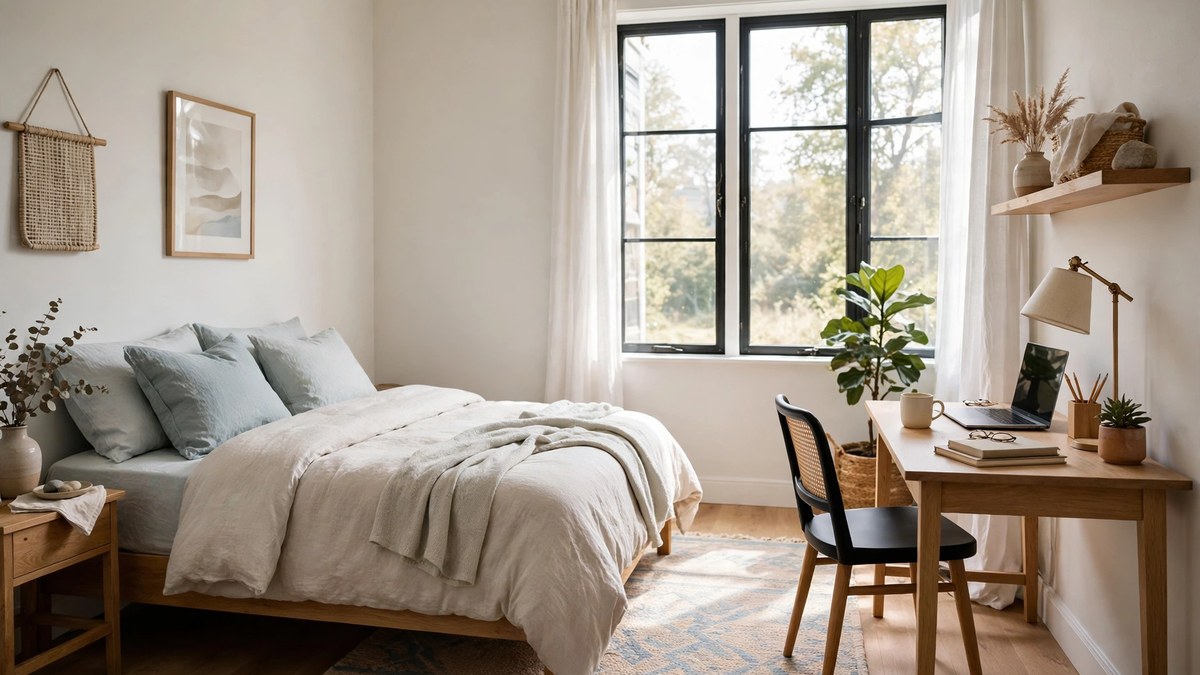
The best bedroom to office design ideas treat sleep as the room’s primary job and work as a well-mannered guest. That hierarchy drives the details. Choose a desk style that matches the bedroom furniture — a wooden writing desk or a slim console in the same finish as your nightstands disappears into the room in a way a black metal office desk never will.
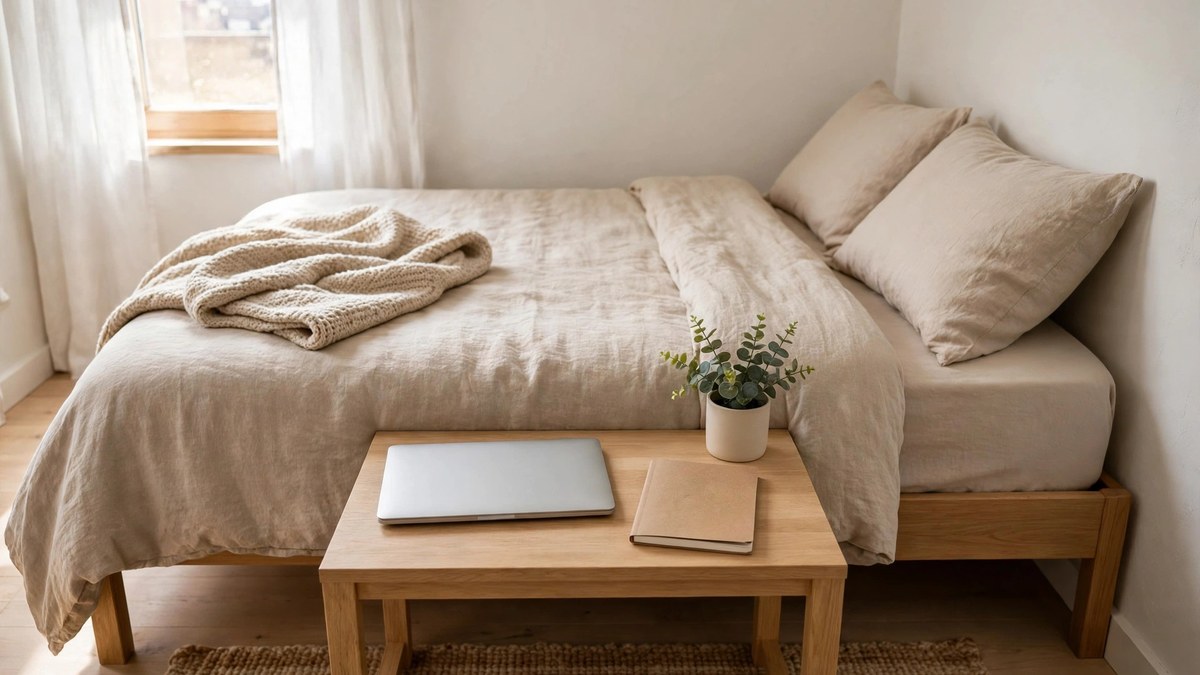
Hide the office at night. A desk with a closing lid, a laptop that sleeps in a drawer, or a simple linen cloth draped over the monitor all remove work from view. Cover or unplug glowing chargers and standby lights; that tiny red dot is a surprisingly effective sleep thief. If your printer lives in the bedroom, park it inside a wardrobe or under a fabric-covered box rather than on display.
Keep work paper out of the sleep zone entirely. Files, notebooks, and the day’s to-do list stay at the desk or in its drawers. The bed is for reading novels, not contracts. That one rule, held consistently, is what lets your brain treat the room as restful again the moment you cross the invisible line.
Desk Placement: Window, Wall, or Foot of the Bed?
Placement is the biggest decision in a bedroom office, and each option has honest trade-offs. Against the wall farthest from the bed is the safest default: it maximizes separation, keeps cables short, and leaves your sleep view free of screens. It is also the easiest arrangement to tidy.
A desk under or beside the window offers the best light and a view that rests your eyes, but face it perpendicular to the window rather than straight on, so daylight falls across the desk instead of glaring on the screen or silhouetting you on calls. Check that a radiator under the window will not cook your legs all winter.
The foot of the bed is the option to treat with caution. It can work in long rooms where a console desk doubles as a bench or media stand, but most people find that working literally at the foot of the bed blurs the boundary too much. If you try it, style the desk as bedroom furniture first — writing desk, pretty chair — and keep the laptop closed and stored elsewhere outside work hours. Our roundup of small bedroom ideas has more placement tricks for tight rooms specifically.
Furniture That Works Double Duty
In a two-job room, every piece should ideally earn its place twice. A writing desk with drawers doubles as a vanity or dressing table. A comfortable desk chair in an upholstered finish can serve as the bedroom’s occasional chair for reading. A storage ottoman at the foot of the bed hides files and doubles as seating.
The bed itself can help. A daybed or a neatly dressed bed with structured cushions reads as a sofa-like backdrop during the day in studio-style rooms. In a conventional bedroom, simpler is better: make the bed properly each morning. It takes three minutes, transforms the room’s whole feel, and — this is not a small thing — removes the temptation to work from it.
Scale matters more here than in a dedicated office. Choose a desk around 40 to 48 inches wide and no deeper than about 24 inches, a chair without bulky arms if the room is tight, and shelving that mounts to the wall rather than standing on the floor. The lighter the footprint, the more the room still feels like a bedroom that happens to host work, rather than an office that happens to contain a bed.
Storage That Puts Work Out of Sight at Night
The golden rule of bedroom office storage is: closed, not open. Open shelves of files and equipment keep your brain in work mode at bedtime. Prefer a desk with drawers or a door, a lidded basket for the day’s papers, a wardrobe section surrendered to work supplies, or a rolling cabinet that slides into the closet each evening.
A simple system works well. The laptop, notebook, and charger live in one drawer or one attractive box — your entire office, packed in under a minute. Reference books can stay on a shelf if they look like books rather than binders; swap office-y binders for matching storage boxes and the shelf reads as bedroom decor again.
Do not forget vertical space. One shelf above the desk, styled with a plant and a few books alongside your storage boxes, gives you capacity without visual noise. And keep one surface sacred: the nightstand holds a lamp, a book, and a glass of water — never a laptop, a stack of reports, or tomorrow’s meeting notes.
Colors, Light, and Decor That Suit Both Moods
A bedroom office needs a color scheme that can concentrate at 9 a.m. and unwind at 9 p.m. Soft, muted colors do this best: warm whites, gentle greiges, sage, dusty blue, and other low-saturation shades feel alert in daylight and restful in lamplight. Use your energizing accent — the color that wakes you up — in small, work-zone-only doses: the desk chair cushion, a desk lamp, a pinboard.
Lighting does the heavy lifting for mood switching. You need bright, focused task light at the desk and warm, dim light at the bed. A desk lamp on a cooler, daylight-style bulb serves work; bedside lamps with warm bulbs serve rest. If the room has one ceiling light, choose a warm bulb and let the desk lamp provide the crisp light, rather than the other way around.
Decor should tilt bedroom, not office. Art, plants, textiles, and a rug soften the workspace into the room, while motivational posters and whiteboards drag the office into your sleep. If you need a whiteboard, mount it inside a closet door or use a pretty framed pinboard that reads as decor when empty.
Scent and texture are underrated mood tools here. A linen spray, a candle lit only after shutdown, or simply opening the window for five minutes between work and rest gives the room a small sensory reset. On the texture side, keep the work zone’s materials warm — a wooden desk, a woven basket, a fabric-covered pinboard — so nothing in the room feels like it belongs in a cubicle farm.
Living Room Office Ideas When the Bedroom Is Off-Limits
Some people simply cannot sleep in the room where they worked all day — and they are not wrong. If your bedroom office experiment fails, the living room is the usual refuge, and these living room office ideas make it work without turning the sofa into a cubicle farm.
Claim one corner, ideally the one farthest from the television, and define it with a rug and a desk that suits the room’s style — a writing desk or console rather than office furniture. A bookcase placed at right angles to the wall creates a pocket of privacy and doubles as your video-call backdrop. Storage must be closed or beautiful, because it is on display full-time: baskets, a cabinet, or a desk with doors.
The living room office lives or dies on the shutdown ritual. At the end of the day the laptop closes, papers go into their box, and the chair tucks in. If your setup includes a monitor, consider a slim one on an arm that can swing flat to the wall, or style the desk as a console with a plant and a lamp so the room reverts to a living room in minutes. Our collection of office decor ideas shows how to style a work corner so it flatters the room around it.
Small Bedroom Offices in Apartments and Spare Rooms
In a small bedroom, think like a sailor: everything has a fitted place. The strongest small-space move is the closet desk — remove the doors or not, fit a worktop at desk height, add one shelf above and a clamp lamp, and close the whole office away at night. A reach-in closet is typically deep enough for exactly this.
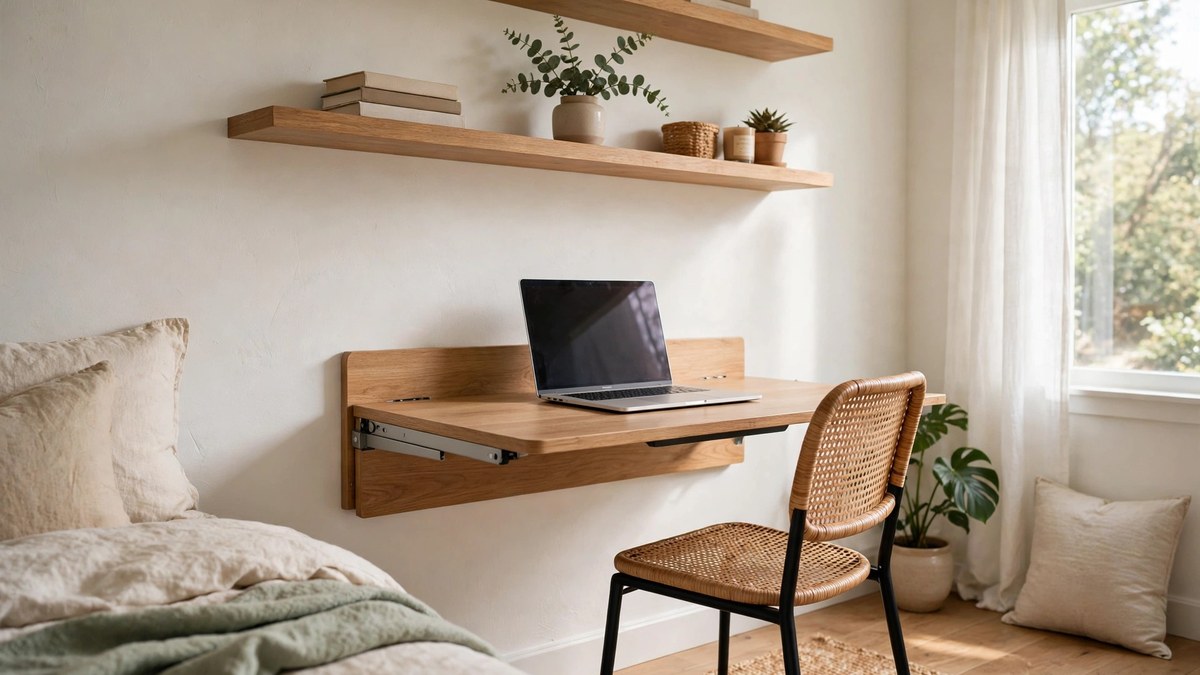
No closet to spare? A wall-mounted drop-leaf desk folds flat after hours, and a ladder desk stacks storage above a narrow worktop. Corners beside the bed, the wall facing the bed’s foot, and even a wide windowsill-depth shelf under the window can all host a compact setup. Measure honestly and beware the chair: a slim chair that tucks fully under the desk is what makes these micro-offices livable, because a chair permanently adrift in a small bedroom will annoy you every single night.
Renters, take heart: nearly all of this is achievable without screws. Tension rods, clamp lamps, leaning shelves, and over-door storage build a complete office that leaves with you, deposit intact.
One more small-room trick deserves a mention: use the wall above the bed’s headboard zone for nothing at all. It is tempting to mount shelves wherever wall space exists, but keeping the sleep zone visually empty while the work wall carries the shelves, boards, and gear strengthens the boundary your brain relies on. Empty wall is a design choice, and in the sleep zone it is the right one.
Sound, Privacy, and Sharing the Room
If you share the bedroom, your office has a second user to consider — one who is trying to sleep, dress, or simply not feel like a guest in a call center. Sound is the main battleground. Keyboards and notification pings carry in a quiet bedroom, so choose a quiet keyboard, silence non-essential alerts, and take calls on a headset with a decent microphone rather than on speaker.
Privacy runs both ways. A partner should not wander through your video background in a bathrobe, and you should not hold a salary negotiation at full volume beside their pillow. Agree on simple signals: a closed door or a small sign on it means a call is live; headphones on means do not interrupt unless it matters. If your hours regularly clash — shift work, international calls — be honest early: the living room or a closet office may be the kinder long-term answer.
Temperature and light spill matter too. A desk lamp with a shade aimed down gives you working light without flooding the bed, and blackout curtains can dim your side less than your partner’s if the layout is planned with care. These small courtesies are not decoration; they are what makes the arrangement sustainable for two people instead of a slow-motion argument.
The Two-Minute Shutdown Ritual
The single most valuable habit in a bedroom office costs nothing. When work ends, spend two minutes shutting the room down: close the laptop and store it, clear the desk to a bare surface, put papers in their box, switch off the desk lamp, and switch on the bedside lamp instead. That small ceremony is your commute — the signal that the office is closed and the bedroom is open.
Reinforce it with light and scent if you like: work under the bright lamp, rest under the warm one; light a candle or change into home clothes at shutdown. It sounds almost too simple, but people who work where they sleep consistently say the ritual, not the furniture, is what protects their evenings. Keep it short enough that you never skip it.
Common Mistakes to Avoid
The classic mistake is the visible office at bedtime: monitor glowing, papers spread, tomorrow’s stress sitting in plain view of the pillow. If you fix nothing else, fix that. Second is working from the bed itself, which blurs the boundary fastest of all and is rough on your back besides.
Third is office furniture that clashes violently with the bedroom — a corporate desk and a mesh task chair will always look like an invader, no matter how tidy. Choose pieces in the room’s materials and colors instead. Fourth is forgetting sound: bedroom doors are thin, so if you take calls while a partner sleeps, a headset and a door draft seal are kinder than hoping for the best.
Finally, do not let the office annex the room over time. The printer creeps to the dresser, files colonize the nightstand, and the bedroom quietly becomes an office with a bed in it. Defend the zones monthly with a five-minute reset.
Frequently Asked Questions
Is it bad to have an office in your bedroom?
It is not ideal for everyone, but it can work well if you create real separation: a defined work zone, closed storage, and a shutdown ritual that clears work from sight at night. If you find your sleep or your focus suffering after a fair trial, move the desk to the living room or a closet instead — the arrangement should serve you, not the other way around.
Where is the best place for a desk in a bedroom?
Against the wall farthest from the bed, or perpendicular to a window if you want natural light without glare. Both keep the bed out of your working eyeline and the desk out of your sleeping view. Avoid facing the desk directly at the bed or placing it at the foot of the bed if you can.
How do I hide my home office in the bedroom at night?
Use closed storage — a desk with doors or drawers, a lidded box for papers, or a rolling cabinet that goes into the closet. Close or cover the laptop, unplug glowing chargers, and switch from the bright desk lamp to warm bedside lighting. A curtain or screen across the work corner is the deluxe version of the same idea.
What desk works best in a bedroom office?
A writing desk or slim console around 40 to 48 inches wide and about 24 inches deep, in a finish that matches your bedroom furniture. Desks with drawers beat open trestle styles here because they swallow the clutter. In very small rooms, a wall-mounted drop-leaf desk or a closet desk is even better.
How can I make a bedroom office feel cozy, not corporate?
Choose residential materials — wood, upholstery, woven baskets — over metal and mesh, keep the color palette soft and continuous with the rest of the room, and style the desk with a plant, a pretty lamp, and one personal object. Make the bed every morning; a dressed bed instantly makes the room feel like a bedroom first.
Can a bedroom office work for video calls?
Yes, with a little planning. Sit so the bed is not behind you — a wall, bookshelf, or curtain makes the most professional backdrop. If the bed must be in frame, keep it neatly made with plain bedding. Light your face with a lamp behind the screen, and use a headset for clear sound.
What if my bedroom is too small for a desk?
Try a closet desk, a drop-leaf wall desk, or a narrow shelf-style worktop under the window. A laptop tray table is a last resort for occasional work, but for daily use, a fixed small surface plus a chair that tucks away will serve your posture and your sanity far better.
Conclusion
A bedroom office succeeds when the room keeps both of its promises: focused work by day, real rest by night. Zone the space, place the desk with separation in mind, choose furniture that belongs in a bedroom, hide the work away in closed storage, and end every day with a two-minute shutdown. Do those things, and one hardworking room can honestly do both jobs — no spare room required.
