
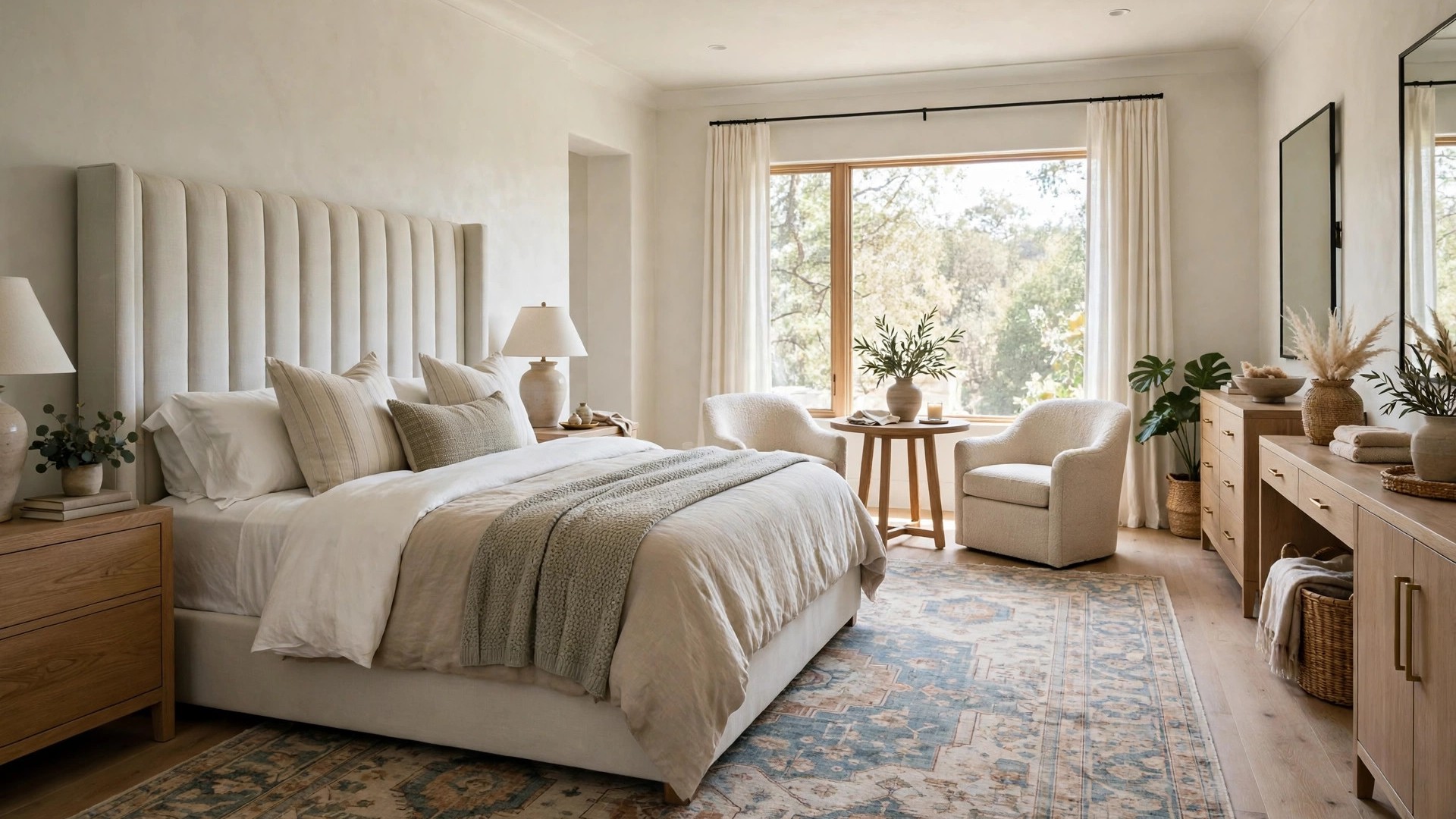

A big bedroom sounds like a luxury problem, but anyone who has lived with one knows the reality: furniture huddled in one corner, echoes, a bed that looks lost, and a room that somehow feels less cozy than the small one you left. These large bedroom ideas treat square footage as raw material. The strategy is zoning — dividing the room into sleep, sitting, dressing, and work areas, each with its own rug, lighting, and reason to exist. Done well, a large bedroom stops feeling like a warehouse with a bed in it and starts feeling like a private suite.
The counterintuitive rule: a big room needs more furniture, bigger furniture, and darker, warmer color than a small one — but arranged in islands, not lined up around the walls. Push everything to the perimeter and you get a ballroom; group it into zones and you get a retreat.
Why Large Bedrooms Can Feel Cold (and How to Fix It)
Large rooms feel cold for physical reasons: sound bounces off hard, distant surfaces; sightlines run unbroken to far walls; and standard furniture, scaled for average rooms, looks undersized and temporary. Warmth is mostly a function of breaking those long lines and distances.
The fixes work together. Textiles absorb sound and signal softness — a big rug, upholstered pieces, layered curtains. Mid-height elements (a bench, a bookcase, a chaise) interrupt the eye’s path across the room. Warm color on at least one major surface stops the gallery-white chill that plagues big, bright rooms.
Scale is the master variable. In a room of 300-plus square feet, a queen bed with small nightstands will always look adrift. A king bed, generous nightstands of 28 to 30 inches wide, and a real dresser restore proportion. Think of it as dressing the room in its correct size.
Zone the Room: Sleep, Sit, Dress, Work
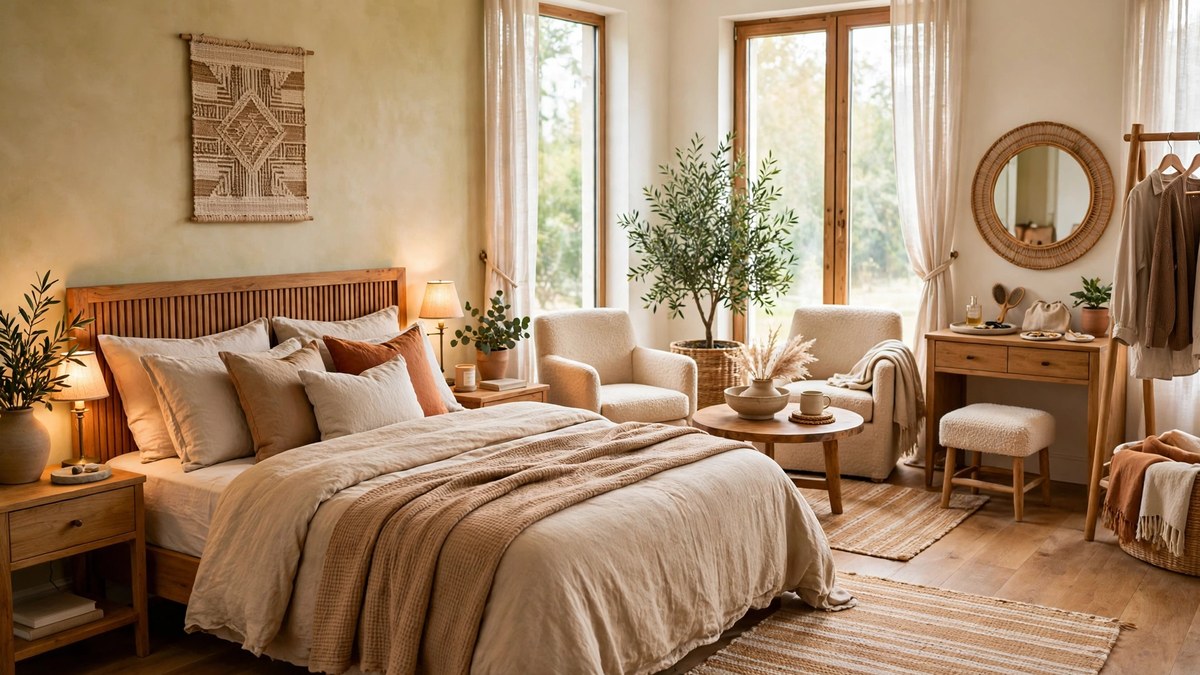
Zoning is the whole game. Before buying anything, assign the room four jobs and draw their territories: the sleep zone around the bed, a sitting zone near the window or fireplace, a dressing zone near the closet, and — if needed — a work corner as far from the bed as the walls allow.
Each zone gets three things: a defined floor boundary (usually a rug), its own lighting, and furniture scaled to the job. The boundaries can be soft — zones should flow into each other — but each area should be legible at a glance: you can point and say what happens there.
Keep traffic paths between zones at least about 30 to 36 inches wide so the room feels gracious rather than obstacle-filled. Our modern bedroom ideas guide shows several zoned layouts in contemporary styles if you want visual formulas to copy.
Bedroom and Sitting Area Ideas That Anchor the Space
A sitting area is the zone that most changes how a large bedroom feels, because it gives the room a second center of gravity. It turns square footage from “extra” into “ours” — the place for morning coffee, evening reading, and conversations that are better in armchairs than in bed.
The classic arrangement: two comfortable chairs and a small round table, angled toward each other or toward a window or fireplace. A loveseat works if the wall run is long and narrow. Add a floor lamp or a pair of sconces, a small rug (5×8 feet is usually right for a two-chair setup), and a throw over one chair, and the zone is complete.
Placement rules: near natural light if the room has it, not blocking the path to the bathroom or closet, and turned slightly away from the bed so it feels like a destination rather than an audience. A low bookcase or console behind a loveseat can double as the zone divider and as storage for the books that inevitably migrate there.
If your sitting area must double as a workspace, choose a desk with a finished back (it will be seen from the bed), a chair you would happily sit in as furniture, and closed storage so paperwork disappears at night.
Furniture Scale: Bigger Room, Bigger Pieces
Scale mistakes are the top reason large bedrooms disappoint. Standard furniture proportions evolved around average rooms; in a big room those pieces read as temporary. The fix is not more small things — it is correctly sized things.
Start with the bed: king or California king if the room is over roughly 14 feet wide, with a headboard that has presence — tall, wide, upholstered, or paneled. Nightstands should be wide enough to hold a lamp, a book stack, and a carafe without crowding; 28 inches wide is a good minimum here, versus 20 inches in a small room.
Then the supporting cast at scale: a long dresser rather than a tall narrow one, a bench or pair of ottomans at the bed’s foot that span most of its width, and a full-size rug — 9×12 feet under a king, extending well beyond the sides — rather than two apologetic runners. One oversized piece (an armoire, a statement mirror, a chaise) per zone is the right rhythm.
Rugs That Define Each Zone
In a large bedroom, rugs are floor plans. Each zone should sit on its own rug, with the rug sized so the zone’s main furniture rests fully or mostly on it. A rug that is too small reads as a bath mat and actually shrinks the zone visually.
Under the bed, the rug should extend at least 24 to 30 inches beyond both sides and the foot of a king bed; for most large rooms that means a 9×12 or larger. In the sitting zone, all chair legs (or at least the front legs) should sit on the rug. In a dressing zone, a runner or a 4×6 rug in front of the dresser or closet doors softens the morning routine.
Coordinate rather than match: rugs in the same color family with different patterns or textures look collected and intentional. Keep one element consistent — palette, material, or pile style — across all zones so the room reads as one suite rather than three apartments.
Budget reality: large rugs are the budget shock of large bedrooms, because prices climb steeply past 8×10. Two hedges that work: choose durable flatweave or low-pile wool-look rugs for the biggest footprints and reserve plush pile for the small sitting rug where feet actually linger; or layer — a large, inexpensive natural-fiber rug (jute or sisal) as the base with a smaller patterned rug on top in the sitting zone or at the bed’s foot. The layered look is a designer staple anyway, and it converts one unaffordable rug into two affordable ones without a visible compromise.
A Statement Bed and Headboard Wall
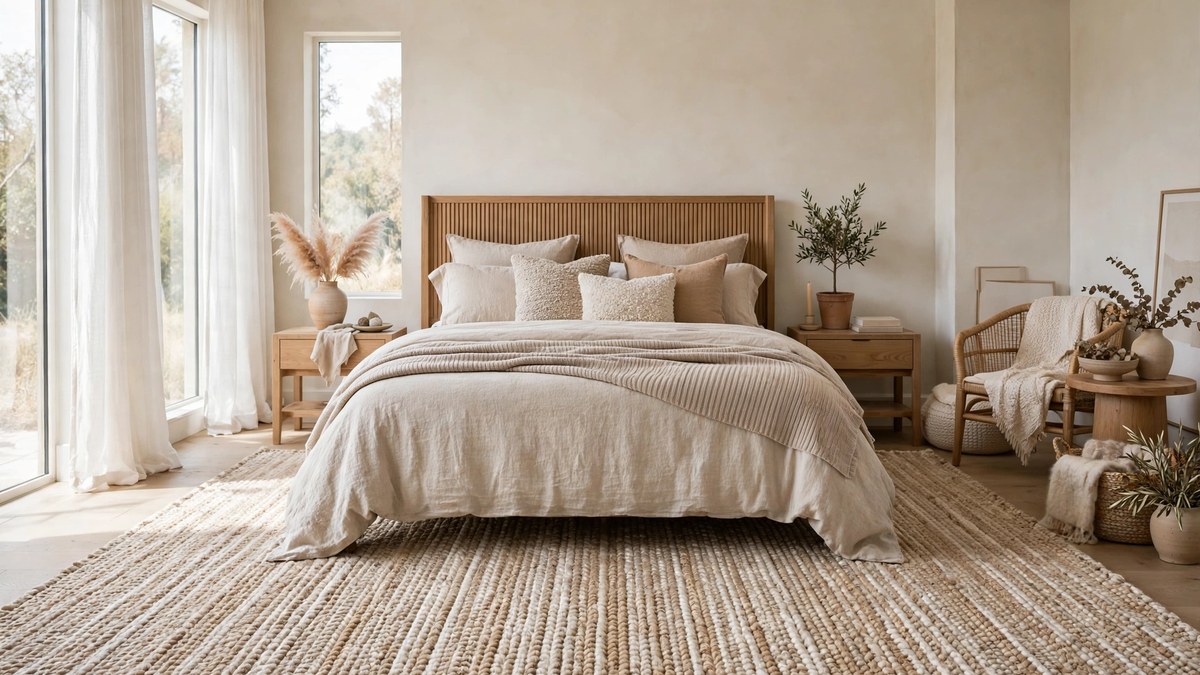
The bed remains the room’s headline, and in a large room it must be scaled and styled like one. A tall upholstered headboard (48 to 60 inches) holds its own against high ceilings and long walls; a low platform frame tends to disappear. Extend the composition wider than the bed itself with art, panels, or sconces so the whole wall participates.
Wall treatments that work at this scale: picture-frame molding painted to match, a limewash or deep-hued paint across the full headboard wall, wood paneling, or an oversized mural wallpaper. In large rooms you can use the deep colors and big patterns that small rooms cannot carry — this is their natural habitat.
Balance the bed wall with the wall opposite: the view from the pillows deserves intention — a fireplace, a large mirror, a gallery, or the sitting area composition. Large rooms are seen from many angles; design the sightlines from bed, door, and sitting chairs, and the room will feel finished from everywhere.
Fill the Walls: Art, Panels, and Built-Ins
Long walls are assets in a large bedroom — you finally have room for the oversized art that looks cramped elsewhere. One large piece (48 inches wide and up) over the dresser, a run of built-in bookcases along one wall, or a gallery that is allowed to spread out: big rooms want big gestures, evenly distributed.
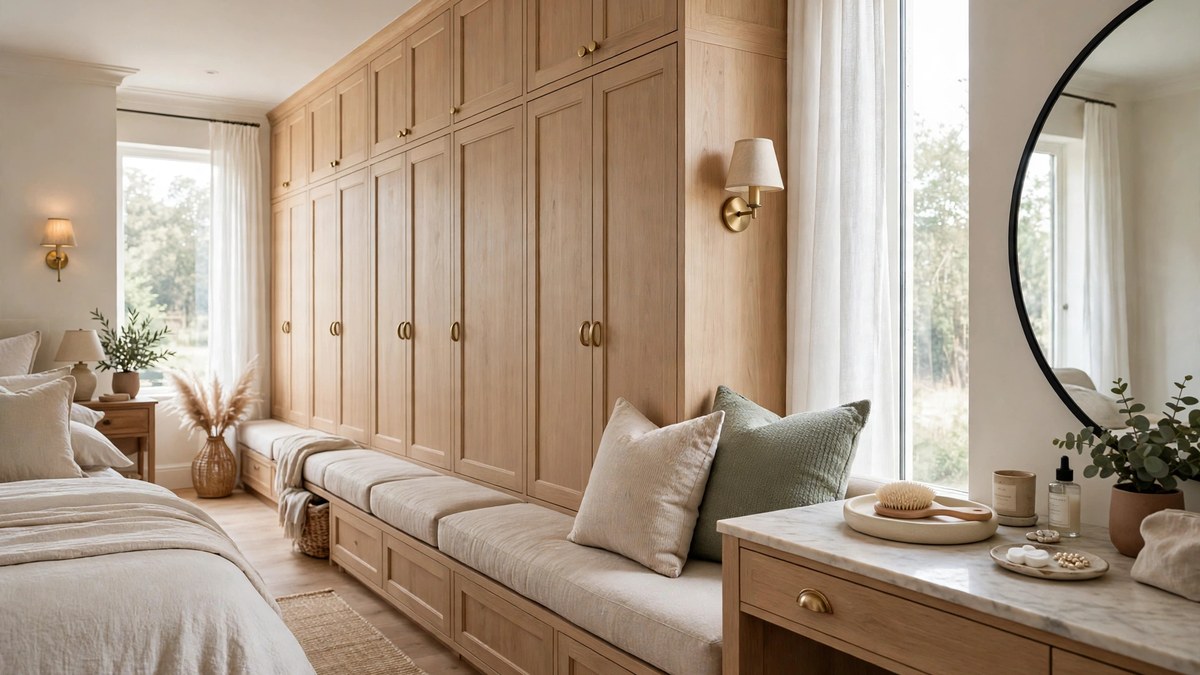
Built-ins earn special mention. A wall of shelves and cabinets around a window, with a window seat tucked between, converts the room’s least useful stretch into its most charming. If built-ins are not in the budget, tall bookcases (72 inches or more) with a unifying paint color give a similar architectural effect.
Distribute wall interest around the room rather than concentrating it behind the bed. Stand at the door, then at each zone, and check for a blank expanse that looks forgotten. One considered piece per wall is usually enough; the eye should always have somewhere pleasant to land.
Lighting in Layers for a Big Footprint
A single ceiling fixture cannot serve a large bedroom — it leaves the corners dark and the room feeling like a lobby. Plan lighting per zone: bedside lamps or pendants for reading, a floor lamp and table lamp in the sitting area, a lit mirror or sconces in the dressing zone, and ambient ceiling light tying it together.
Put each zone on its own switch or dimmer. The ability to light only the sitting corner in the evening, with the sleep zone in shadow, is what makes a big room feel intimate instead of exposed. Warm bulbs (around 2700K) throughout keep the large volume feeling close rather than commercial.
Scale fixtures up as you did furniture: a chandelier or pendant over a king bed or sitting area should be generously sized — roughly a third to half the width of what it hangs over is a useful visual rule — and hung where heads will not meet it, generally at least 7 feet above the floor in traffic paths.
Do not neglect the dressing zone’s light, the one most large suites get wrong: a mirror lit only from a ceiling fixture guarantees unflattering shadows. Sconces at face height on both sides of the mirror, or an LED mirror with a warm setting, make the zone function like the boutique dressing room the square footage promised. And give the room one low, warm evening circuit — sitting lamp plus bedside lamps only — so that after dark the big room contracts into an intimate one at the flick of two switches.
Color and Texture to Warm Things Up
Large bedrooms can carry the colors small rooms cannot: deep green, aubergine, navy, charcoal, and warm clay all look rich rather than heavy when there is daylight and distance to balance them. If you prefer light walls, warm the whites toward cream and add depth with saturated textiles instead.
The inverse lesson from small rooms is useful: the tricks in our small bedroom ideas guide — light colors, mirrors, minimal contrast — are exactly what to avoid here. Contrast and depth are your friends; they make distance feel designed.
Texture does the warming that color starts: a nubby wool rug, velvet chairs, a linen duvet, wood with visible grain, a stone or plaster fireplace surround if you have one. Aim for at least three distinct textures per zone. And do not forget the ceiling — a soft tint or beams in a large room removes the last echo of the empty-box feeling.
Plants and Greenery at a Bigger Scale
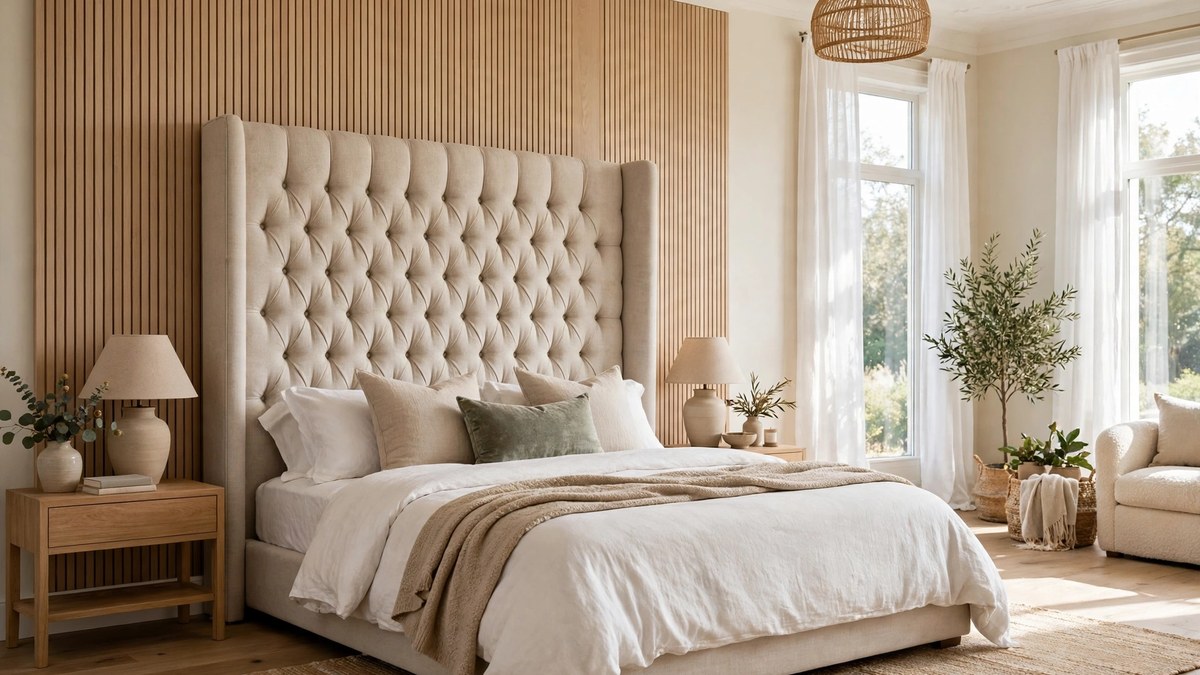
Most bedrooms can host a plant or two on a nightstand. A large bedroom can do something better: plants at architectural scale. Greenery is one of the few decor elements that grows more convincing as it gets bigger, and a room with distance and daylight is exactly where a tall specimen tree stops looking like a houseplant and starts reading as part of the architecture.
Think in three sizes. One tall anchor — typically 5 to 6 feet, such as a fiddle-leaf fig, an olive tree, or a mature dracaena — claims a corner or flanks the sitting area and gives the eye a living focal point. A few medium plants fill the middle register on the dresser or beside the chairs. Small trailing plants belong up high, softening the top edge of a bookcase or wardrobe where nothing else reaches.
Placement follows the zoning you have already built. Put the tall plant where it is seen from the bed and from the door, but clear of traffic paths and at least a few inches from walls and curtains, since leaves pressed against surfaces mark both. Keep sun-lovers near the window wall; the room’s far corners usually get far less light than they appear to, so reserve those for tolerant species like snake plants, ZZ plants, or pothos.
Treat the planter as furniture, because at this scale it is: a woven basket, a simple ceramic pot on a stand, or a metal planter wide enough to look stable under a tall plant. Add a deep saucer or a discreet waterproof liner under every floor plant — a slow leak onto a large rug or hardwood is the one genuinely expensive mistake in this section.
Match ambition to your actual watering habits. One or two large, forgiving plants on a weekly rhythm will look better in a year than a collection you resent by February. If a corner is too dark for anything real, one high-quality faux plant there is a reasonable trade; just keep it dusted, because dusty leaves are the tell.
Storage Walls and Dressing Areas
A large bedroom finally allows the dressing area most people dream about: a dedicated zone with a dresser, a full-length mirror, a small ottoman or chair for dressing, and good light. Place it on the route between bed and bathroom/closet so the morning flow feels natural, not zigzagged.
If the room lacks a walk-in closet, a storage wall — a run of wardrobes or cabinets along one wall, painted to match the walls — gives the capacity without visual noise. Keep the run symmetrical and take it close to ceiling height; stopping short leaves a dust-catching gap that also looks unfinished.
Inside the zone, closed storage wins again. Open shelving for a curated stack of sweaters and a few beautiful boxes is fine; the everyday machinery of two wardrobes belongs behind doors. Finish with a hook rail or valet stand for tomorrow’s outfit — in a big room, the chair-drobe temptation is strong, so give clothes a sanctioned landing spot.
If the suite includes a television, the storage wall can absorb that too — a cabinet that closes over the screen returns the room to bedroom mode on demand, and media consoles built into the wardrobe run keep cables and boxes out of sight. In large bedrooms the difference between “hotel suite” and “room with stuff in it” is almost always whether the functional machinery has doors. Budget for doors — on wardrobes, on the media cabinet, on the desk’s paper tray — and the calm takes care of itself.
Mistakes That Make Large Bedrooms Feel Empty
The perimeter habit is the biggest: every piece pushed against the walls, a prairie of carpet in the middle. Pull furniture in, onto rugs, into zones. The second mistake is under-scaling: a small rug, small art, and small lamps in a big room look like a dollhouse lost in a hall.
Third, lighting only the center. Fourth, leaving the far wall blank because the bed wall got all the attention. Fifth, matching-set furniture at small scale times six pieces — a full suite of petite furniture makes the emptiness more obvious, not less.
Finally, forgetting softness: no curtains (or skimpy ones), no upholstery, bare floors. Large hard rooms echo, and echo reads as cold no matter how warm the paint. If the room feels empty, add fabric before you add furniture — it is usually the missing layer.
A Worked Example: Laying Out a 16×20-Foot Bedroom
To make zoning concrete, here is one reliable layout for a rectangular room of about 16 by 20 feet (roughly 320 square feet) with the door on a short wall and windows on the opposite short wall — a common primary-suite shape. Adapt the proportions, not the logic, to your own room.
The bed wall: center the king bed on the long wall opposite the entry sightline if possible, or on the window wall’s perpendicular — in this example, the headboard sits centered on the 20-foot wall, flanked by 30-inch nightstands and sconces. A 10×14 rug runs under the bed, extending about 30 inches on each side and beyond the foot bench. Headboard wall gets molding panels painted to match, giving the sleep zone its architecture.
The sitting zone takes the window end: two armchairs angled toward each other across a 30-inch round table, on a 5×8 rug, with a floor lamp behind one chair. The dressing zone takes the wall nearest the closet and bathroom door: a 72-inch dresser, a full-length mirror, and an upholstered ottoman, with a 4×6 rug underfoot and a sconce-lit mirror doing morning duty.
Traffic flows in a gentle loop: door to bed, bed to dressing, dressing to bath, with no path narrower than about 32 inches. Nothing in the room is against a wall except the dresser, bookcase, and nightstands — the chairs and bench float, which is precisely what makes 320 square feet feel like a suite rather than a very large bedroom.
Frequently Asked Questions
How do I make a large bedroom feel cozy?
Zone it into sleep, sitting, and dressing areas, each anchored by its own rug and lighting. Use larger-scale furniture, warm or deep color on at least one surface, and plenty of textiles — curtains, upholstery, layered bedding — to soften sound and sightlines.
What size rug goes under a king bed in a large bedroom?
A 9×12-foot rug is the standard starting point, extending at least 24 to 30 inches beyond the sides and foot of the bed. In very large rooms, a 10×14 gives the bed zone a truly grounded footprint. Runners alone usually look undersized at this scale.
How many zones should a large bedroom have?
Three is typical: sleep, sitting, and dressing. A fourth work zone is common now, placed as far from the bed as possible. More than four usually fragments the room; each zone needs enough space, furniture, and light to feel real rather than suggested.
Can I use dark colors in a large bedroom?
Yes — large rooms are the best place for deep colors, because daylight and distance keep them rich rather than heavy. Use them on the headboard wall or throughout if the room is bright, and balance with warm metals, pale bedding, and layered lighting.
What do I do with the awkward empty corner?
Give it a job: a reading chair with a lamp and side table, a plant grouping on stands of varied heights, a dresser with a mirror, or a small desk. An empty corner with a purpose reads as a feature; an empty corner without one reads as leftover space.
Should furniture go against the walls in a big bedroom?
Some should (dressers, wardrobes, bookcases), but the sitting area and even the bed rug should float into the room so zones form. Keep traffic paths around 30 to 36 inches wide. A room where everything hugs the walls almost always feels emptier than it is.
How do I light a large bedroom properly?
Layer it by zone: bedside reading light, sitting-area lamps, dressing light at the mirror, plus ambient ceiling light — each on its own switch or dimmer. Warm bulbs around 2700K and fixtures scaled up to the room keep a big footprint feeling intimate.
Final Thoughts
A large bedroom is not a problem to fill; it is a suite waiting to be zoned. Give each part of the room a job, scale the furniture to the footprint, anchor every zone with a rug and its own light, and warm the whole with color and texture.
Start with the sitting area — it is the zone that changes the room’s character most. Once there are two places to be in the bedroom, it stops being a big room with a bed and starts being the best room in the house. And when the bed itself needs the full treatment, our bedroom bedding ideas guide covers the layers that finish the main zone.
