
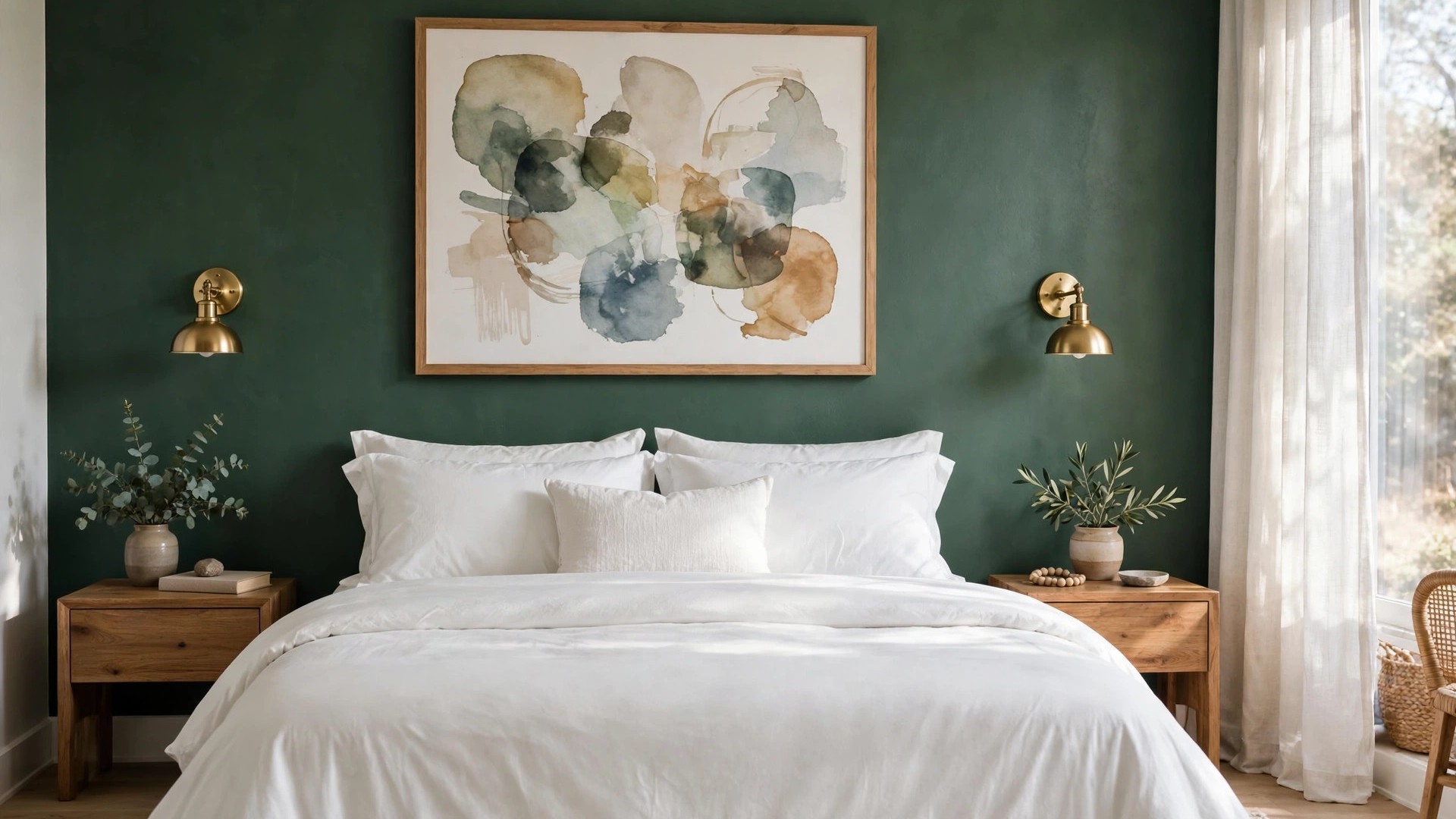

Bedroom walls take up more visual space than everything else in the room combined, yet they are often the last thing anyone plans. A bed gets bought, nightstands get styled, and four blank walls just… stay blank. These bedroom wall ideas fix that, whether your budget is a gallon of paint or a full paneling project. You will find paint techniques, gallery arrangements, wallpaper, wood treatments, and renter-friendly tricks, plus the measurements and proportions that make each one look professional instead of improvised.
The guiding principle is simple: a bedroom needs one wall that leads. Usually that is the wall behind the bed. Give that wall a clear treatment — color, texture, art, or structure — and support it with quieter walls, and the entire room suddenly looks designed.
Start With the Wall Behind the Bed
The headboard wall is the room’s natural headline. You see it when you walk in, and everything else is arranged in front of it. Whatever treatment you choose, this wall should carry the strongest version of it: the deepest color, the boldest pattern, or the largest art.
There are three reliable ways to anchor this wall. First, color: paint it two to three shades deeper than the other walls in the same family, and it recedes into a cozy backdrop. Second, structure: paneling, slats, or wainscoting add shadow lines that read as architecture. Third, composition: one large piece of art or a planned gallery above the headboard.
Whichever route you take, mind the proportions. Art above a bed should span roughly two-thirds the width of the bed — for a queen (about 60 inches wide), think a piece or arrangement around 40 to 45 inches wide, hung so its center sits about 55 to 60 inches from the floor or 6 to 8 inches above the headboard.
Renters and the commitment-shy can get the same anchored effect without touching the wall finish at all: an oversized leaning artwork or mirror on the floor behind a low headboard, a wide tapestry hung from a slim rod, or a pair of tall plants flanking the bed to frame it. The eye only needs a clear “this is the center” signal; paint is merely the most common way to send it. And if your bed sits under a window — a common awkward layout — treat the window itself as the headboard wall: full-width curtains hung wall to wall turn the problem into the room’s softest feature.
Paint Techniques: Color Blocking, Limewash, and Two-Tone Walls
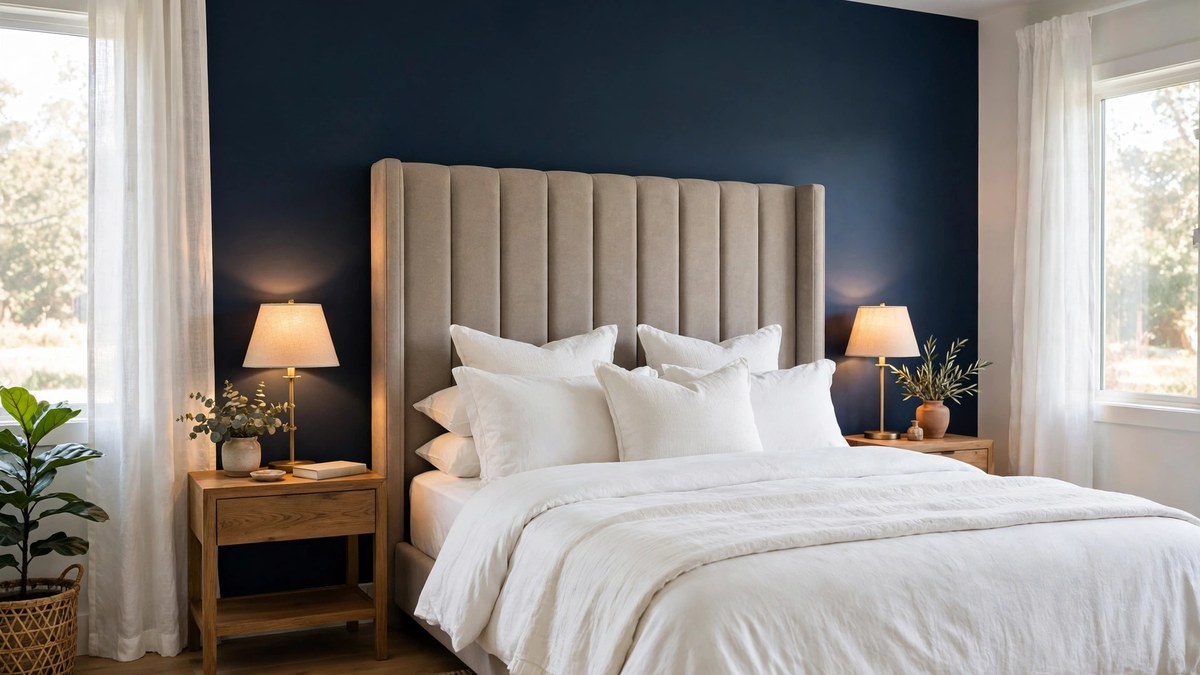
Paint is the fastest wall transformation there is, and modern techniques go well beyond a single flat color. Color blocking — painting a rectangle, arch, or half-wall shape behind the bed — creates the effect of a giant headboard for the price of a quart. Tape your shape, keep the edges crisp, and choose a shade with enough contrast to read as intentional.
Limewash and other textured, cloud-effect paints have surged in popularity because they add movement without pattern. The mottled finish hides imperfect walls and looks expensive in soft neutrals and clay tones. Application is forgiving — you work in loose X strokes with a block brush — which makes it a friendly weekend project.
Two-tone walls, split horizontally with the darker shade below, ground a room and make ceilings feel taller when the upper section is pale. If you like this route, our guide to two colour combinations for bedroom walls walks through the pairings that work best, from sage-and-cream to charcoal-and-blush.
Choosing the Right Paint Color for Your Walls
Before any technique, the color itself has to be right — and bedrooms have specific demands. You see the color first thing in the morning and last at night, often in warm artificial light, so a shade that looked fresh in the store can turn muddy by your bedside lamp.
North-facing rooms receive cool, bluish light and tend to make colors look grayer; warm-toned paints compensate. South-facing rooms get golden light that intensifies warm colors, so you can often go a shade cooler or more muted than planned. East and west rooms change character across the day, which argues for testing.
Always paint a large swatch — at least two feet square — on two different walls, and live with it for a full day. Our collection of bedroom paint ideas covers the most reliable color families if you need a starting shortlist, and the golden rule holds everywhere: when between two shades, the slightly grayer, dustier one usually wins in a bedroom.
Accent Walls That Earn the Name
An accent wall fails when it is arbitrary — a random bright wall with no relationship to the room. It succeeds when it answers a question: it highlights the bed, frames a reading chair, or balances a window wall. Before painting, ask what the accent is for. If you cannot answer, the accent is decoration without a job.
The strongest accent walls use texture or depth, not just hue. A wall painted in a flat, saturated color can look one-dimensional; the same color with panel molding, a limewash finish, or grasscloth wallpaper gains shadow and richness. Depth is what separates a designer accent wall from a dorm-room paint job.
Placement matters too. In most bedrooms, the accent belongs on the headboard wall — the wall without doors or windows interrupting it. Accenting a wall with a door or a small off-center window usually emphasizes the room’s awkwardness instead of its assets.
A useful test before committing: photograph your bedroom from the doorway, then digitally darken or color the candidate wall in any free photo editor. Crude as it is, the mock-up reveals instantly whether the accent organizes the room or merely shouts. If you rent or hesitate, create the accent with the largest removable layer instead — a full-width curtain wall, an oversized tapestry, or a grid of framed prints dense enough to read as one treatment. Removable accents fail softer: worst case, they come down in an hour.
Master Bedroom Wall Decor Ideas for a Polished Look
In a primary bedroom, walls should feel finished rather than busy. The polished look comes from scale and restraint: fewer, larger pieces; consistent frames; and hardware and finishes that repeat the room’s metals. Think of the walls as part of one composition, not four separate canvases.
Start with the headboard wall: one oversized artwork, a pair of matching prints, or a shallow picture ledge with layered frames. Then give the opposite wall — the one you see from the bed — something calm to look at: a mirror that catches morning light, a low-contrast textile hanging, or a simple grid of black-and-white photos in identical frames.
Leave one wall nearly empty if you can. Negative space is what makes the decorated walls read as deliberate. In a master suite, a quiet wall beside a door or along a traffic path keeps the room restful, which is ultimately the point of the space. If you are choosing a color scheme to support the decor, the palettes in our bedroom color ideas guide pair well with these arrangements.
Gallery Walls and Framed Art Arrangements
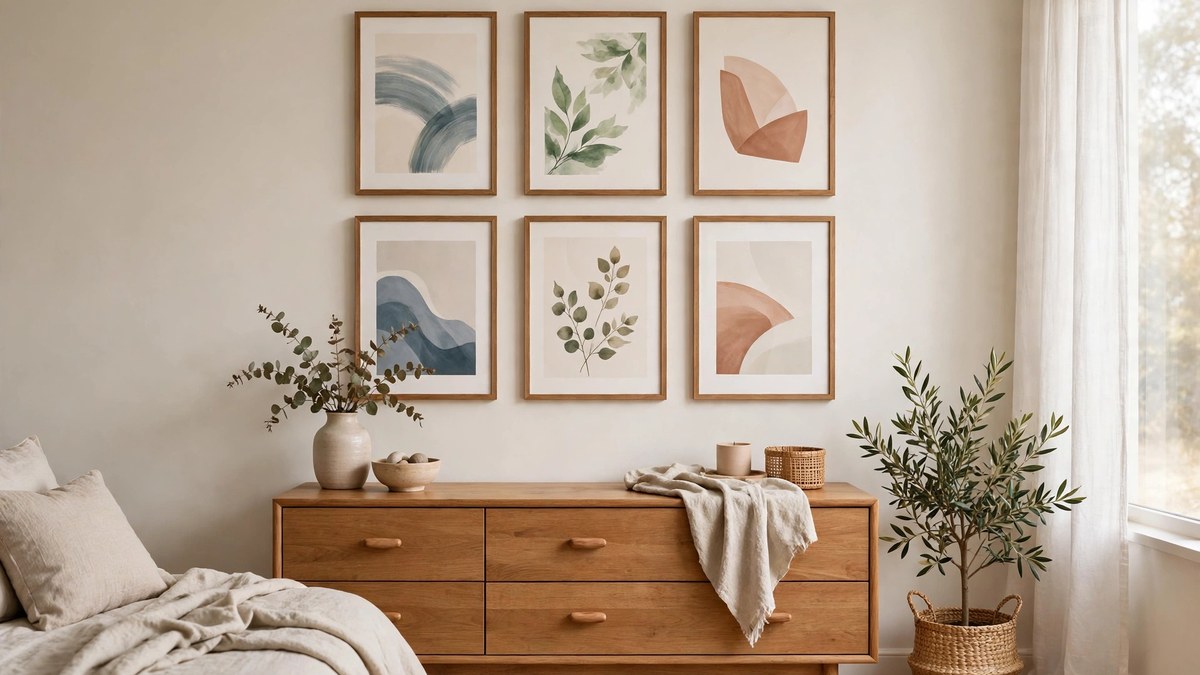
Gallery walls suit bedrooms best when they are calmer than their living-room cousins. The winning formula is a tight palette (black, white, and one metal, say), consistent spacing of about 2 to 3 inches between frames, and art with a shared mood — landscapes, abstracts, or photography in similar tones.
Plan on paper first. Trace each frame on painter’s tape or kraft paper, tape the arrangement to the wall, and live with it for a day before drilling. Arrange the largest piece first, slightly off-center, then fill around it, keeping the group’s outer edges roughly rectangular. The whole arrangement should center around 57 to 60 inches from the floor — standard eye level.
For above-bed galleries, keep the total arrangement to about two-thirds the bed’s width and leave breathing room above the headboard. Alternatively, a single long picture ledge above the bed gives the layered gallery effect with one installation — and lets you swap pieces whenever the mood changes, no new holes required.
Sourcing art on a budget is easier than the gallery look suggests. Large-scale prints from public-domain museum collections can be downloaded legally for free and printed locally; a single big print in a real frame beats six small unframed ones. Textile pieces — a woven hanging, a framed scarf, a vintage quilt section — add the softness bedrooms want and cost little secondhand. Mix one personal photograph into any arrangement and the wall stops looking like a catalog page: the formula is cohesion of palette and frame, not uniformity of content.
Wallpaper and Murals: Pattern Without the Paint Commitment
Wallpaper has outgrown its fussy reputation. Wallpaper today includes grasscloth textures, large-scale botanical prints, subtle geometrics, and full-wall photographic murals, in both traditional paste and peel-and-stick forms. In a bedroom, it shines on the headboard wall, where pattern reads as a backdrop rather than an assault.
Scale is the decision that matters. Small rooms handle small patterns and big rooms handle large ones — but the reverse is a stylish trick: a large-scale mural in a small bedroom can read as one immersive artwork rather than busy repetition. What fails is the middle: medium patterns on all four walls.
Peel-and-stick products suit renters and commitment-phobes, with two cautions: they need smooth walls (they telegraph every bump), and steamy or very humid rooms can loosen the adhesive over time. Bedrooms are usually dry enough that either type performs well.
Paneling, Wainscoting, and Wood Slats
Applied molding is the hardest-working wall treatment in bedrooms right now. Picture-frame molding — simple rectangles of trim applied to drywall and painted the same color — adds architecture to plain new-build rooms for the cost of trim and paint. It works behind beds, along long walls, and in traditional or modern rooms alike.
Wainscoting, covering the lower third or half of the wall, protects against scuffs and gives a room instant structure. In bedrooms it looks best painted to match the trim or in a contrasting deep shade below a pale upper wall. Chair-rail height, around 32 to 36 inches, is the classic proportion, though a taller two-thirds treatment behind the bed has a striking, contemporary feel.
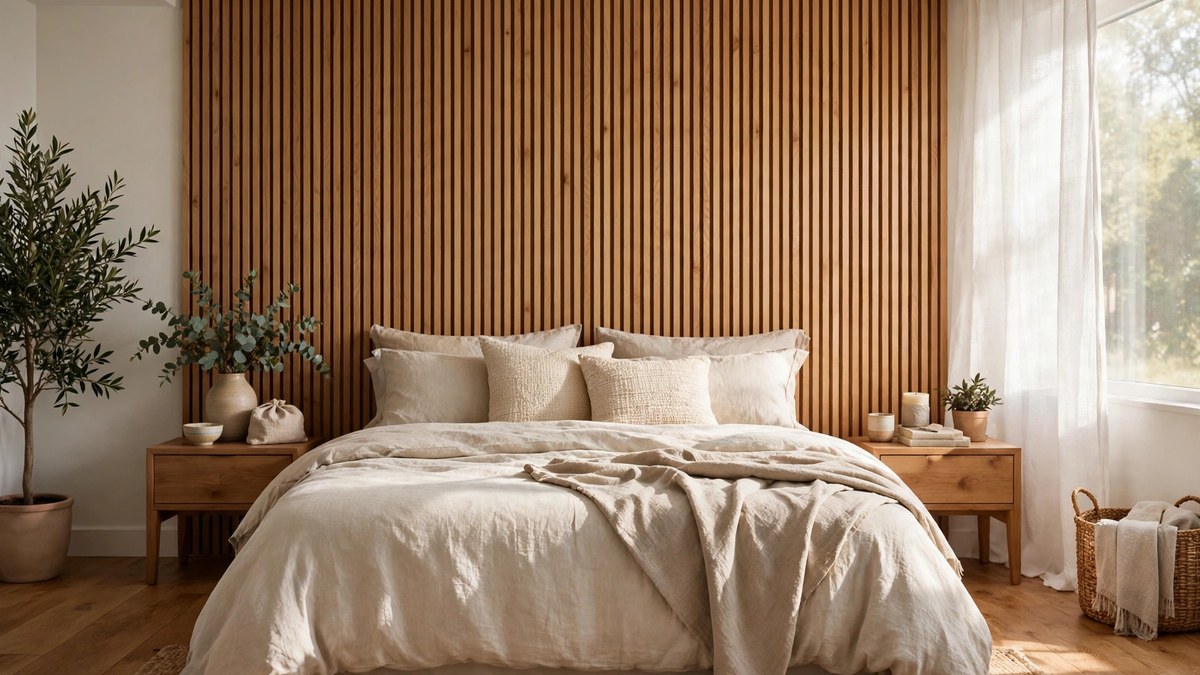
Wood slat panels bring warmth and acoustic softness. A run of slats behind the bed in oak or walnut tones acts as both headboard and art. Pre-made panels have made this a one-day project; just confirm the total look stays restful — busy grain across all four walls is too much for a sleep space.
Budget and effort notes: picture-frame molding is the value champion of this family — a room’s worth of trim, adhesive, and paint typically costs less than a single large artwork and takes a weekend of measuring, cutting, and caulking. Wainscoting runs higher because of material volume and the chair rail profile. Slat panels vary the most: DIY slats from individual boards are slow but cheap, while pre-finished acoustic panels are fast and priced accordingly. Whichever you choose, paint grade matters more than trim grade — molding painted in the same durable trim enamel as your doors will read as architecture for a decade.
Shelves, Ledges, and Functional Wall Storage
Walls can work for a living in a bedroom. A shallow ledge above the bed or along a side wall holds books, a small clock, and rotating art — the nightstand overflow problem solved without more furniture. Floating shelves beside the bed can even replace nightstands in small rooms, freeing floor space and making the room feel larger.
Keep shelf styling loose and personal rather than showroom-tight: stacks of books lying flat, one leaning frame, a small trailing plant, a ceramic object with breathing room around it. The rule of thirds works here — group in threes, vary heights, and leave at least a third of the shelf empty.
Safety and practicality count. Anchor shelves properly into studs or with rated anchors, keep heavy or glass items away from directly above pillows, and remember that everything on an open shelf collects dust. One or two ledges is a feature; a wall of open storage is a chore.
Mirrors and Lighting as Wall Decor
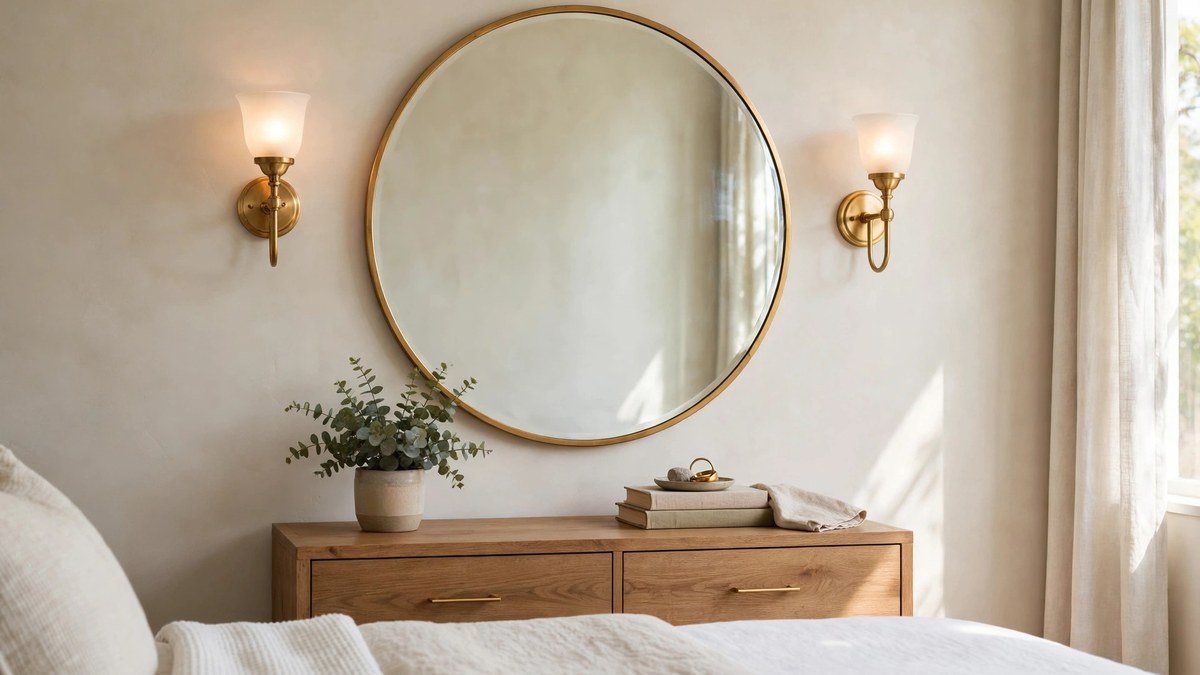
Mirrors earn their place in bedrooms for light as much as looks. A round mirror opposite or beside a window doubles the daylight in that corner and breaks up the rectangle-heavy geometry of most rooms — bed, frames, doors. Above a dresser, a mirror turns a storage piece into a vanity zone.
Sconces are the other double-duty player. A pair flanking the bed frees the nightstands, looks tailored, and puts reading light exactly where you need it. Plug-in sconces with cord covers keep the project renter-friendly; hardwired versions look cleaner if you are renovating. Either way, warm bulbs around 2700K keep the mood restful.
Treat lighting itself as decor: a sculptural pendant over each nightstand, a picture light over art, or a slim floor lamp arcing into a reading corner. When light fixtures are chosen with the same care as the art, the walls feel finished even where nothing hangs.
Add dimmers to whatever you install beside the bed — plug-in dimmers work for most lamp setups and smart bulbs handle the rest. A wall arrangement that looks perfect at noon can feel harsh at 10 p.m. under full brightness; the ability to drop sconces to a glow turns the headboard wall into evening scenery instead of office lighting. This is also why candles and a small amber-glass lamp keep appearing in styled bedrooms: warm, low light is itself a wall treatment, painting everything in a kinder tone after dark.
Wall Ideas for Small and Low-Light Bedrooms
Small bedrooms need walls that work harder and rest quieter. Lighter colors with a satin or eggshell sheen reflect light gently, and painting walls, trim, and ceiling in one continuous pale color erases the boundary lines that make a room feel boxed in.
Vertical tricks help too: floor-to-ceiling curtains hung just below the ceiling (even on a short window), tall narrow art, and vertical panel lines all pull the eye up. A single large mirror on the wall opposite the window is the classic small-room multiplier.
In low-light or north-facing rooms, avoid pure grays and icy blues, which turn chilly; choose warm whites, pale greige, soft sage, or dusty rose instead. And put art behind glass only where it will not catch glare from the window — a moody, reflective gallery helps no one.
Furniture height plays into wall success in small rooms too. Low-profile beds and dressers expose more wall, which makes treatments read grander and gives art the breathing room it needs. If your furniture is tall and the room is small, keep wall decor concentrated in one planned arrangement rather than sprinkled in the leftover gaps — concentration reads as design, sprinkling reads as storage overflow that happens to be vertical.
Common Wall Decor Mistakes to Avoid
The most common error is art hung too high — the floating-frame look that disconnects art from the furniture below it. Keep art’s center near 57 inches, or 6 to 8 inches above the headboard or dresser it relates to. The second error is too-small art: a lone 8×10 on a wide wall reads as an accident. Group small pieces or go bigger.
Third, ignoring the bed wall’s competition. If your headboard is tall and ornate, the wall behind it needs almost nothing; upholstered wings plus a gallery plus sconces equals visual shouting. Choose one lead element per wall.
Fourth, sample-less paint. Untested color is the top reason bedroom projects get repainted, and it is entirely avoidable for the price of a sample pot and a day’s patience. Finally, over-theming: a bedroom covered in matching motif art ages fast. Mix subjects and periods within your palette for a room that stays interesting.
Frequently Asked Questions
What should I put on the wall behind my bed?
The reliable options are a deeper paint color, paneling or slats, one large artwork about two-thirds the bed’s width, a planned gallery, or wallpaper. Choose one lead treatment — combining more than two usually looks busy rather than layered.
How high should art hang above a bed?
Leave about 6 to 8 inches between the top of the headboard and the bottom of the frame, and aim for the artwork’s center around 55 to 60 inches from the floor. If the headboard is very tall, hang the art closer to the headboard so the two read as one composition.
Is an accent wall outdated in a bedroom?
A lone random bright wall can look dated, but accent walls built on texture — limewash, panel molding, grasscloth, or wood slats — are very current. The modern version uses depth and a color tied to the room’s palette rather than a loud contrast.
Can I use wallpaper in a rental bedroom?
Usually, with peel-and-stick products, a smooth wall, and your landlord’s permission in writing. Test a small section and remove it slowly with gentle heat at move-out. Traditional pasted wallpaper is a different commitment and rarely suits rentals.
How do I make a gallery wall feel calm enough for sleep?
Limit frames to one or two finishes, keep spacing consistent at 2 to 3 inches, and choose art in a restrained, related palette — landscapes, abstracts, or black-and-white photography. One cohesive grid feels far calmer than an eclectic salon wall.
What is the cheapest way to upgrade bedroom walls?
Paint — especially a color-blocked shape or arch behind the bed, which costs a quart of a second color. After that, a picture ledge with frames you already own, and rearranging existing art into one planned composition costs nothing but an afternoon.
Should all four walls match?
Three quiet walls and one lead wall is the most flexible formula. Matching all four in a deep color can be gorgeous in a large, bright room — the cocoon effect — but in small or dark rooms it usually feels heavy. Split the difference with two-tone walls if you want more color overall.
Final Thoughts
Great bedroom walls are planned, not accumulated. Choose the headboard wall as your lead, pick one treatment with real presence — color, texture, structure, or art — and let the other walls support it quietly.
Start with the lowest-commitment version of your favorite idea: a paint shape, a ledge, a single bold print. You can layer from there. The rooms that feel most finished are the ones where every wall knows its job.
