
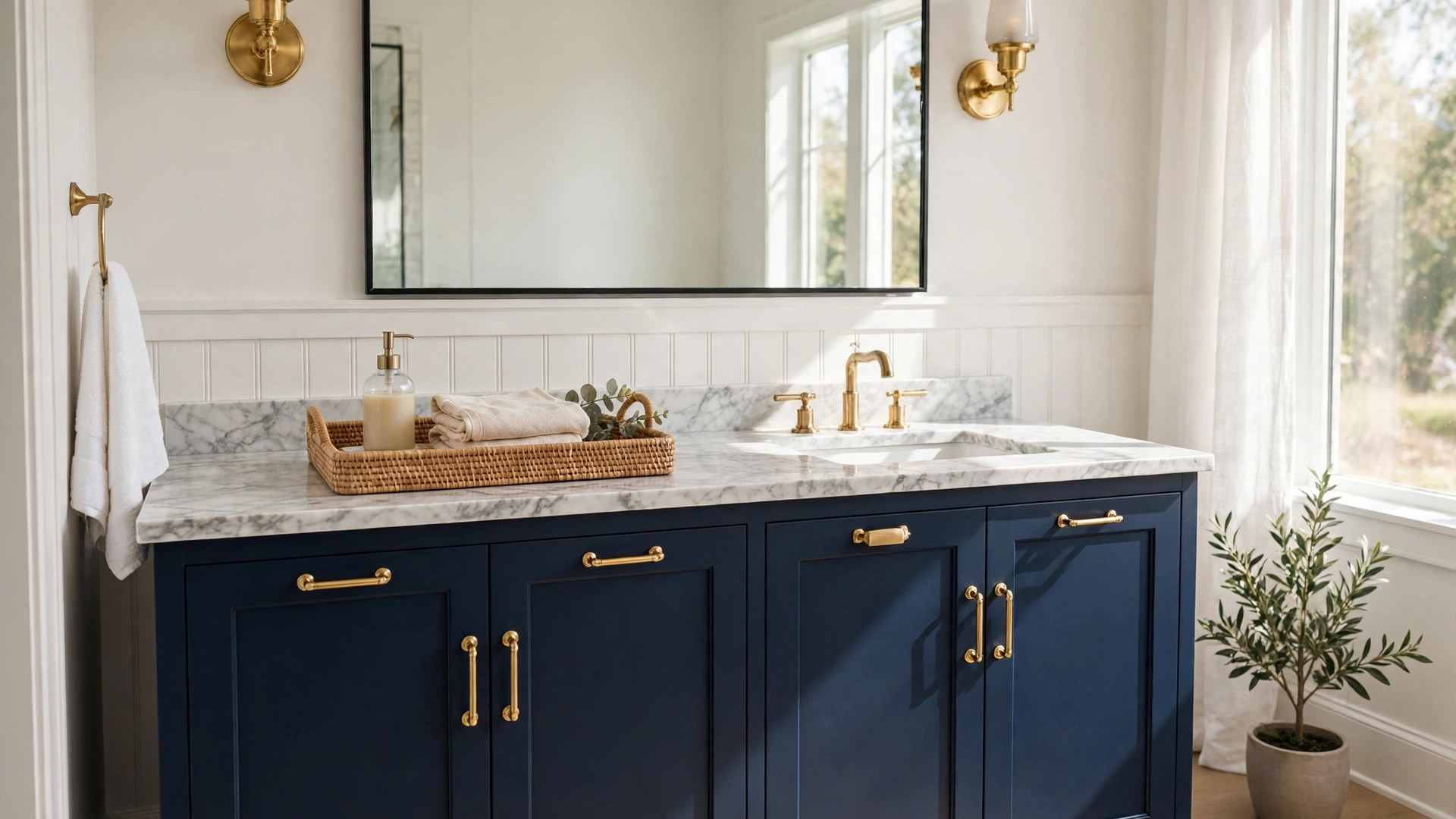

The vanity cabinet is the bathroom’s hardest-working piece of furniture. It hides the plumbing, swallows the clutter, sets the room’s style, and takes daily abuse from water, heat, and slammed doors, usually in the least glamorous finish the builder could find. The encouraging truth is that bathroom cabinet ideas span every budget and skill level: a hardware swap on Saturday, a paint transformation in a weekend, or a full vanity replacement that redefines the room.
This guide covers cabinet styles, colors, and hardware first, then turns inside, organization systems, the medicine cabinet question, and the sink counter itself, so the whole vanity zone works as one designed unit.
Start With How Your Cabinets Need to Work
Before style, audit function. Count what your cabinet must hold: daily grooming products for how many people, cleaning supplies, a hair dryer and tools, towels, backstock. Most bathroom frustration is a storage arithmetic problem, and the right cabinet idea is the one that makes your particular count fit.
Measure what you have. Standard vanities run about 21 inches deep and 30 to 36 inches tall, with modern “comfort height” models at the taller end, and widths from 24 inches for a powder room to 72 for a double. Knowing your envelope tells you whether you are redecorating a cabinet, replacing doors, or shopping for a new vanity entirely.
Note the plumbing, too. The drain and supply lines dictate where drawers can go; modern vanities use U-shaped drawers that wrap around the plumbing, and knowing your pipe positions saves a return trip. Take a photo inside the cabinet with the doors open; every later decision gets easier with that picture on your phone.
Finally, decide your camp: keep, refresh, or replace. Sound cabinet boxes deserve refresh; swollen particleboard, water damage, and layouts that waste the room deserve replacement. The rest of this guide follows that decision tree.
Vanity Styles: Furniture-Look, Floating, and Built-In
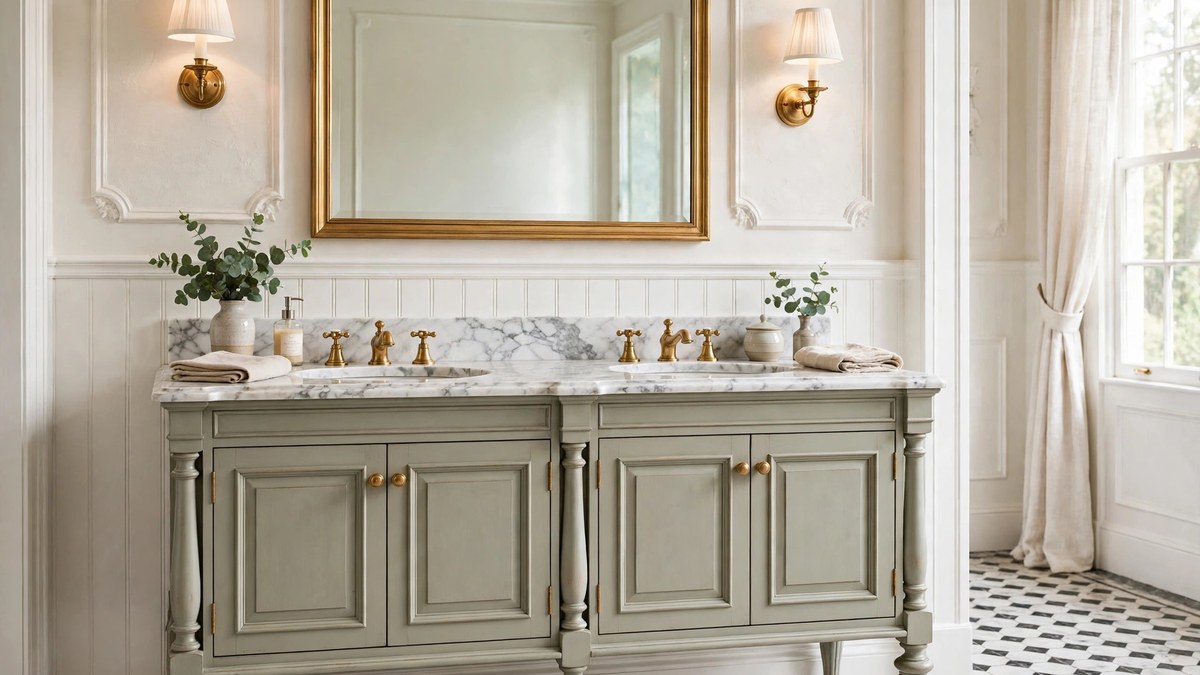
The furniture-look vanity, legs, raised panels, a top that overhangs like a dresser, brings warmth and suits traditional, farmhouse, and transitional rooms. Because it reads as furniture, it lets the bathroom feel furnished rather than fitted, and it is the easiest style to source as a ready-made piece with the counter and sink included.
Floating vanities mount to the wall and hover above the floor, the signature of modern and minimalist rooms. The visible floor beneath makes small bathrooms feel larger and cleaning simpler, and the height can be set to your household rather than a standard. What you surrender is some storage volume and the ability to hide floor-level clutter; what you gain is air.
Built-in and wall-to-wall cabinetry maximize storage and look architectural, filling alcoves and awkward spans that freestanding pieces waste. This is the cabinet-maker’s territory, or the territory of stock cabinets combined with filler pieces, and it rewards bathrooms with a true primary-suite workload. The tailored vanities in our modern bathroom ideas showcase show how seamless this approach looks when the whole room is planned around it.
Between camps sit the hybrids: a floating upper drawer bank with an open shelf below, a furniture vanity with a toe-kick added. Style rules are guidelines; the right vanity is the one whose storage and silhouette solve your room’s actual problems.
Cabinet Colors and Finishes That Change the Room
No surface in the bathroom covers more visible area than the vanity, so its color is effectively the room’s color decision. White remains the default because it reads clean and pairs with everything, but today’s interesting bathrooms often run the other way: a deep navy, forest, or charcoal vanity against pale walls becomes the room’s anchor and its art.
Wood tones are back in force, from white oak and walnut in modern rooms to painted-wood farmhouse pieces. Natural wood warms the hard surfaces around it and hides wear gracefully. If your existing cabinets are sound but orange-toned, gel stain or paint can shift them into this decade without replacement.
Two-tone schemes stretch small budgets stylishly: a colored base cabinet with a light counter, or upper and lower elements in different tones. The rule is contrast with intention, one dark element, one light field, and hardware as the bridge.
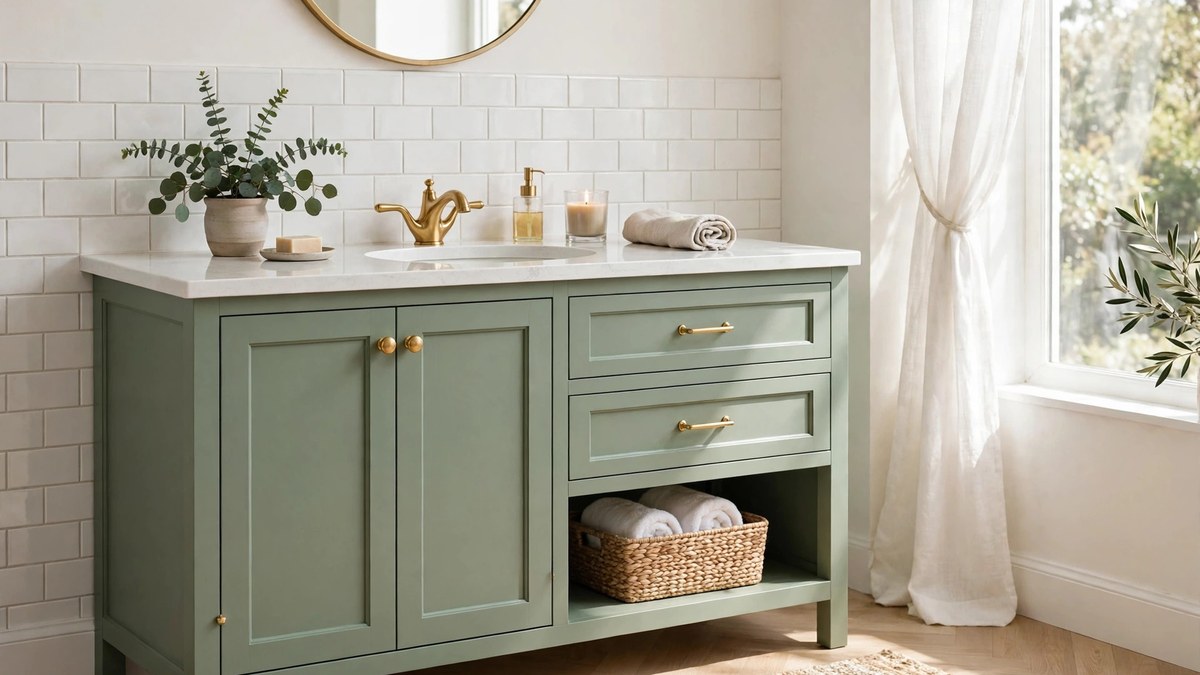
Specific colors earn their reputations in this role. Deep navy cabinets in a shade like Benjamin Moore’s Hale Navy HC-154 give a bathroom instant architecture, especially with brass hardware and a white counter. Soft sage greens such as Sherwin-Williams’ Evergreen Fog SW 9130 suit spa-leaning rooms and hide wear gracefully. For the undecided, a warm greige or a true white in a quality enamel remains the safest long-term wager, because tile and textiles can change around it for decades.
Whatever color you choose, the finish must be bathroom-grade: a quality enamel or factory finish rated for humidity, in satin or semi-gloss so it wipes clean. Save flat matte for powder rooms without showers, where steam is an occasional guest rather than a daily roommate.
Hardware: The One-Hour Cabinet Transformation
If cabinets are the room’s largest surface, hardware is its punctuation, and changing it is the highest return-per-hour project in the bathroom. New pulls in a finish that matches or deliberately accents your faucets make builder cabinets look specified rather than standard.
Choose shapes for hands, not just eyes. Bar pulls and edge pulls suit modern rooms and are easy to grip; knobs and cup pulls carry traditional and farmhouse stories; oversized pulls, 5 inches or longer on drawers, are both a style statement and a genuine ergonomic kindness. Keep one finish story across the cabinet hardware, and let it relate to, not necessarily match, the faucet: brushed brass with chrome faucets can work if it repeats in the mirror frame or lighting.
Mind the mechanics: measure the center-to-center distance of existing screw holes before ordering, since standard sizes, commonly 3 inches, 3-3/4, and 5 inches, are not interchangeable without filling holes. For knobs-to-pulls conversions, backplates hide the old holes and add a designed detail in one move.
While the hardware is off, do the invisible upgrades: soft-close hinges and drawer slides. They cost little, install with a screwdriver, and make a decade-old cabinet feel like new furniture every single morning.
Open Shelving vs. Closed Cabinets: An Honest Comparison
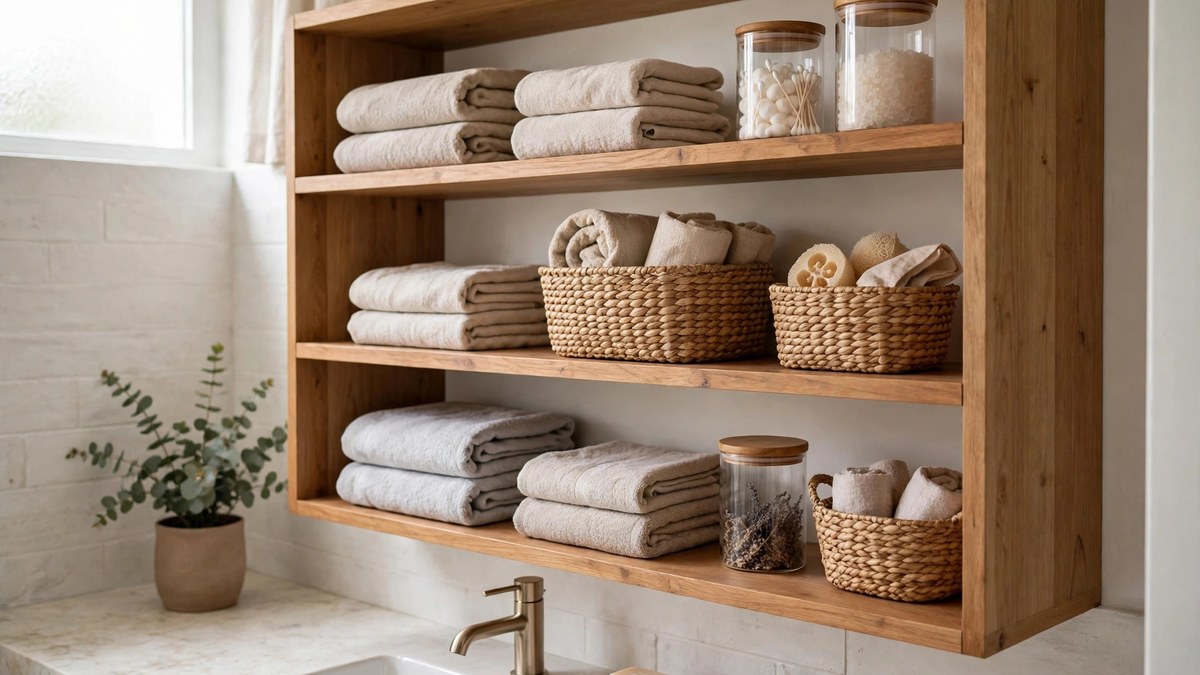
Open shelving, usually a floating shelf or an open vanity base, photographs beautifully and works genuinely well for a narrow set of contents: folded towels, baskets, a plant, the pretty bottles. It forces tidiness, grants quick access, and makes small rooms feel airier because the eye travels through it.
Closed cabinets forgive real life. They conceal the mismatched, the medicinal, and the half-empty, they protect contents from dust and bathroom humidity’s daily cycle, and they are the only sane choice under a sink where plumbing shares the space. Households with children, pets, or more than four products per person will vote closed within a month.
The mature answer is a ratio, not a side: mostly closed storage for the working clutter, with one open moment, a shelf, a niche, an open lower tier with baskets, for the display layer. Guest baths can lean more open because their contents are curated; primary baths should lean closed because their contents are honest.
If you remove cabinet doors for an open look, keep them. Tastes and households change, and a door you can reinstall is a reversible experiment rather than a commitment.
Medicine Cabinets and Mirrored Storage
The medicine cabinet is the bathroom’s secret storage weapon: inches-deep shelving hidden behind the mirror you need anyway. As the medicine cabinet has evolved from a simple mirrored box to versions with lighting, outlets, and magnification, it has become the hardest-working square footage in the room, holding daily products at eye level, off the counter entirely.
Recessed models install between studs and sit nearly flush, reading as a plain mirror while hiding a surprising volume. Surface-mount models need no wall surgery and suit rentals and thin walls. Measure your stud spacing and plumbing vents before choosing; the wall decides which type you can have.
Inside, organization is simple: daily items on the bottom shelf at eye level, occasional items up top, and small risers or clear bins for tiny bottles. Add a magnetic strip inside the door for tweezers, clippers, and bobby pins, the small metal things that otherwise live at the bottom of every drawer.
If your bathroom lacks a medicine cabinet, a mirror with integrated storage or a pair of shallow wall cabinets flanking the mirror recovers most of the benefit. The goal is a home for the counter’s daily dozen, and any hidden shelf near the mirror achieves it.
Inside the Cabinet: Organization Systems That Last
Open most bathroom cabinets and you find a cavern where bottles go to be forgotten. The fixes are cheap and structural. A small two-tier organizer or turntable tames the under-sink jungle; stackable bins with labels end the archaeological digs; and a door-mounted rack reclaims the cabinet door’s wasted face for flat items and tools.
Drawer vanities deserve drawer discipline: dividers by category, makeup, dental, hair, first aid, with daily items in the top drawer. Drawer liners keep everything from migrating and make wipe-downs trivial. The systems in our bathroom towel storage ideas guide apply the same zoned logic to linens, and the two together will civilize the whole vanity.
The plumbing zone needs its own strategy. A U-shaped bin or a low tray that corrals cleaning supplies around the pipes keeps leaks visible instead of hidden, put a water alarm or at least a leak-detection mat under the trap, because the cabinet floor is where slow disasters announce themselves last.
Adopt the one-in-one-out rule for products and the cabinet stays organized without seasonal purges. Systems fail when volume grows past capacity; the cabinet is a container, and containers have honest limits.
Bathroom Sink Decor That Keeps the Counter Pretty and Practical
The counter around the sink is the bathroom’s most-seen and most-used surface, and bathroom sink decor is the art of keeping it both beautiful and functional. The principle from every styled bathroom is containment: what stays out lives on a tray. A soap dispenser, a lotion, and a small tray or dish for jewelry and watches form the classic trio, grouped so the arrangement reads as one object.
Choose dispensers as decor, because they are. Refillable bottles in amber glass, ceramic, or matte metal elevate the whole counter for a few dollars and end the visual noise of branded plastic. Add one soft or living element, a folded hand towel on a ring, a tiny plant, a candle, and the sink zone feels finished.
Faucet and mirror do the heavy visual lifting here. A clean, polished faucet and a spotless mirror are worth more than any accessory; conversely, water spots undo styling instantly. Keep a microfiber cloth in the top drawer and make the ten-second wipe a habit, and your sink decor will always look freshly arranged.
Resist filling every inch. The sink counter needs working room for a toothbrush cup, a hair tool cooling off, a guest’s toiletries. Decor that leaves half the counter empty looks generous; decor that crowds it looks anxious.
Small Bathroom Cabinet Ideas That Steal Back Space
Small bathrooms punish standard cabinets, so steal space like you mean it. A shallow vanity, 18 inches deep instead of 21, returns floor area you can feel, and wall-mounted faucets let the counter shrink further. In powder rooms, a petite console or pedestal with a beautiful basket beneath may serve better than any cabinet.
Vertical theft pays best: a tall, narrow cabinet or shelving tower beside the vanity, an over-toilet cabinet, and the medicine cabinet’s hidden depth together can double a small room’s storage without touching its footprint. Mirrored doors on any of them return light as interest on the investment.
Inside, go miniature and modular: small bins, tiered risers, and door racks sized to the cabinet, because standard organizers waste precious inches in small spaces. And edit the inventory to the room’s reality: backstock and rarely used appliances belong in a linen closet, leaving the small cabinet for the daily essentials it can actually hold beautifully.
Tall Cabinets and Linen Towers: The Vertical Answer
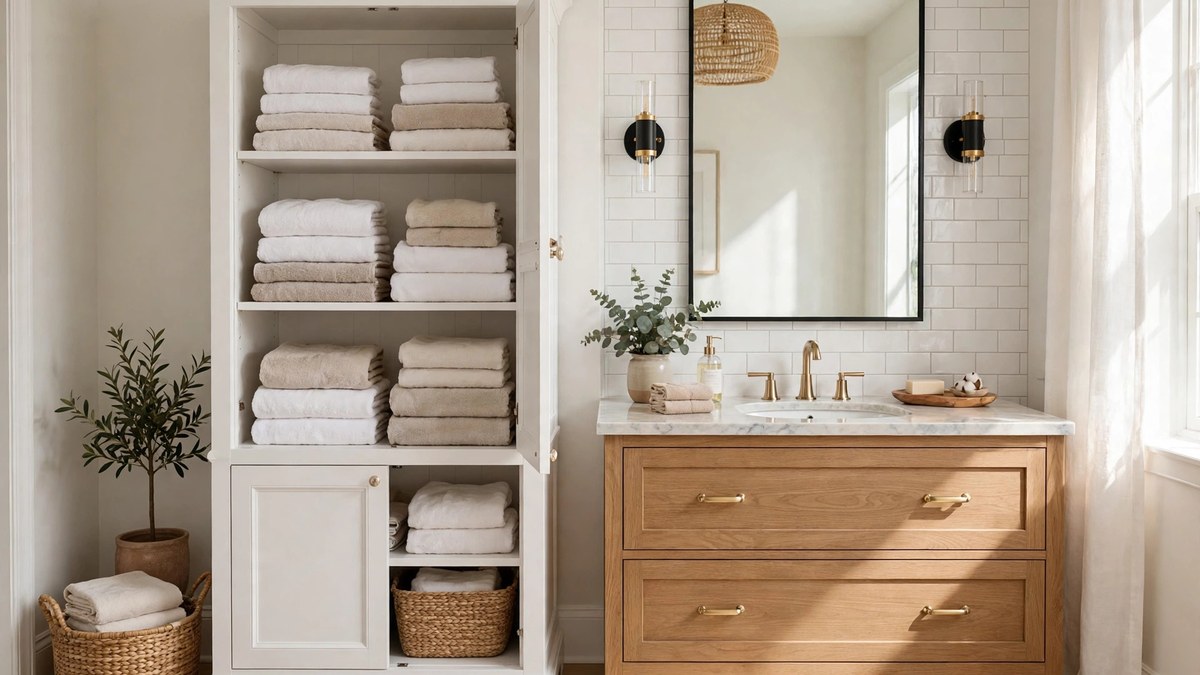
When the vanity alone cannot hold the household, the answer is usually up, not out. A tall cabinet, a linen tower sitting on the counter beside the sink or a full-height unit standing on the floor, adds the storage of several vanity drawers while taking a single square foot of floor or a slice of counter. In primary baths, a tower between two sinks is the classic solution: it divides the stations, hides each person’s clutter behind a door, and gives the double vanity the finished, built-in look of much pricier cabinetry.
Style a tower as cabinetry, not furniture that wandered in: match its finish to the vanity, repeat the same hardware, and align its top with the mirror or a consistent line so it reads as part of the original plan. Glass-front uppers can hold folded towels and pretty baskets as display, while solid lower doors conceal the working supplies.
Renters and the renovation-shy can borrow the idea with a freestanding tall cabinet or a narrow shelving unit in an unused corner. The principle is the same: bathrooms are tall rooms used only at their bottom half, and every vertical foot you claim is storage your counters get back.
DIY Refreshes: Paint, New Doors, and Peel-and-Stick Magic
A sound but ugly cabinet is the best DIY bargain in the house. Paint transforms it for the cost of supplies and a weekend: clean, degloss or sand, prime with a bonding primer, and finish with a quality cabinet enamel in thin coats. The prep is unglamorous and decisive; paint over grease or gloss fails, paint over proper prep lasts for years.
If the doors themselves are the problem, replace only the doors and drawer fronts, keeping the boxes. New shaker or slab fronts on old cabinets read as a new vanity for a fraction of the price, and soft-close hinges complete the impersonation. This is the middle path our bathroom remodel ideas recommend for budgets that cannot stretch to full replacement.
Peel-and-stick products have their honest niche: wood-look film can rescue a water-stained cabinet side, removable wallpaper can line a cabinet back or interior, and stick-on tile can refresh a backsplash behind the vanity. Use them as accents and reversible experiments, not as armor in wet zones.
The refresh ladder, hardware, then paint or doors, then counter, lets you stop at the rung your room needs. Many bathrooms are one hardware swap away from looking renovated; diagnose before you demolish.
Common Bathroom Cabinet Mistakes
The first mistake is choosing style before storage: the gorgeous open vanity that holds nothing, in a household with forty products. Count your things first. Second is ignoring water: unsealed wood, MDF swelling at the base, and finishes that cannot be wiped will all surrender to bathroom humidity on schedule.
Third is hardware as an afterthought, mismatched finishes and leftover holes telling a sloppy story inches from your face. Fourth is the cavern effect, deep, dark, unorganized cabinet interiors where products go to expire. A light interior paint, a riser, and bins fix it permanently.
Fifth is blocking the plumbing with permanent organizers, so the first leak requires demolition to reach. Keep the trap accessible and a leak mat beneath it. And sixth is forgetting the doors themselves: slamming, sagging hinges and crooked gaps make new cabinets feel old, so adjust and add soft-close hardware before judging the whole vanity.
Frequently Asked Questions
How can I update my bathroom cabinets without replacing them?
In order of impact: new hardware, a proper paint job in a current color, replacement doors and drawer fronts on the existing boxes, and soft-close hinges. Together these deliver most of a new vanity’s look for a fraction of the cost.
What is the best color for bathroom cabinets?
The best color serves your room: white for bright and classic, navy, forest, or charcoal for a dramatic anchor against pale walls, and natural wood tones for warmth. Choose a satin or semi-gloss bathroom-grade finish so the color survives steam and scrubbing.
Are floating vanities a good idea?
Yes for modern looks and small rooms: they make the floor visible, which enlarges the space, simplify cleaning, and allow custom mounting height. They hold slightly less than floor-standing equivalents, so pair one with a medicine cabinet or tall storage.
How do I organize a deep bathroom cabinet?
Zone it. Bins or a two-tier organizer for products, a tray corralling cleaning supplies around the plumbing, door-mounted racks for flat items, and labels so the system survives other people’s tidying. Keep the drain and trap accessible.
Should I paint or replace my bathroom cabinets?
Paint when the boxes are sound, the layout works, and only the finish is tired. Replace when there is water damage, swollen materials, broken drawers, or a layout that wastes the room. New doors are the middle option when boxes are sound but the style is not.
What hardware finish should I choose?
Pick one finish story and repeat it: matte black for modern and farmhouse, brushed nickel for transitional, brass for traditional and glam. It should relate to your faucets and repeat in the mirror frame or lighting for a designed look.
How much storage does a bathroom vanity really need?
Enough for the daily products of everyone who uses the room, plus cleaning supplies, with backstock stored elsewhere. If the count overflows the cabinet, the answer is usually a medicine cabinet or tall tower, not a bigger vanity.
Final Thoughts
Bathroom cabinets reward a clear-eyed sequence: count what they must hold, choose the style that fits the room, let color and hardware carry the design, and organize the interior like you will open it every day, because you will. Whether your project is a one-hour hardware swap or a full vanity replacement, the result is the same happy outcome: a bathroom that looks designed because it finally works.
