

A bathroom without a theme is a room full of fixtures; a bathroom with one is a place. The difference rarely costs money. It is the moment the towels, the art, the shower curtain, and the cabinet color start telling the same story, whether that story is a serene spa, a breezy coast, or a jungle of botanical prints. Choosing among bathroom themes is the highest-leverage decorating decision you will make in this room, because one clear idea organizes every later purchase.
This guide walks through the themes that actually work in real bathrooms, spa, coastal, modern, vintage, cute, whimsical, botanical, and bold, and shows how to carry each one through fixtures, textiles, and art without sliding into kitsch. Pick the story that sounds like your house, then let it make your decisions for you.
How to Choose a Theme That Will Not Date Overnight
Start with the bones you cannot change: your tile, your fixtures, your home’s overall style. A theme that cooperates with the fixed elements looks intentional; one that fights them looks like a costume. A chrome-and-white bathroom takes spa, coastal, modern, and botanical themes gracefully. Warm wood and brass invite vintage, farmhouse, and traditional stories. Work with the room you have.
Next, decide how loud the theme should be. As a working principle borrowed from interior design practice, themes live on a spectrum from literal to suggested, and bathrooms age best at the suggested end: colors, materials, and textures that evoke a place or mood, with at most one or two literal motifs. A coastal palette of sand, white, and sea-glass blue will look fresh in ten years; a room papered in lighthouses will not.
Consider also who uses the room. A primary bath wants calm and longevity; a kids’ bath can carry a playful theme that changes as they grow; a powder room, seen for thirty seconds at a time, is the safest place in the house for your boldest idea. Match the theme’s intensity to the room’s audience and exposure.
Finally, test the theme in textiles before committing to tile or paper. Towels, a curtain, and a print in the theme’s palette will tell you within a week whether you love living inside the idea.
Spa and Serene: The Theme That Never Fails
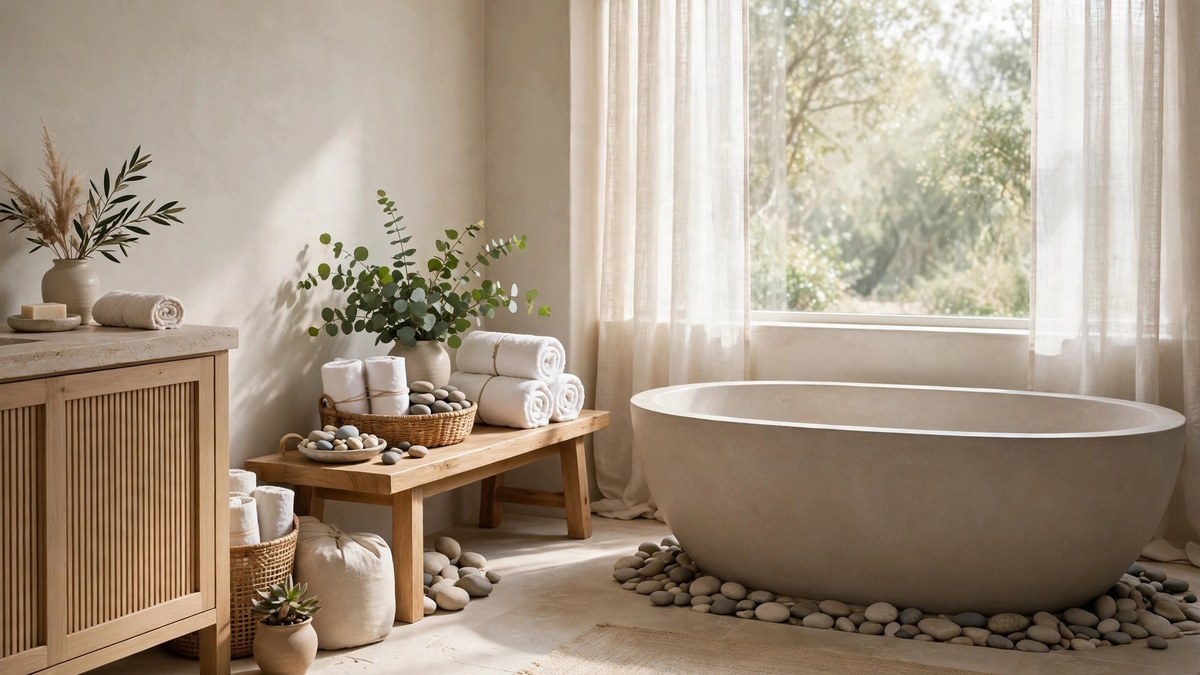
The spa theme endures because it asks the bathroom to do what bathrooms are for: restore. Its palette is soft and natural, whites, warm grays, pale wood, stone tones, and its materials repeat that calm: bamboo, teak, river rock, linen, and glass. Clutter is the enemy; every surface is edited down to the beautiful and the useful.
The formula is well known because it works. Rolled white towels, a wooden bath mat or stool, eucalyptus stems, candles in glass, and dispensers in amber or stone replace a dozen mismatched bottles. A tray across the tub with a book rest completes the ritual. Our dedicated guide to spa bathroom ideas builds this theme layer by layer if it is the direction your room wants.
Spa styling forgives almost any existing bathroom, because its magic is subtraction plus textiles. It is also the easiest theme to maintain: when everything is white, wood, and glass, a room looks clean because it is clean, and nothing in it expires stylistically.
Sound and scent complete the theme more cheaply than tile ever could. A small speaker, a diffuser in cedar or eucalyptus, and low, warm lighting change the felt experience of the room while the eye is still admiring the towels.
Coastal and Beach Themes Without the Kitsch
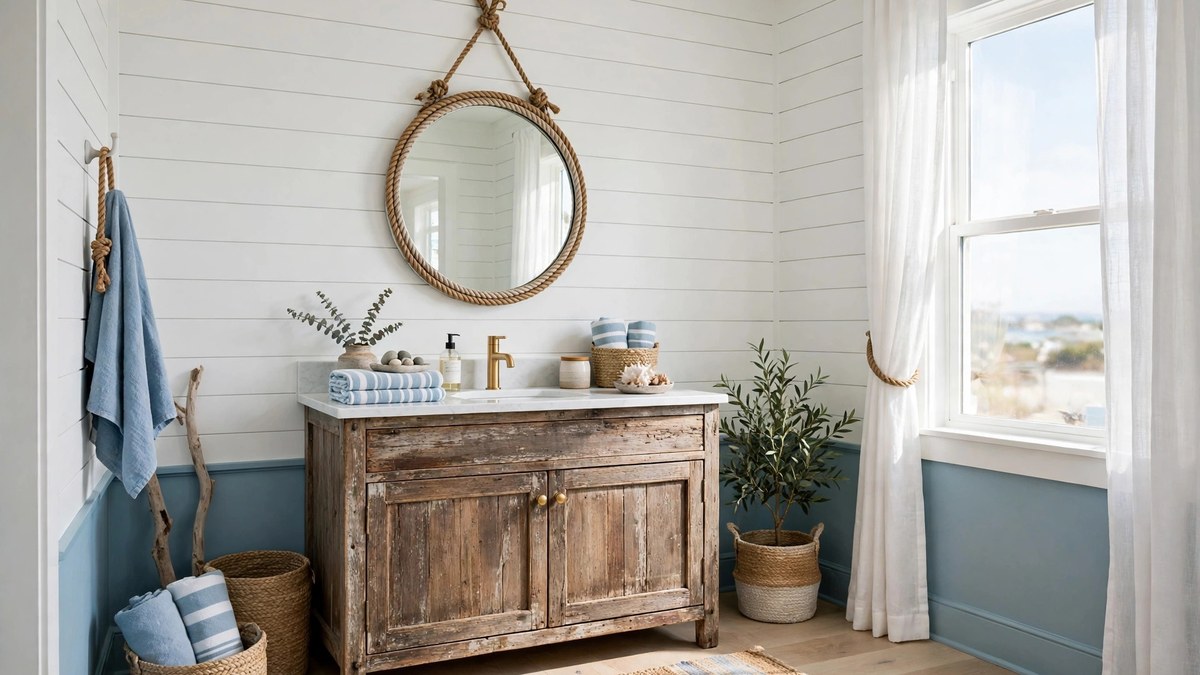
Coastal is the most loved and most parodied bathroom theme, and the line between the two is motif discipline. The sophisticated version uses the coast’s palette and textures: white, sand, driftwood gray, sea blues and greens, rope, rattan, woven grasses, and weathered wood. The kitsch version adds anchors, seagulls, and “beachy” signage until the room becomes a souvenir stand.
Get the light right first. Coastal rooms are bright rooms: sheer or no window coverings where privacy allows, white or pale walls, and reflective touches in glass and polished nickel that bounce daylight the way water does. In a windowless bath, compensate with layered warm lighting and the palest version of the palette.
Natural texture is the theme’s signature. A woven basket for towels, a teak bath mat, a rope-framed mirror, and linen textiles deliver the beach without a single shell glued to anything. If you do use shells or coral, use real ones, sparingly, as objects in a bowl or on a shelf, the way they would appear in a house near the sea rather than a shop selling the idea of one.
Finish with art that suggests the shore: a misty seascape photograph, a simple line drawing of waves, a map of a beloved coastline. One strong coastal image anchors the theme more firmly than a dozen themed accessories.
Modern and Minimalist Themes
Modern bathroom themes trade decoration for precision: clean lines, flat-front cabinetry, large-format tile, frameless glass, and a restrained palette, often monochrome, that lets materials and light do the visual work. The style suits primary baths and anyone whose ideal morning is calm, bright, and uncluttered.
The discipline is in the details. Hidden storage keeps counters empty; fixtures share one finish, usually matte black, chrome, or brushed nickel; and grout lines are planned like graphics, aligned, minimal, and often matched to the tile. A single sculptural element, a freestanding tub, a wall-mounted faucet, an oversized mirror, supplies the art.
Minimalism’s risk is coldness, and the cure is texture rather than stuff: a wood vanity against stone-look tile, a woven basket, one plant, towels with visible weave. The room stays serene but stops feeling like a laboratory. The transformations in our roundup of modern bathroom ideas show how warmth sneaks back into even the sleekest scheme.
Budget note: modern themes forgive inexpensive materials chosen carefully, big tiles mean fewer grout lines to keep clean, but they punish sloppy installation. Spend on alignment and caulk lines, not on exotic stone.
Vintage, Farmhouse, and Traditional Themes
Heritage themes give bathrooms the one thing new construction lacks: a past. Vintage styling leans on clawfoot or pedestal forms, hex and subway tile, cross-handle faucets, and medicine cabinets with beveled mirrors. Farmhouse softens the same bones with wood, shiplap, aprons-front sinks, and matte black or oil-rubbed bronze metals. Traditional design is the formal cousin: marble-look surfaces, panel molding, and polished nickel or brass everywhere.
These themes are kind to older homes, because they make original features, radiators, hex floors, heavy trim, look like the plan rather than the problem. They are also thrift-friendly: vintage mirrors, stools, ladders for towels, and framed prints carry the style authentically and inexpensively.
The period details reward consistency. Choose one era’s metal story and keep it across faucets, lighting, and hardware; mixing chrome with antique brass “because both are pretty” dissolves the illusion. Paint colors follow suit, warm whites, heritage blues and greens, and the occasional deep, formal navy.
For a sharper mid-century take on the heritage idea, our guide to mid-century modern bathroom ideas shows how walnut, geometry, and starburst details update the vintage formula. The lesson generalizes: pick your decade and commit.
A Cute Bathroom That Feels Sweet, Not Childish
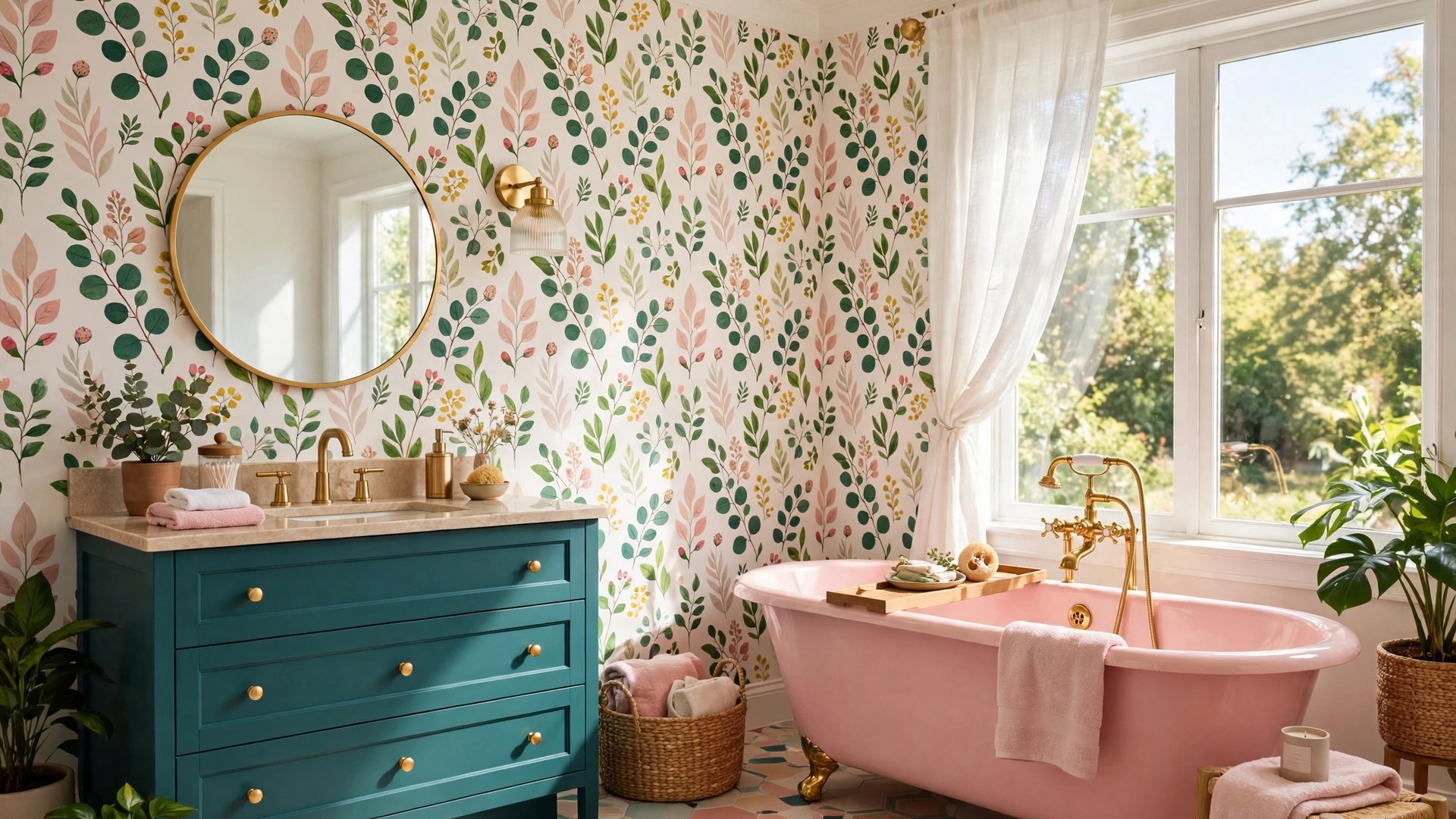
“Cute” is a legitimate design brief: soft, cheerful, a little romantic, and popular for powder rooms, girls’ baths, and anyone who wants the morning to start kindly. The grown-up version of a cute bathroom is built on palette and pattern, pastel or candy colors, scallops, bows, polka dots, gingham, and floral prints, applied with the same discipline as any serious theme.
Choose one cute motif and one main color, then treat them with adult rigor. Blush pink walls, a scalloped mirror, and brass fixtures is a designed room; pink walls, pink towels, a bow print curtain, flamingo art, and a neon sign is a theme park. The pattern can appear twice, curtain and hand towel, say, with everything else quiet.
Balance the sweetness with grown-up materials. Marble-look tile, real wood, glass, and metal keep cute from tipping into nursery. A vintage-style faucet or a smart light fixture does more for the effect than another adorable accessory, because contrast is what makes the soft elements read as chosen rather than defaulted.
Cute themes are also wonderfully inexpensive to run: their power lives in textiles and paint, the two cheapest layers to change, so the room can evolve from sweet to sophisticated without touching a fixture.
Whimsical Bathroom Ideas for Kids and the Young at Heart
Whimsy is cute’s bolder sibling: humor, surprise, and storybook imagination, and the bathroom, small and enclosed, is its natural stage. For kids’ bathrooms, whimsical bathroom ideas turn a chore room into a destination, which any parent who has negotiated bath time will recognize as a genuine functional upgrade.
The reliable whimsical engines are color and character. A saturated wall color, teal, coral, sunshine yellow, sets the stage; then one story arrives: under-the-sea with fish decals and a wave-patterned curtain, jungle with leaf prints and animal hooks, space with a starry shower curtain and planet towels. Keep the cast small and the fixtures standard, so the theme can retire gracefully when tastes change.
Removability is the design principle. Decals, textiles, art, and accessories carry 90 percent of whimsy; tile and fixtures stay neutral. A dinosaur bathroom becomes a teen bathroom over one weekend with new towels and prints, which is exactly how a children’s theme should be engineered.
Adults are allowed whimsy too, in powder rooms especially: a surrealist print, a monkey-faucet moment, wallpaper with a hidden joke. One unexpected element in an otherwise polished room is the definition of charm, and guests will talk about your powder room at dinner.
Nature and Botanical Themes
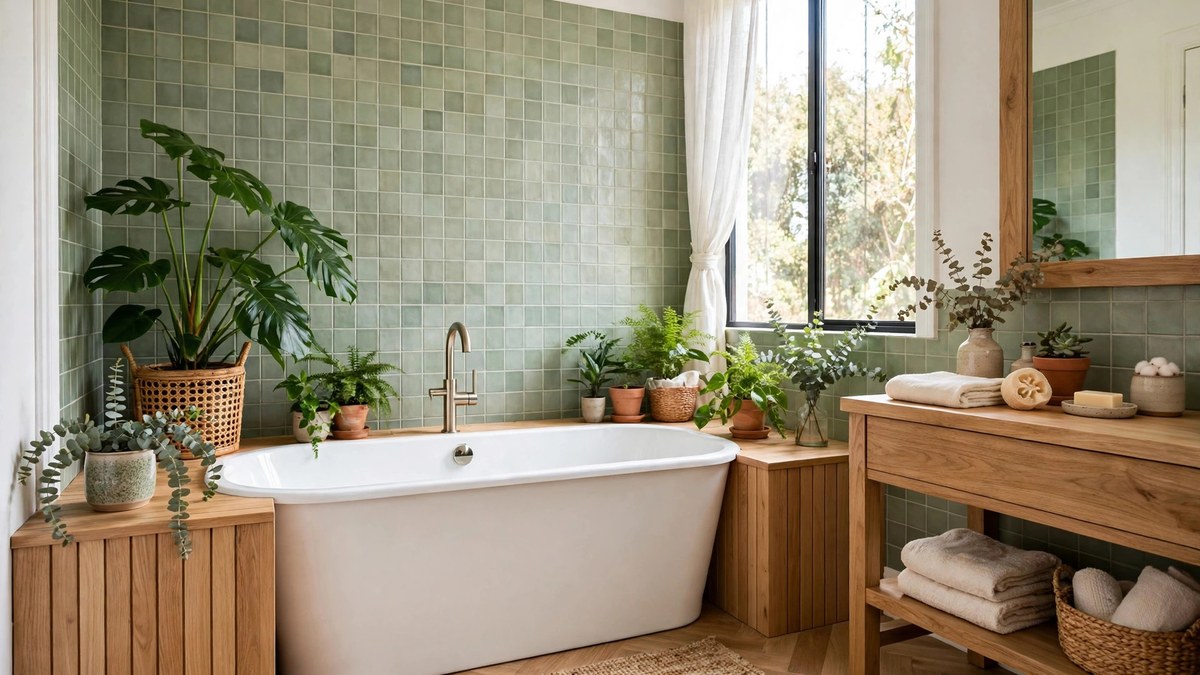
Botanical themes let the bathroom pretend it is a greenhouse, and the pretense is easy because bathrooms offer the humidity plants love. The palette is green in every depth, supported by white, wood, stone, and black; the motifs are leaves, ferns, and floral line drawings, ideally in one generous print rather than many small ones.
Living plants are the theme’s foundation: pothos trailing from a shelf, a fern on the vanity, eucalyptus in the shower. Choose species that tolerate low light and steam, and cluster them at varied heights so the room reads as layered rather than decorated. In a windowless bath, high-quality faux greenery in a few key spots sustains the effect honestly.
Materials reinforce the garden story: a wood stool or bath caddy, stone-look tile, woven baskets, a jute or cotton rug. Botanical wallpaper is the theme’s showpiece; a single wall of oversized leaves behind the vanity or tub makes the entire room feel planted, and vinyl versions handle the moisture.
Botanical overlaps happily with spa, so the two blend for people who want calm with more life in it. If spa alone felt too quiet, add the plants and the leaf print and keep everything else serene.
Bold and Moody: Dark Themes Done Right
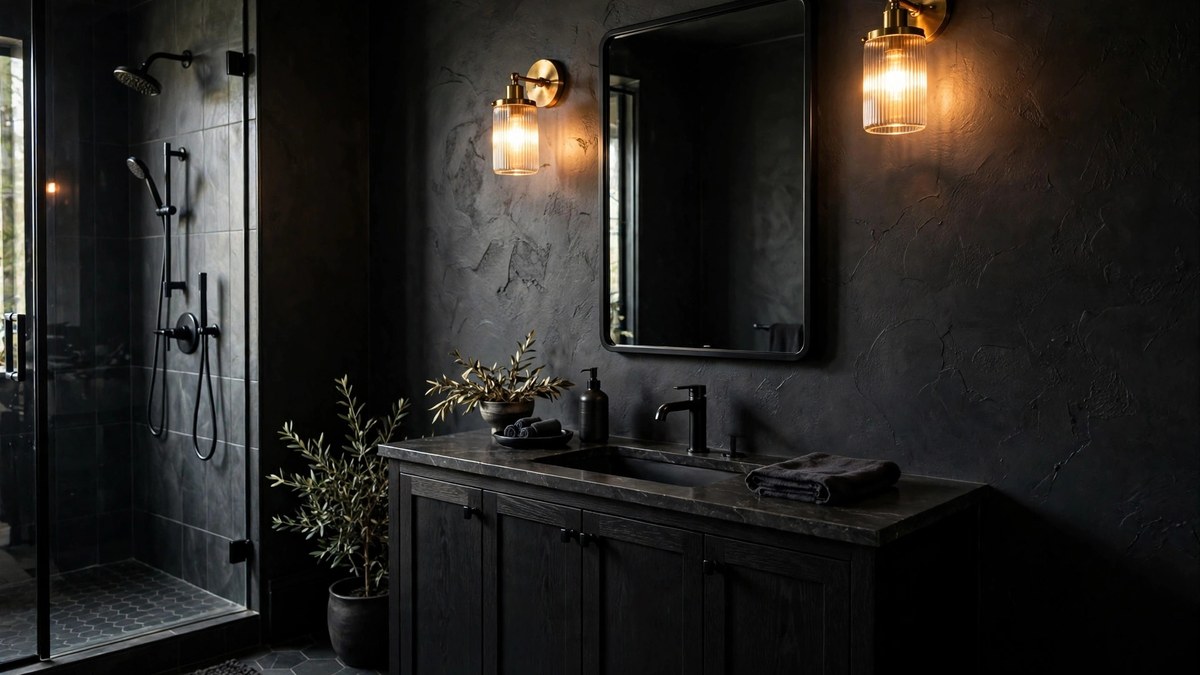
A dark bathroom theme, charcoal, ink navy, deep green, even black, is the dramatic opposite of the spa playbook, and in small rooms it works shockingly well. Dark walls erase the visual boundaries of a tiny space, make white fixtures glow by contrast, and turn a powder room into the house’s little black dress.
The supporting cast decides success. Warm metals, brass and copper especially, keep dark rooms luxurious rather than cave-like; mirrors multiply what light exists; and lighting must be layered and intentional, because a single ceiling bulb in a dark room is a recipe for gloom at the mirror.
Texture is the other safeguard. In a monochrome dark scheme, the eye reads surfaces: glossy tile against matte paint, rough stone beside smooth porcelain, woven textiles against sleek glass. Choose at least three finishes and the room gains the depth that color contrast provides in lighter rooms.
Start small if you are nervous: one dark wall behind the vanity, or dark cabinets under pale walls. Moody themes are seductive partly because they are reversible, and a gallon of paint is a small wager on a room people will remember.
Carrying a Theme Through Fixtures, Textiles, and Art
A theme succeeds when it appears at three heights and in three materials. Work the checklist: the palette in a permanent layer (tile, paint, or cabinet color), in a textile layer (curtain, towels, rug), and in an object layer (art, tray, plant, hardware finish). If a theme exists only in towels, it is a towel set, not a theme.
Fixtures are the theme’s grammar. Faucet and hardware finishes should speak one language, and their shapes should agree with the story: cross handles for vintage, lever minimalism for modern, gooseneck charm for farmhouse. Lighting fixtures are the most underused theme-carriers in the bathroom; a lantern sconce or a schoolhouse light can announce a theme before a single towel is hung.
Art and mirrors finish the sentence. Choose the mirror’s frame as a theme statement, rope for coastal, gilt for traditional, frameless for modern, scalloped for cute, and let one piece of art repeat the theme’s motif or palette at eye level. Guests will read the room in five seconds; give those seconds a coherent story.
Finally, edit ruthlessly. Remove one thing that belongs to a different story. The fastest theme upgrade is subtraction, and it is free.
Mixing Two Themes Without Clashing
Real homes blend: spa-calm with botanical life, vintage bones with modern fixtures, coastal palette with farmhouse wood. Blending works when the two themes share a palette or a material and when one theme clearly leads. A 70/30 split, one dominant story with an accent of the other, reads as layered; a 50/50 split reads as indecisive.
The bridge technique is to repeat the secondary theme’s signature at least twice. If modern fixtures meet a vintage room, echo the modern note in the mirror and the light fixture, and the pairing looks curated rather than conflicted. Shared metals and shared colors are the diplomats that negotiate most blends successfully.
Avoid blending themes whose palettes fight, pastel cute with moody dark, or whose motifs compete at the same scale, two bold wallpapers in one small room. When in doubt, let one theme own the walls and fixtures, and let the other appear only in textiles and objects, the layers you can change in an afternoon.
Common Bathroom Theme Mistakes
The first mistake is the literal pile-up: shells on every surface, signs on every wall, a motif repeated until the room becomes a themed retail display. Motif discipline, one or two literal references maximum, keeps every theme on the stylish side of the line.
Second is theming only with replaceables. A shower curtain and towels cannot carry a room whose tile, paint, and fixtures tell a different story; the eye believes the permanent layers. Third is ignoring the fixed elements, forcing a farmhouse theme onto chrome-and-glass bones or a sleek modern theme into a room with ornate traditional tile.
Fourth is forgetting function: a spa theme with nowhere to put anything, a cute theme whose pastel towels show every stain, a dark theme with one sad bulb. Themes that fight the room’s use collapse into annoyance within a month.
Fifth is fear: matching everything so timidly that the theme disappears. A theme you cannot identify from the doorway is not a theme yet. Commit to the palette, repeat it visibly, and trust the edit to keep it tasteful.
Frequently Asked Questions
What is the most popular bathroom theme?
Spa-inspired design is the enduring favorite: soft neutrals, natural wood and stone, rolled white towels, and plants. Coastal and modern minimalist themes follow closely, and all three share the same virtue, they rely on palette and texture more than motifs, so they age slowly.
How do I choose a bathroom theme?
Start with the fixed elements you will not change, tile, fixtures, cabinet color, then pick a story that cooperates with them. Add your household’s needs, calm for a primary bath, play for a kids’ bath, drama for a powder room, and test the palette in towels and a curtain before committing to paint or paper.
Can a small bathroom have a bold theme?
Yes, small bathrooms often carry bold themes best. A deep color or a large-print wallpaper wraps the little room completely, turning its size into a jewel-box effect. Keep fixtures and textiles quieter so the theme has room to perform.
How much does a themed bathroom makeover cost?
A textile-led refresh, towels, curtain, art, accessories, typically runs in the low hundreds of dollars. Paint adds modestly. Themes become expensive only when they demand new tile or fixtures, which a well-chosen theme, matched to your existing bones, does not.
How do I make a theme not look cheesy?
Limit literal motifs to one or two, carry the theme through palette and materials instead, and use quality basics: plain towels in the theme’s colors will always look classier than novelty-printed ones. Edit out one item at the end; subtraction is the anti-cheese.
Should all my bathrooms share one theme?
They should share a palette thread, a metal finish or a color family, so the house feels coherent, but each room can tell its own story. A calm primary bath, a playful kids’ bath, and a dramatic powder room make a house more interesting, not less unified.
Can I change my bathroom theme without renovating?
Almost always. Paint, textiles, art, lighting fixtures, and hardware carry most of any theme’s identity. If your tile and fixtures are neutral, you can move from coastal to botanical to modern with a weekend of swaps and no contractor.
Final Thoughts
A theme is simply a decision made once that makes a hundred later decisions easy. Choose the story that fits your room’s bones and your household’s temperament, carry it through one permanent layer, one textile layer, and one object layer, and edit anything that belongs to a different tale. Do that, and your bathroom stops being a collection of fixtures and becomes the room guests describe as “so them.”
