
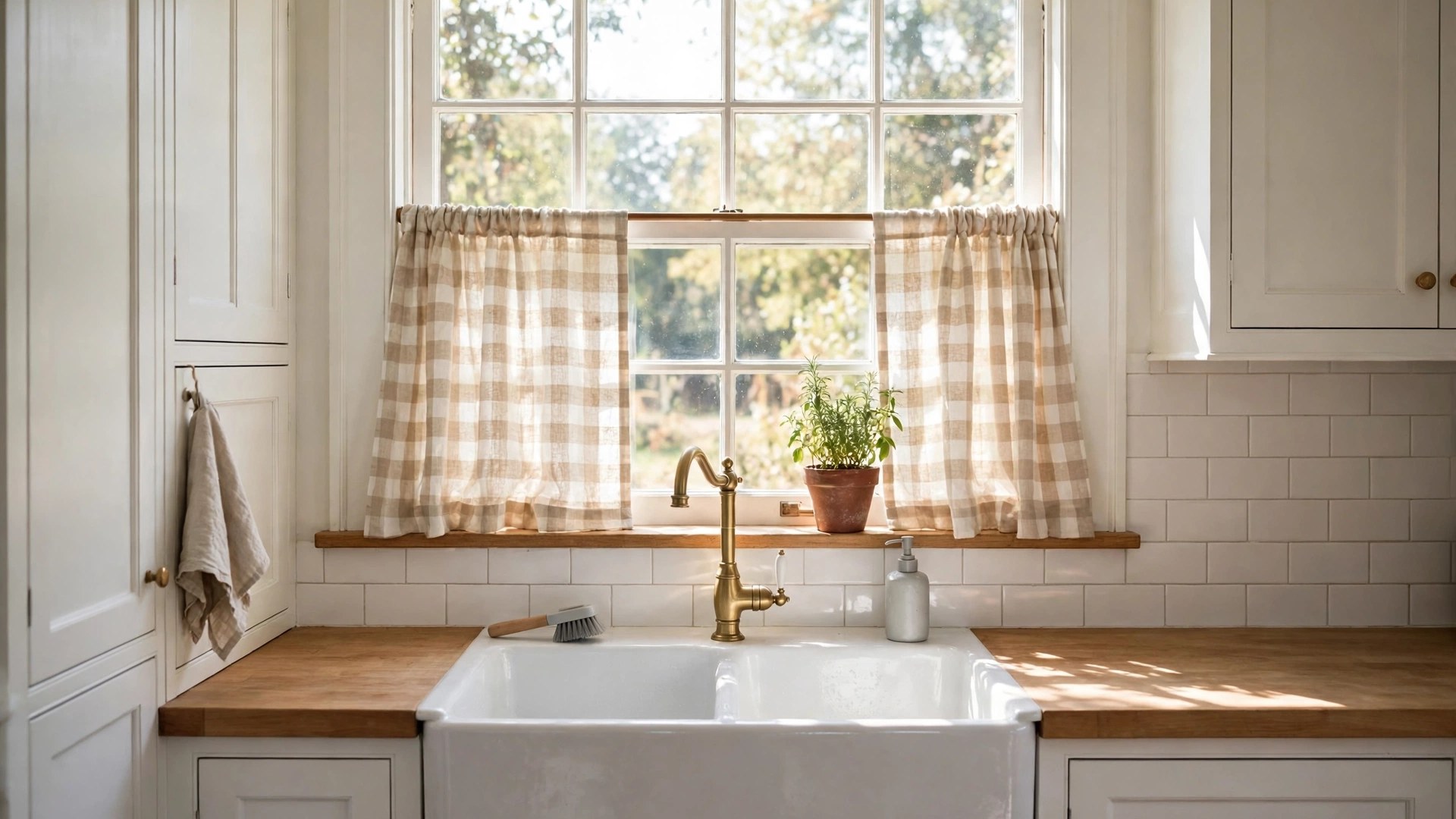

A kitchen window has the hardest job of any window in the house. It sits over a sink full of steam, within splashing distance of sauces, in direct sun at breakfast and in full view of the neighbors at dinner. The curtains that dress it have to earn their place: washable, light-friendly, privacy-smart, and safe around a working stove. That is why curtains for kitchen windows ideas deserve their own playbook, separate from the drapery rules of calmer rooms.
This guide covers the classic café curtain and its modern rivals, valances, Roman and roller shades, tiered panels, and the fabrics and lengths that actually survive kitchen life. Whether your window is a wide picture window over the sink or a small square in a rental, you will find a treatment that fits it here.
Why Kitchen Windows Need a Different Kind of Curtain
Three forces shape every kitchen window decision: moisture, mess, and light. Cooking sends steam and a fine mist of grease into the air, and both settle on fabric. Splashes from the sink reach further than you expect. And because kitchens are workspaces, the window covering has to modulate glare on counters without plunging the room into gloom.
As the overview of window treatments explains, coverings exist to manage light, privacy, and insulation, and the kitchen adds a fourth demand: cleanability. Whatever you hang must come down easily and go through a washing machine, or wipe clean in place. Treatments that need dry cleaning or delicate handling will quietly become the dirtiest thing in the room.
Safety is the non-negotiable. Keep fabric well away from open burners and toaster ovens, never let panels hang where they can drift onto a cooktop, and choose shorter lengths anywhere near heat. Kitchens reward curtains that end at the sill, not ones that pool romantically near appliances.
Café Curtains: The Timeless Kitchen Classic
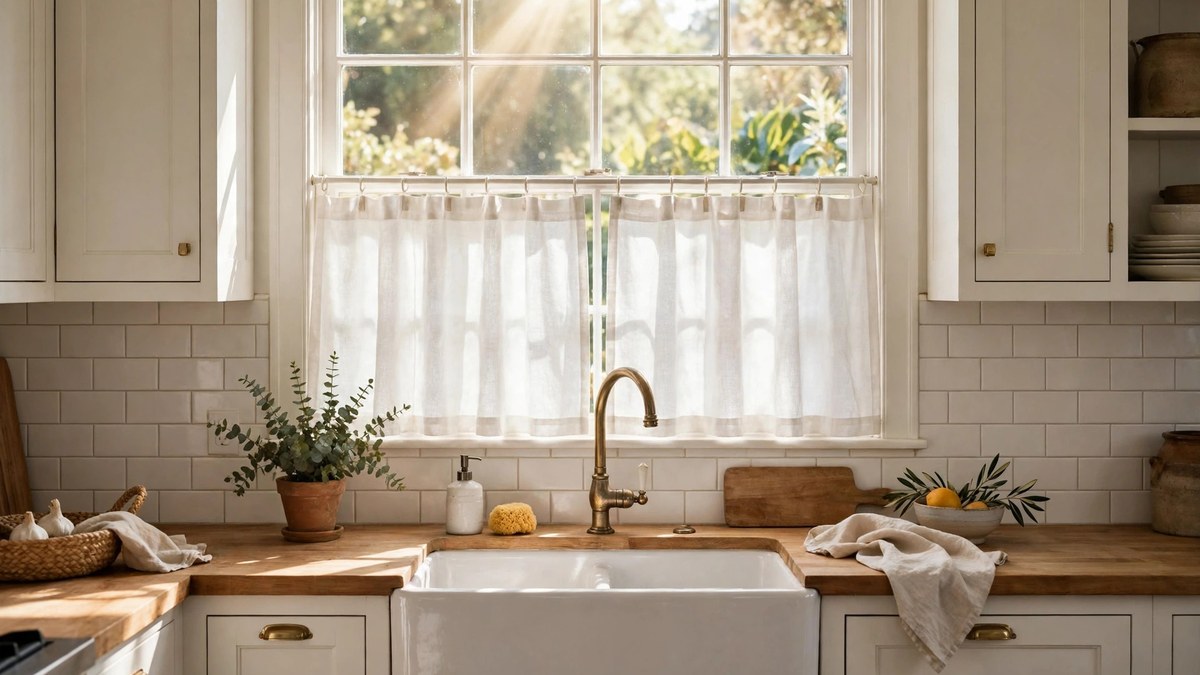
The café curtain, a short panel hung from a rod at mid-window, covering the lower half and leaving the top open, was practically invented for kitchens. It gives privacy at street and sink level, where it matters, while daylight pours over the top. For a window over the sink facing a neighbor, it remains the single most practical and charming answer.
Café curtains typically hang 24 to 36 inches long, mounted with a slim rod inside the frame or on its face, using clip rings, rod pockets, or tab tops. Linen and cotton in white, natural, or a small check or stripe are the traditional fabrics, and the look suits farmhouse, cottage, French country, and, in a plain weave with black hardware, surprisingly modern kitchens.
Styling is simple because the format is forgiving. A gentle gather of one and a half to two times the rod width gives soft folds without bulk. Add a narrow topper or leave the top bare; both are correct. For renters, a spring tension rod inside the frame holds café panels with zero holes, which is why this style is the default recommendation for apartments.
One refinement worth copying: hang the café rod a few inches above the exact middle of the window so the covered portion protects privacy even when you are standing at the sink, and the open band still lands at eye level when seated.
Valances for Color Without the Commitment
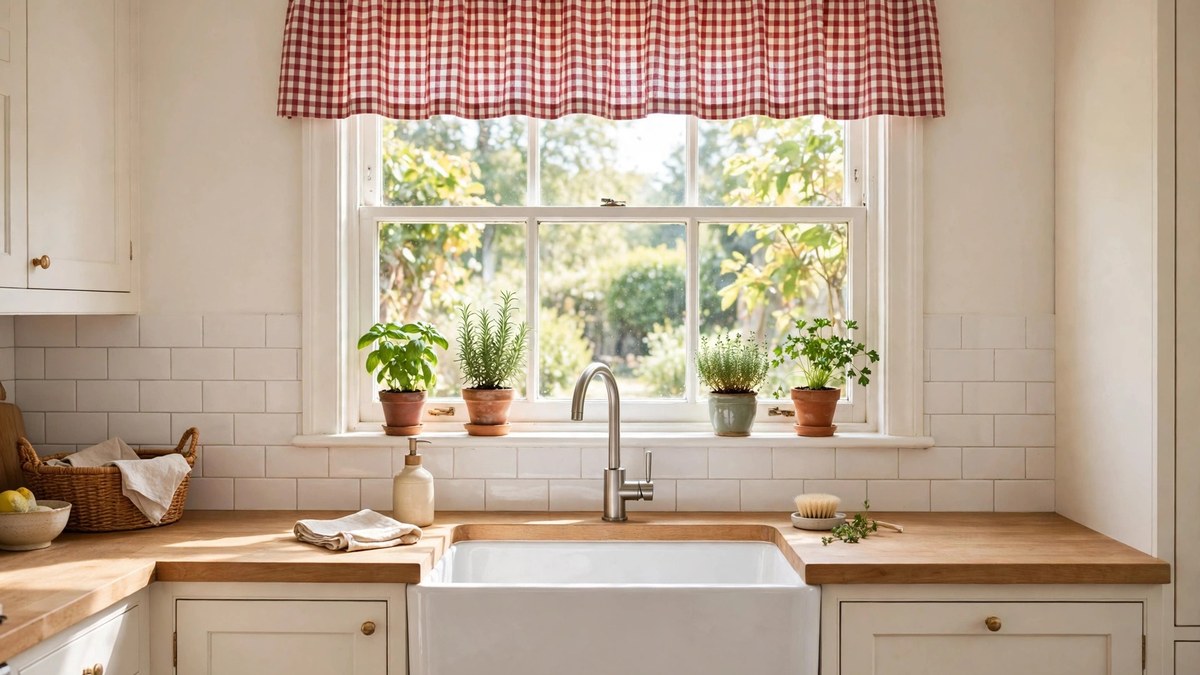
A valance covers only the top portion of the window, typically 12 to 18 inches of fabric, and functions as the kitchen’s exclamation point. It adds color, pattern, and a finished top edge while leaving nearly the whole window free for light and views. For people who find bare windows too stark and full curtains too much, the valance is the compromise that satisfies both instincts.
Styles range from tailored box-pleat valances that suit transitional kitchens, to gathered swags for traditional rooms, to flat scalloped or arched valances in cottage spaces. Because a valance uses little fabric, it is the place to spend on a print you love, the one that would overwhelm as full panels becomes perfect in a 15-inch dose.
Valances pair well with blinds and shades. Mount the valance on a short rod or board a few inches above the frame, and let a simple roller or Roman shade behind it do the privacy work. The combination reads as a designed, layered treatment for a fraction of the cost of custom drapery.
Mind the proportions: a valance that is too short looks like a mistake, and one that hangs below the top third of the window starts eating light. Aim to cover roughly the top quarter to third of the glass, and if your window is short, mount higher to fake the ratio.
Roman Shades and Roller Shades for a Clean, Modern Look
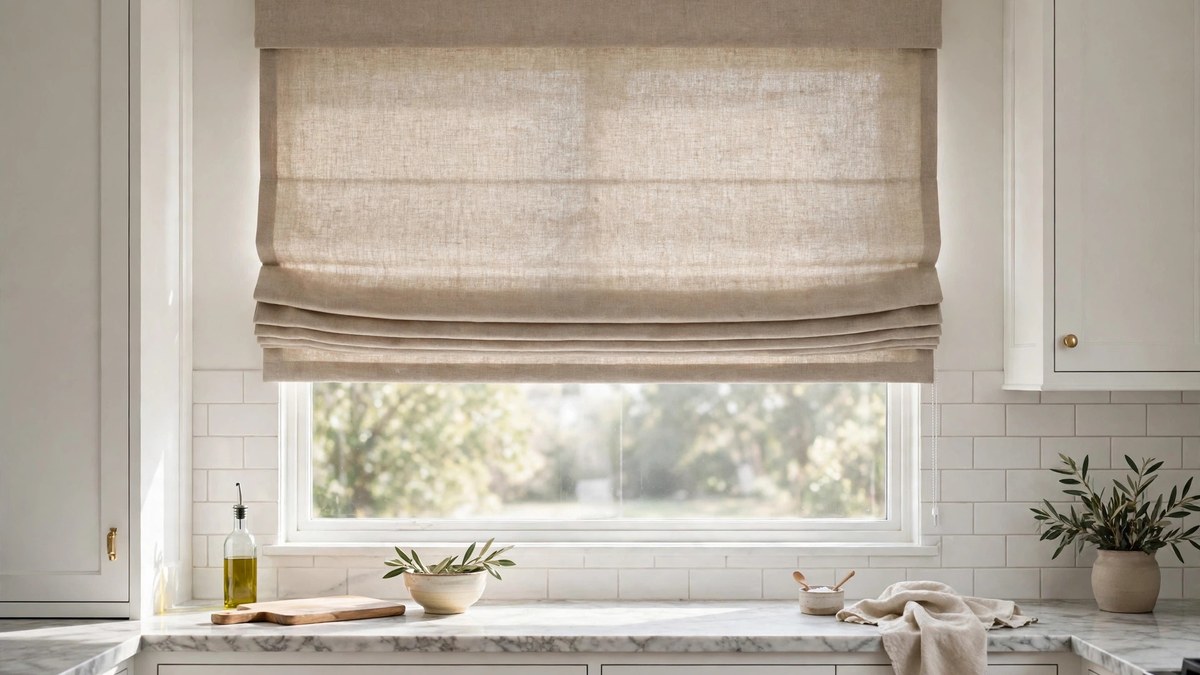
When the look you want is tailored and uncluttered, shades beat curtains. A Roman shade, fabric that folds into soft horizontal pleats as it rises, gives the warmth of fabric with the tidy profile of a blind. Inside-mounted, it disappears into the frame; outside-mounted, it can make a small window read larger and hide an ugly frame completely.
Flat Roman shades suit modern and transitional kitchens; relaxed Romans, with their gentle bottom curve, suit softer styles. Choose washable fabrics or faux linen in a performance weave, because a Roman shade over a sink will meet steam daily. Many makers now offer removable, washable liners, which extends the shade’s life considerably.
Roller shades are the minimalist’s answer: a clean sheet of fabric that vanishes into a slim roll. Solar and light-filtering weaves cut glare while preserving the view and are completely wipeable, a genuine advantage over the range or sink. A roller paired with a valance or a pair of side panels gives you function plus the softness of a “curtain” look.
Cord safety applies to every shade in a kitchen, where children and pets pass constantly. Choose cordless or motorized operation whenever you can; it is cleaner visually and removes a real household hazard.
Tiered Curtains and Sill-Length Panels
Tiered curtains, a valance plus café panels sold and hung as a set, are the traditional full treatment for kitchen windows, and they remain popular because they solve everything at once: privacy below, softness above, light throughout. Modern versions in linen-look fabrics and restrained prints look far fresher than the ruffled sets many people remember.
Full sill-length panels, curtains that hang from the top of the window to the sill, suit windows away from sinks and counters: the eating-nook window, the door to the patio, the tall window at the end of a galley. Hung on rings so they slide, they give real privacy and a more dressed look, and in a pair of simple panels they can frame a view beautifully.
Apron length, ending a few inches below the sill, is the graceful middle option for windows over radiators or low counters. What kitchens should avoid is floor-length panels near cooking and traffic: hems collect dust, mop water, and pet hair, and they drift toward heat sources. Save the puddle for the dining room.
Whatever length you choose, measure from the rod, not the frame, and remember that kitchen humidity can relax natural fibers slightly. A panel that kisses the sill in August may brush it by October; an inch of clearance is a kindness to your future self.
The Best Fabrics for Kitchen Curtains
Fabric choice decides whether your curtains look fresh for years or tired by spring. The winners in kitchens are washable, dimensionally stable, and resistant to fading. Cotton and cotton blends top the list: easy to launder, widely available in prints, and crisp after ironing. Linen is beautiful and breathes well, but it wrinkles and can shrink; linen-look polyester gives the same texture with far less fuss.
Performance and outdoor-rated fabrics deserve more kitchen fans. Solution-dyed acrylics resist sun fading and mildew, shrug off splashes, and wash clean, which makes them ideal over sinks and in steamy rooms. Sheer polyester voiles are the classic under-curtain for a reason: they launder endlessly without yellowing as fast as natural sheers.
What to avoid: silk and delicate natural fabrics, which water-spot and fade; heavy velvets and lined drapery panels, which hoard cooking smells; and anything that cannot be machine washed or wiped. A simple test before buying: if the care label makes you sigh, the curtain will not survive your kitchen.
Prints hide a multitude of sins. A small pattern camouflages the odd splash between washings far better than flat white, which is why classic kitchen curtains lean toward checks, stripes, and small florals. In a very busy kitchen with patterned counters, reverse the logic and go plain.
Getting the Length and Fullness Right
Most kitchen curtain disappointment is a measuring problem, not a fabric problem. Measure the window width including the frame if mounting outside, and order panels totaling one and a half to two times the rod length for soft, gathered folds. Skimpy panels stretched flat look like a sheet on a line; generous fullness looks like design.
For café curtains, mount the rod where you want coverage to start, usually mid-window or slightly above, and choose a panel length that ends at the sill or a breath below it. For valances, plan the drop at about a quarter to a third of the window’s height, adjusted for mounting above the frame.
Heights can cheat proportions. Mounting rods a few inches above the frame, and letting a shade or valance cover the gap, makes standard windows look taller. In the modern kitchen ideas homeowners love right now, that trick, treatments hung high and wide, is doing much of the visual work.
Keep a small kit with the curtains: spare clip rings, a couple of tension rods, and the care instructions. Kitchen curtains get washed more than any others in the house, and the household member who takes them down should not need an engineering degree to put them back.
Colors and Patterns That Work With Your Cabinets
The safest kitchen palette rule: pull curtain colors from something already in the room. A stripe that picks up the cabinet color and the countertop’s veining will look custom-chosen. White cabinets welcome nearly anything, which is exactly the danger; choose the curtain to echo your accent color, the one in your rug, towels, or small appliances, so the room coheres.
Wood cabinets, especially warm oak and walnut, look wonderful with natural linen, soft white, and botanical prints in green tones. Cool-toned kitchens with gray or blue cabinets pair well with white, pale blue, and small navy checks. Black-and-white kitchens take graphic patterns confidently: a ticking stripe or a small black grid on white is practically a neutral there.
Pattern scale should answer the window size. Small windows wear small prints; a big picture window can carry a bold, oversized botanical or stripe. The guidance in our roundup of curtain patterns for living rooms applies the same scale logic, and most of its motifs translate straight into kitchen fabrics.
When in doubt, order swatches and live with them taped to the frame for a few days, checking morning and evening light. Kitchens get both the harshest noon sun and the warmest lamp light, and fabric that survives both auditions is fabric you will love.

Curtains for the Window Above the Sink
The sink window is the most common kitchen window and the most abused: sprayed daily, steamed nightly, and blasted with sun. Short is the rule here. Café curtains or a Roman shade that ends at the sill stays clear of the faucet arc and the dish pile, and both can be raised or opened for the washing-up view.
Faucet clearance decides the mount. If your faucet is tall, an inside mount keeps fabric behind the frame line and away from spray; if the window is shallow, mount outside and choose a shade that projects minimally. Wipeable roller shades in a light-filtering weave are the pragmatic champion of this window, especially paired with a short valance for softness.
Materials at the sink should be the most washable you own. This is the window to choose polyester or a performance fabric without a twinge of guilt, because it will be laundered monthly. Two identical sets, one up and one in the wash, is the professional trick for the sink window specifically.
Mind the sill itself: leave a small gap so panels do not sit in puddles, and avoid wooden rods that swell with moisture. Slim metal or tension rods are the sink window’s best hardware.
Small Windows and Awkward Windows
Small windows do not need small treatments; they need treatments with confidence. A shade mounted above the frame and extending a few inches beyond each side makes the glass look larger when open. A café curtain in a fresh print gives a tiny window a deliberate, cottage air instead of an apologetic one. The compact designs in our kitchen ideas for modern, small, and luxury spaces use exactly these tricks to keep small rooms feeling planned.
Corner windows and windows butted against cabinets want inside mounts and slim profiles, so nothing fights the cabinet door swing. Bay windows in eating nooks take individual shades per section better than any curtain rod gymnastics. For a window in a door, use an enclosed blind or a shade mounted directly on the door with hold-down brackets so it does not swing with the door.
Basement and high, wide windows, the kind that sit near the ceiling, benefit from top-down shades that cover the lower band for privacy while keeping the sky visible. And for a window that faces a truly unfortunate view, a frosted film on the glass plus a pretty valance solves the outlook while keeping every lumen of light.
The unifying principle: treat the window you have with the full ceremony of fabric, color, and hardware, and it will read as a feature at any size.
Hardware: Rods, Rings, and Tension Tricks
Hardware is the jewelry of the treatment, and kitchens reward the practical kind. Slim metal rods in matte black, brushed nickel, or brass that matches your faucet and cabinet pulls make the whole window look coordinated. Keep finishes consistent across the room’s metals and the treatment instantly looks more expensive.
Inside-mount tension rods are the rental hero and the café curtain’s best friend: no holes, adjustable, and strong enough for light panels. For heavier or frequently moved curtains, a properly anchored rod with rings and clips moves smoothly and lets panels come down for washing in seconds, which, in a kitchen, is often.
Finials should be small in kitchens. Oversized finials crowd cabinets and collect grease in their crevices; simple end caps or small balls in the rod’s finish are cleaner. Where a rod passes in front of a cabinet that opens, check the swing clearance before drilling, not after.
One underrated detail: matching the rod’s diameter to the treatment’s scale. A chunky rod overwhelms a café curtain; a spindly rod sags under full panels. When the hardware disappears and only the fabric reads, you have sized it right.
Common Kitchen Curtain Mistakes
The first mistake is length near heat: panels that hang beside or behind a range are a safety problem before they are a style problem. Keep fabric short and clear of burners, always. Second is choosing dry-clean-only or delicate fabric for the hardest-working window in the house; it will be dirty, then ignored, then resented.
Third is skimping on fullness. Flat, stretched panels look like laundry, not curtains; budget for one and a half to two times the width in fabric. Fourth is forgetting the view from outside: kitchen windows face streets and neighbors, and a treatment should look tidy from the street as well as the sink.
Fifth is ignoring moisture at the sink window, where cotton mildews and wood rods swell. And sixth is matching everything: curtains that exactly match the towels, rug, placemats, and canisters tip from coordinated into themed. Echo one or two elements and let the rest of the room breathe.
Frequently Asked Questions
What type of curtains are best for a kitchen?
Short, washable ones. Café curtains, tiered sets, Roman shades, and roller shades in cotton, linen-look polyester, or performance fabric handle steam, splashes, and frequent laundering better than any full-length drapery.
How long should kitchen curtains be?
Usually sill length or shorter. Café panels of about 24 to 36 inches cover the lower window for privacy, valances drop 12 to 18 inches, and panels away from sinks and stoves may end at the sill or just below it. Floor length belongs away from cooking zones.
Are café curtains still in style?
Yes. In linen, cotton checks, and simple stripes with slim black or brass rods, café curtains are a staple of farmhouse, cottage, and modern-country kitchens, and they remain the most practical privacy solution for sink windows.
Can I put regular curtains in the kitchen?
You can for windows far from the sink and stove, in washable fabrics and sill or apron lengths. Avoid delicate, lined, or dry-clean fabrics, and never hang panels where they can reach a burner.
What fabric washes best for kitchen curtains?
Cotton and polyester blends, linen-look polyester, and solution-dyed performance fabrics all launder well and resist fading. Polyester sheers are the easiest-care choice for layered looks.
How do I get privacy without losing light?
Cover only the lower half with a café curtain, use a light-filtering roller or sheer, or choose a top-down shade. All three block sightlines at standing and seated eye level while daylight enters above.
What curtain colors suit white kitchen cabinets?
Almost anything, so choose by accent: pull a color from your rug, towels, or backsplash. Classic performers are navy or red small checks, botanical greens, and natural linen; bold prints work because the cabinets stay quiet.
Final Thoughts
Kitchen curtains succeed when they respect the room: short enough to stay safe, washable enough to stay clean, and tailored enough to let the light in. Start with the window over your sink, choose the format that fits its job, café, shade, valance, or tiers, and let fabric and color do the decorating. One well-dressed kitchen window has a way of making the whole room look freshly painted, and it usually costs less than dinner out.
