
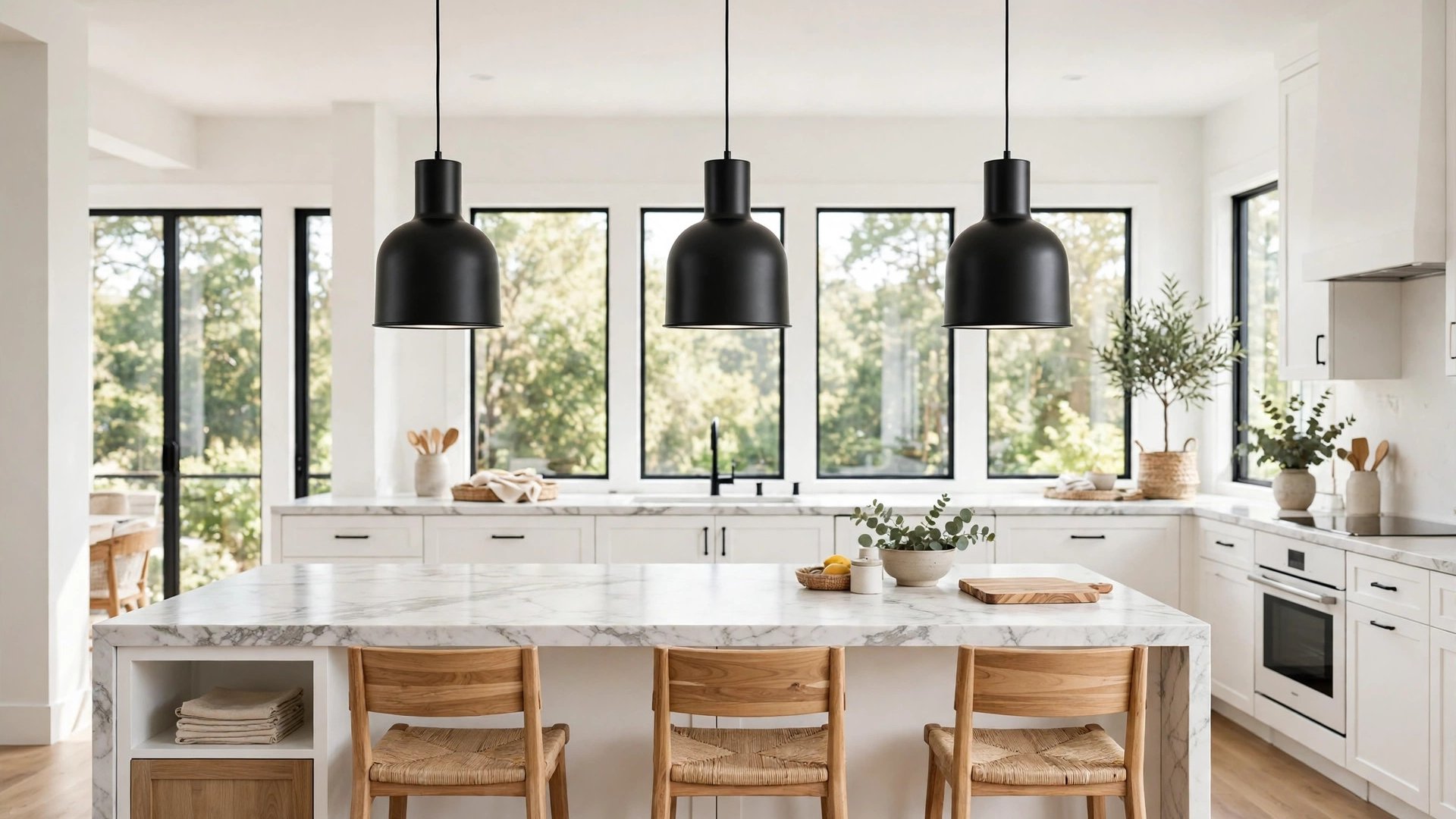

Few fixtures deliver as much design per dollar as black pendant lights. Hang two or three over a kitchen island and the room instantly gains contrast, rhythm, and a focal point, even if nothing else changes. Black is the rare finish that reads modern and classic at the same time: graphic against white cabinets, warm against wood, and completely at home beside brass, chrome, or matte black hardware.
That versatility hides a few decisions that matter. Pendant size, count, spacing, and hanging height follow learnable rules, and getting them wrong is why some pendant rows look like a showroom and others look like an accident. Finish matters too, because matte black, glossy black, and blackened metal behave differently under kitchen light and show dust differently on a Tuesday morning.
This guide walks the whole decision: the styles worth knowing, the sizing math for islands and tables, the hanging heights that keep sightlines open, and the special case of tall ceilings where standard pendants get lost. You will finish with a plan you can measure against your own kitchen rather than a guess you hope works.
Why Black Pendants Work in Almost Every Kitchen
Black’s first gift is contrast. Most kitchens are dominated by light surfaces — white or pale cabinets, light stone, stainless steel — and a line of black pendants draws a confident horizon through all that lightness. Your eye gets somewhere to land, and the island, usually the room’s workhorse, becomes its visual anchor too.
Second, black is finish-proof. It coordinates with every common metal without matching any of them, which frees you from the exhausting game of making the pendants, faucet, handles, and appliances all one metal. Black pendants beside a chrome faucet look deliberate; beside brass, they look tailored. Very few finishes can claim both.
Third, black hides the sins of real kitchens better than most. Cooking film and dust show less on matte black than on polished chrome, and the simple silhouettes most black pendants use do not date as quickly as ornate fixtures. Our broader recommended kitchen lighting guide places pendants inside the full layered plan; this article is the deep dive on the fixture that does the visual heavy lifting in that plan.
Finally, black scales. A tiny galley kitchen can carry two small black pendants without feeling decorated at itself, and a vast open-plan kitchen can carry five large ones as a genuine architectural feature. The color stays constant; only the sizing changes.
Popular Styles: Dome, Cone, Cage, and Lantern
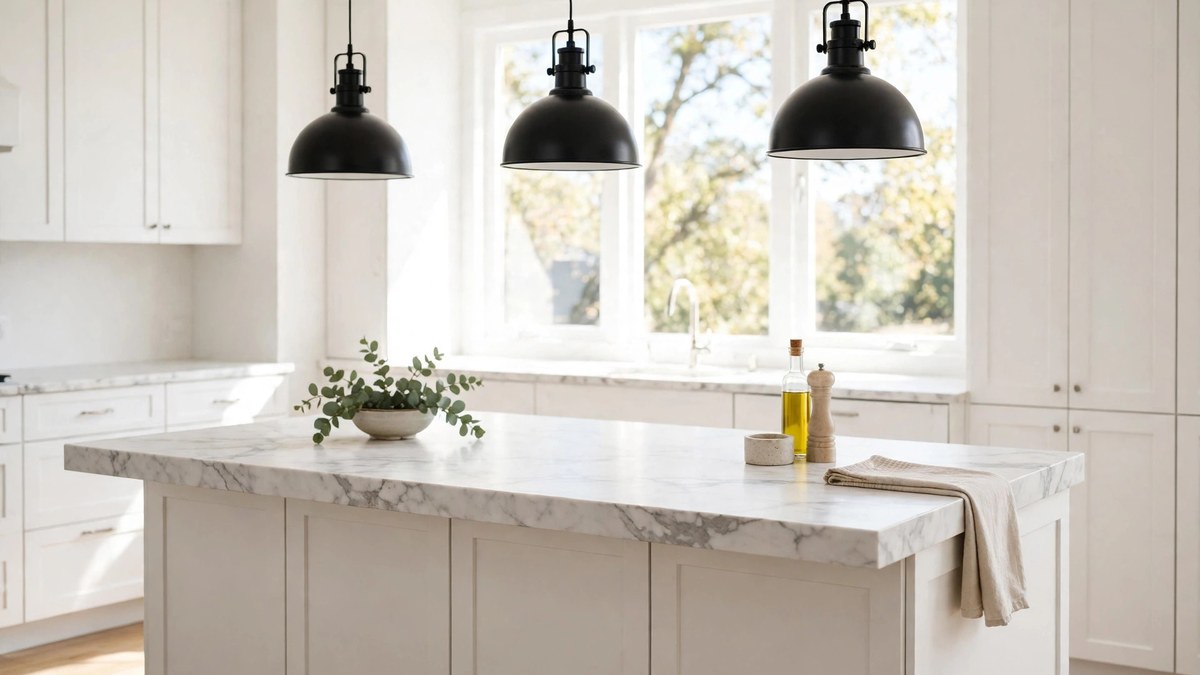
The dome pendant is the classic: a half-round metal shade that throws light down onto the work surface and reads farmhouse, industrial, or modern depending on its finish and stem. Domes are the safest choice over islands because their light is focused where you cook and their shape is universally understood.
Cone pendants angle the light into a tighter pool and look sharper and more contemporary. They suit modern kitchens and work well in rows of three, where their geometry sets up a pleasing rhythm. Because the cone narrows the spread, space them a touch closer than domes or choose slightly brighter bulbs.
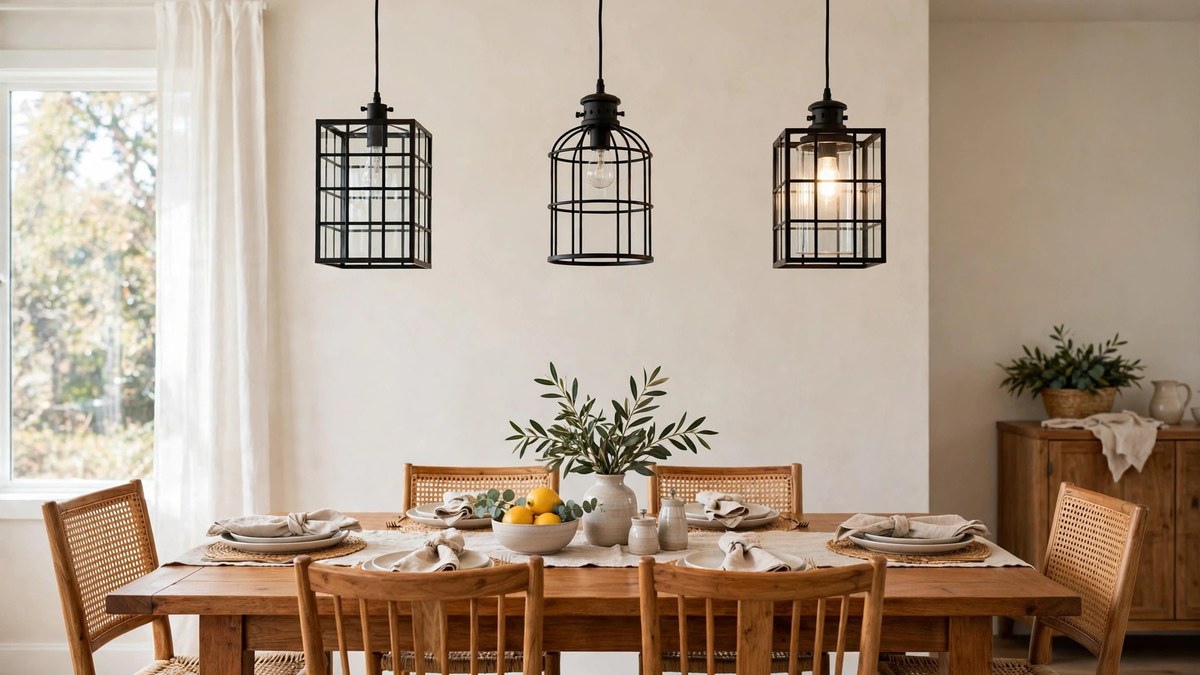
Cage and open-frame pendants trade shade for structure: a black metal frame around an exposed bulb. They contribute style without blocking sightlines, which makes them ideal over islands in open plans where a solid shade would cut the room in half visually. Their light is ambient as much as task, so pair them with good recessed or under-cabinet light for actual work illumination.
Lantern pendants box the bulb in a frame with glass panels, borrowing from outdoor and traditional design. They bring a slightly formal, collected feel and suit traditional and transitional kitchens. Glass keeps their visual weight light even at larger sizes, so lanterns are the forgiving choice when you want a bigger fixture over a table or island.
Beyond these four, black also appears in globe pendants (opal glass in black fittings), linear pendants (one long fixture instead of a row), and artisan ceramic or rattan pieces painted black. The style families matter less than consistency: pick one silhouette language and repeat it.
Matte, Gloss, and Mixed-Metal Finishes
Matte black is the current default for good reason. It absorbs light softly, looks expensive, coordinates with everything, and does not show every fingerprint. On dome and cone pendants it gives that tailored, almost architectural outline designers love. If your kitchen has black appliances or black window frames, matte black pendants tie the room together without a single matchy decision.
Gloss black is bolder and a little more formal. It reflects light and surroundings, which can make a fixture feel jewel-like over a dining table, but it also highlights dust and cooking film faster, and in a row of three it can look busy. Choose gloss when the pendant is a solo statement, matte when it is part of a working row.
Blackened and oil-rubbed finishes sit between the two, with subtle variation that suits traditional and rustic kitchens. They hide wear gracefully and pair with aged brass and bronze hardware in the same tonal story.
Mixed-metal designs — black shades with brass stems, sockets, or interior linings — have become the sophisticated compromise. The brass interior deserves special mention: a black dome with a gold or brass inside throws warmer, prettier light onto the counter and softens the fixture’s contrast. If you love black pendants but your kitchen is warm and traditional, the brass-lined dome is very likely your fixture.
How Many Pendants Do You Need?
The odd-numbers rule is the famous starting point: one pendant for a small island or a sink, two for a standard island, three for a long one. It survives because it tends to match the underlying math, but count should really follow island length and pendant size together.
Work it from spacing. Pendants look right when the gap between shades is roughly 24 to 30 inches, and when the row leaves comfortable margin at both ends of the island rather than crowding the edges. For a typical six-to-seven-foot island, that math lands on two medium pendants or three smaller ones. For an eight-to-nine-foot island, three medium pendants usually work; beyond that, four or a pair of linear fixtures enters the conversation.
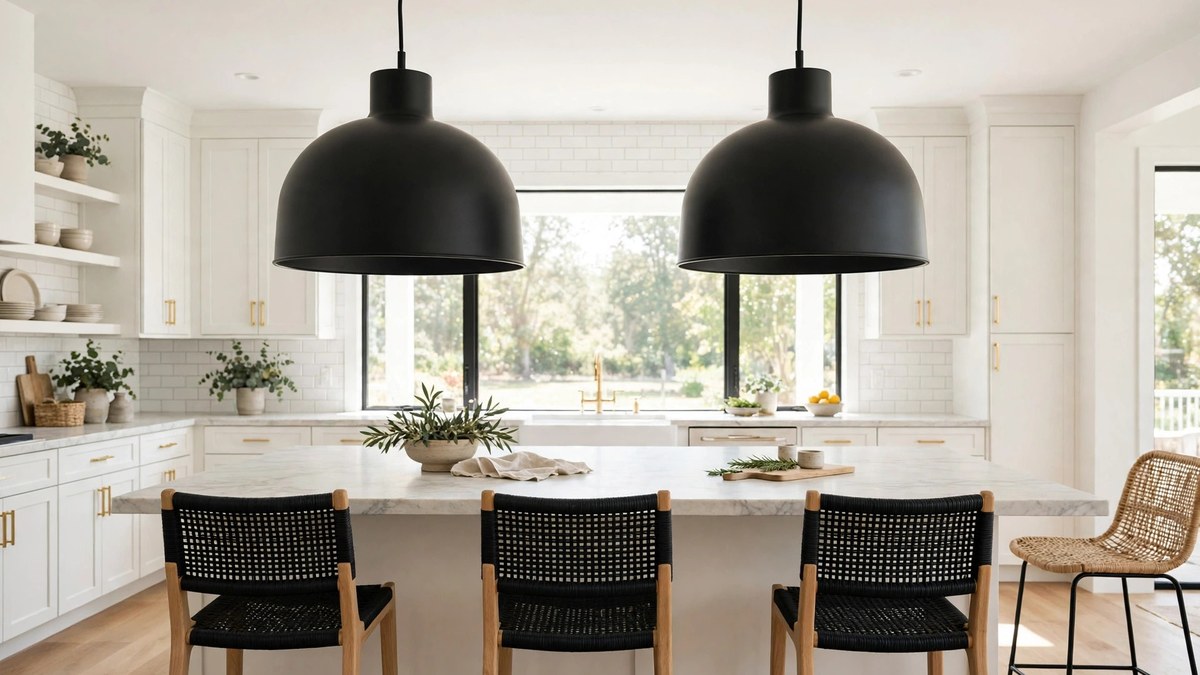
Two pendants deserve a defense, because the odd-number rule sometimes bullies people out of them. Two large pendants centered over a six-foot island, spaced so each sits over its third of the surface, look balanced and intentional. The rule to actually obey is symmetry: the row must be centered on the island and evenly spaced, with equal margins at the ends. A centered, even row of two beats a cramped row of three every time.
Match count to function as well. If the island is your main prep surface, more, brighter task light matters; if it is mostly a breakfast bar, fewer fixtures with warmer, dimmer light may serve the mood better.
Sizing Pendants Over an Island or Table
Pendant diameter is where most mistakes happen, in both directions. Too small and expensive fixtures vanish; too large and they crowd the sightline and bang heads visually even when they clear physically.
A reliable island guideline: the combined visual footprint should leave roughly six inches or more of counter visible beyond the fixture on each end of the row, and individual pendants for a standard island usually land somewhere between about 10 and 20 inches in diameter, depending on count. Three pendants can each be smaller; two pendants should each be larger, so the row holds its own against the island’s mass.
Over a dining table, borrow the chandelier rule: the fixture (or the row’s total span) should be roughly one-half to two-thirds the table’s width, and it should never exceed the table’s width minus about a foot, so nobody’s head or view collides with it while seated. Our over dining table lighting ideas walks those table proportions in full.
Ceiling height feeds size too. On tall ceilings, scale up — a pendant that suits eight feet looks lost at twelve. When in doubt between two sizes, the larger usually wins in photos and in life, provided the hanging height rules in the next section still hold. A pendant light earns its place by presence as much as by lumens.
Hanging Heights That Look Right
Height is the rule people most often get wrong, because the correct number depends on what is beneath the fixture. Over a kitchen island or counter, the standard target is the bottom of the pendant roughly 30 to 36 inches above the countertop. That height puts task light where you work, keeps the shades below eye level of a standing cook across the island, and preserves the view through the kitchen.
Over a dining table, hang the fixture so its bottom sits about 30 to 36 inches above the tabletop. Diners see each other under or around it, the table gets a pool of light, and the fixture reads as part of the table setting rather than ceiling equipment.
In open walkways, the rule flips to clearance: the bottom of any pendant should stay around seven feet or more above the floor so nobody’s head is at risk. Between these rules, prioritize the surface rule where there is a surface, and the head rule where there is a path.
When a row spans an island where tall people sit on stools, check sightlines from the stools. If a pendant bottom lands exactly at seated eye level, raise the row an inch or two; even a small adjustment removes the glare line and the feeling of a fixture hovering at your forehead.
Adjustable stems and cords exist precisely because these numbers are ranges, not commandments. Order fixtures with more drop length than you think you need; shortening is easy, lengthening is a return shipment.
High Ceiling Lighting: Stems, Chains, and Longer Drops
Tall ceilings are where pendant plans go to die quietly, because standard fixtures hung at standard drops end up floating in the black band above the room’s life. High ceiling lighting needs its own rules: bring the pendants down to the same working heights as any other kitchen — bottoms around 30 to 36 inches over the island — and let the stems or chains cover the distance.
That distance is the design opportunity. Long black stems create strong vertical lines that organize a tall room; chains read more traditional and allow fine height adjustment link by link. Many pendants ship with several stem sections for exactly this purpose, and additional stems can be ordered for very tall spaces, including sloped ceilings with the right canopy adapters.
Scale is the other half. In a tall room, increase pendant diameter and count so the row holds the volume: what looked generous at eight feet looks skimpy at fourteen. Consider also layering upward — a tall kitchen still needs its ambient and task layers, and pendants alone rarely fill a high room with light. Our bedroom chandelier ideas cover similar drama-first fixture logic for tall bedrooms if your ceilings make every room a high-ceiling problem.
For two-story foyers and stair landings, the pendant rule changes again: fixtures hang for the view from both levels, often in clusters at varied heights. Black pendants excel here because their silhouettes read clearly against light walls and windows from above and below.
Black Pendants Beyond the Kitchen
Once you trust the fixture, uses multiply. Over a bathroom vanity, a pair of black pendants frees the mirror wall of sconces and gives even, flattering light at face height — just confirm the fixtures are rated for damp locations. Beside a bed, pendant drops replace table lamps and free the nightstand entirely; hang them so the bottom sits comfortably above the mattress sightline when you are sitting up reading.
In dining rooms, a row of black pendants over a rectangular table delivers the rhythm of a chandelier with a more modern, architectural feel, and the sizing rules from the table section above apply directly. In entryways with the headroom, a single large black lantern pendant makes a confident first impression and hides dust between cleanings better than glass alone.
Black pendants also solve a rental problem gracefully: a dramatic plug-in or swag pendant can transform a room’s light without hardwiring, and it moves with you. The swag hook look is deliberately casual, so lean into it with a cage or globe style rather than pretending it is a stem fixture.
Bulbs and Brightness: Exposed Filament vs. Shades
The bulb decision splits by style. In cage, globe, and open pendants, the bulb is visible, so it becomes part of the design. LED filament bulbs mimic the warm glow of old Edison bulbs while using a fraction of the energy; choose them around 2700K for kitchens where warmth matters, and check the lumen output, because decorative bulbs vary widely — a pretty bulb that emits almost no light is a sculpture, not a fixture.
Under dome and cone shades, the bulb hides, so performance leads: brighter LEDs, typically the equivalent of 60 to 100 watts per pendant depending on the kitchen’s other layers, with high color rendering so food and counters look true. Warm-to-neutral temperatures around 2700K to 3000K suit most kitchens; cooler bulbs can make black fixtures look stark and food look dull.
Dimmers are close to mandatory. Pendant rows that are perfect for chopping at full brightness are glaring at a dinner party; dimming to 30 percent turns the same fixtures into ambiance. Confirm your bulbs and dimmer are compatible before the electrician leaves, because LED flicker at low levels is the most common pendant complaint and it is nearly always a pairing problem, not a fixture problem.
Coordinating With Hardware, Faucets, and Appliances
Black pendants simplify coordination because black is a neutral in metal terms. The rules that remain are about consistency of temperature and finish character. If the pendants are matte black, nearby matte black hardware is a perfect match, but aged brass or chrome hardware also works because black frames them rather than competing. What looks off is a near-miss: glossy black pendants beside matte black handles can read as a failed match instead of a deliberate mix.
Black stainless appliances are the closest family, and together they create the modern, tonal kitchen. Standard stainless and white appliances also work, because black reads as an accent line above them. Wood is black’s best friend at every tone: walnut warms it, white oak brightens it, and black pendants over a wood island or wood stools is a combination that rarely misses.
Repeat the black somewhere else at a lower level — stool legs, cabinet hardware, a faucet, or picture frames — so the pendants do not float as the room’s only black note. Two or three echoes are enough; the rule of repetition applies to finishes just as it does to colors.
Cleaning and Maintenance
Black fixtures have one honest drawback: they show dust and cooking film against their dark surface when the light rakes across them, especially on the tops of domes. The good news is that the fix is trivial — a monthly pass with a dry microfiber cloth or a feather duster on an extension pole keeps them crisp, and matte finishes forgive more than gloss between cleanings.
Kitchen pendants collect a fine grease mist over months of cooking. A cloth dampened with warm water and a drop of dish soap restores them; avoid abrasive pads on matte black, which can polish shiny spots into the finish. Glass globes and lantern panels come off on most models for a proper wash, which also brightens their light noticeably.
Bulb changes are the other maintenance moment. LEDs should last for years, but buy your spares at installation time, matched to the exact bulb in use, so a single replacement does not introduce a different color temperature into the row. A pendant row with one bulb glowing warmer than the others is a small thing that everyone notices.
Mistakes to Avoid
The most common pendant mistake is hanging them at ceiling-dictated height instead of surface-dictated height. Pendants that hug a tall ceiling or dangle at eye level over an island both trace back to skipping the 30-to-36-inch rule. Measure from the countertop, always.
Second is scale timidity: pendants a size too small, which look like afterthoughts no matter how beautiful they are. When torn between two sizes over an island, take the larger.
Third is ignoring the view from the next room. In open plans, pendants are seen in profile from the living area all day. A row that is off-center on the island, unevenly spaced, or hung at slightly different heights will announce itself from thirty feet away. Measure the row twice; your eye will audit it forever.
Finally, do not install pendants as the kitchen’s only light. They are the jewelry layer. Without ambient and task light beneath them, even the best black pendants leave the corners dark and the counters underlit.
Frequently Asked Questions
How high should black pendant lights hang over an island?
The standard target is the bottom of the pendant about 30 to 36 inches above the countertop. That height focuses task light on the work surface, keeps the fixture out of standing sightlines across the island, and looks proportional in most kitchens. Adjust an inch or two for very tall household members or unusual ceiling heights.
How many pendants do I need over my kitchen island?
Let island length and pendant size decide: roughly one fixture per two to two-and-a-half feet of island, spaced evenly with the shades about 24 to 30 inches apart. Most six-to-seven-foot islands look right with two medium or three smaller pendants, and eight-to-nine-foot islands usually take three medium ones.
Do black pendant lights go with brass hardware?
Yes, it is one of the most reliable pairings in kitchen design. Black reads as a neutral frame, so brass knobs and faucets look warmer and more deliberate beside it. For extra cohesion, choose black pendants with brass sockets or interiors, or repeat a small black element elsewhere so the mix looks planned.
Are black pendant lights going out of style?
Black as a finish behaves more like a neutral than a trend color, and pendant silhouettes in black have been in continuous use from industrial design through today’s modern farmhouse. Styles cycle, but a well-proportioned black dome, lantern, or globe is about as safe as fixture choices get.
What size pendants should I choose for a standard island?
For a typical island, individual pendants often land between about 10 and 20 inches in diameter, smaller when there are three, larger when there are two. Keep roughly six inches or more of counter visible beyond the ends of the row, and if you are choosing between two sizes, the larger usually looks more intentional.
Can I hang black pendants in a room with a low ceiling?
Over an island or table, yes, provided the 30-to-36-inch clearance above the surface works with your ceiling height; short stems and semi-flush-style pendants exist for exactly this. In open walkways with low ceilings, skip pendants and use flush mounts instead, since the bottom of a walkway fixture needs roughly seven feet of head clearance.
What bulbs work best in black pendant lights?
In open or cage pendants, LED filament bulbs around 2700K give the decorative warm look with modern efficiency. Under metal shades, brighter high-CRI LEDs in the 2700K to 3000K range keep food and counters looking true. Put the row on a compatible dimmer so the same fixtures serve prep work and dinner parties.
Conclusion
Black pendant lights succeed on proportion and repetition: the right silhouette in the right size, hung 30 to 36 inches over the surface it serves, in a row your eye can count with pleasure. Get those three things right and the finish does the rest, anchoring your kitchen or table with contrast that flatters everything around it.
Start by measuring your island or table, then choose count and diameter from the spacing rules, not from a product photo. When the row is centered, even, and at the right height, black pendants stop being a purchase and start being the room’s signature.
