
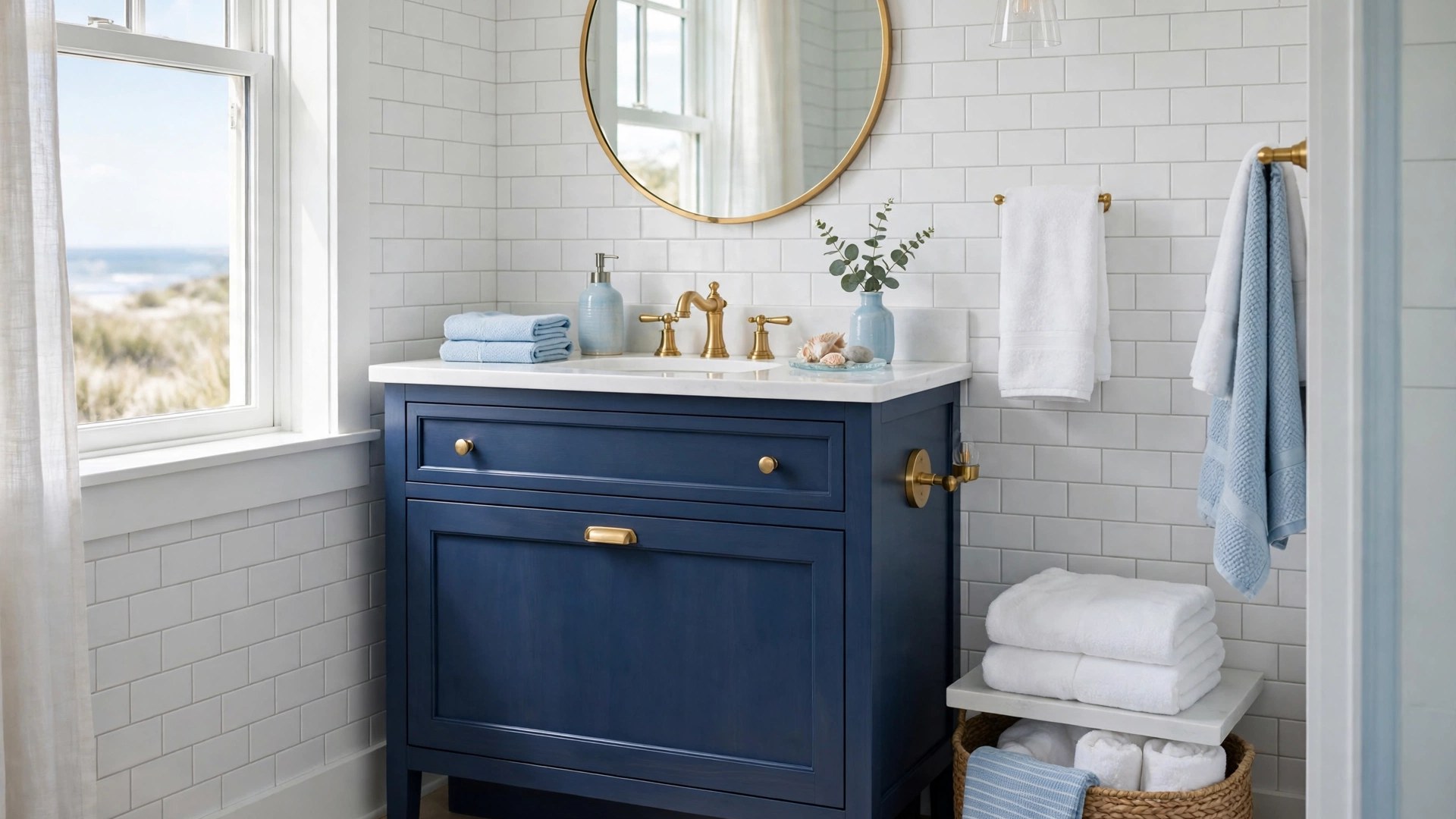

Blue is the bathroom’s native color. It is the color of water, of clean skies reflected in a basin, of the tiles in a century of well-loved baths, and it remains the shade homeowners reach for when a bathroom should feel calm, clean, and quietly classic. These blue bathroom ideas span the full register, ink navy vanities, powder-blue walls, sea-glass tile, denim and slate and robin’s egg, and show how to carry the color through decor, fixtures, and textiles without turning the room into a swimming pool.
Along the way we will pair blue with its two great partners, white and green, build complete color palettes, and solve the hardest blue-bathroom problem of all: choosing paint for a small room with no natural light.
Why Blue and Bathrooms Belong Together
As any introduction to color theory will confirm, blue sits on the cool side of the wheel, and cool colors visually recede, which is why blue rooms feel calmer and, often, larger than warm-colored rooms of the same size. In a room devoted to water and washing, that psychology is not a metaphor; it is the experience guests describe as “clean” and “fresh” without knowing why.
Blue is also the most forgiving color family in decorating. Its range runs from near-black navy through mid-tone denim and slate to tints so pale they read as colored whites, which means there is a blue for every light condition and every courage level. Unlike trend colors that arrive with an expiration date, blue has been the bathroom’s default accent for over a hundred years of white fixtures, so it carries classic credibility in any architecture.
Practically, blue hides the bathroom’s daily evidence gracefully: water spots and dust show less on mid-tone blue than on white or black, and the color flatters both chrome and brass, cool and warm metals alike. When a room must be one color, blue is the safest beautiful answer.
Blue also adapts across the house’s population better than any rival. It reads serene in a primary suite, playful in a children’s bathroom at brighter saturations, and gender-neutral in a shared or guest bath where themed colors risk alienating someone. A color that pleases toddlers, teenagers, and grandparents without changing its name is a rare decorator’s asset.
Blue Bathroom Decor Ideas: Building the Look Layer by Layer
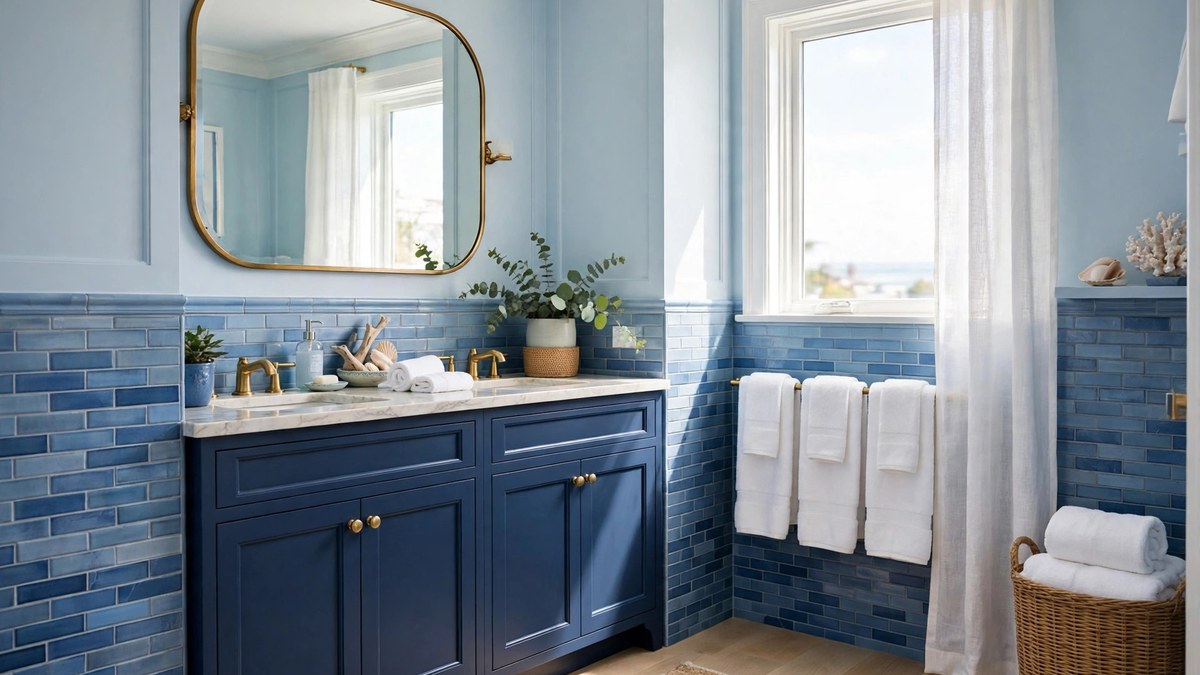
Start with the blue’s placement, because blue bathroom decor ideas divide into two philosophies. The first commits blue to a permanent layer, a navy vanity, blue tile, or saturated walls, and keeps everything else quiet. The second keeps the room’s bones white or neutral and lets blue arrive in textiles, art, and accessories, changeable with the seasons and the mood.
For the committed route, choose the shade by the room’s light. North-facing and windowless rooms make blues go colder and grayer; a blue with a hint of green or warmth, a teal-leaning navy like Sherwin-Williams’ Naval SW 6244, survives that light handsomely. Bright south-facing rooms can carry truer, icier blues without turning chilly. Always test a large swatch on two walls and live with it through a full day’s light before deciding.
For the textile route, layer at least three blues so the room reads collected rather than matched: towels in a mid blue, a shower curtain in a print that marries blue with white or green, a bath mat a shade deeper, art with blue as one color among several. Monochrome layering, many tones of one hue, is the decorator’s trick that makes a simple scheme look expensive.
Finish either route with the blue’s supporting cast: crisp white for contrast, natural wood or rattan for warmth, and one metal repeated consistently. Blue bathrooms fail when the blue is lonely; give it partners and it behaves like the classic it is.
Bathroom Designs White and Blue: The Classic Partnership
If blue is the bathroom’s native color, white is its native fixture, and bathroom designs white and blue together form the oldest successful partnership in the room’s history: Greek islands, coastal cottages, Victorian baths, and spas all run on this pairing because it encodes clean water and clean linen in two colors.
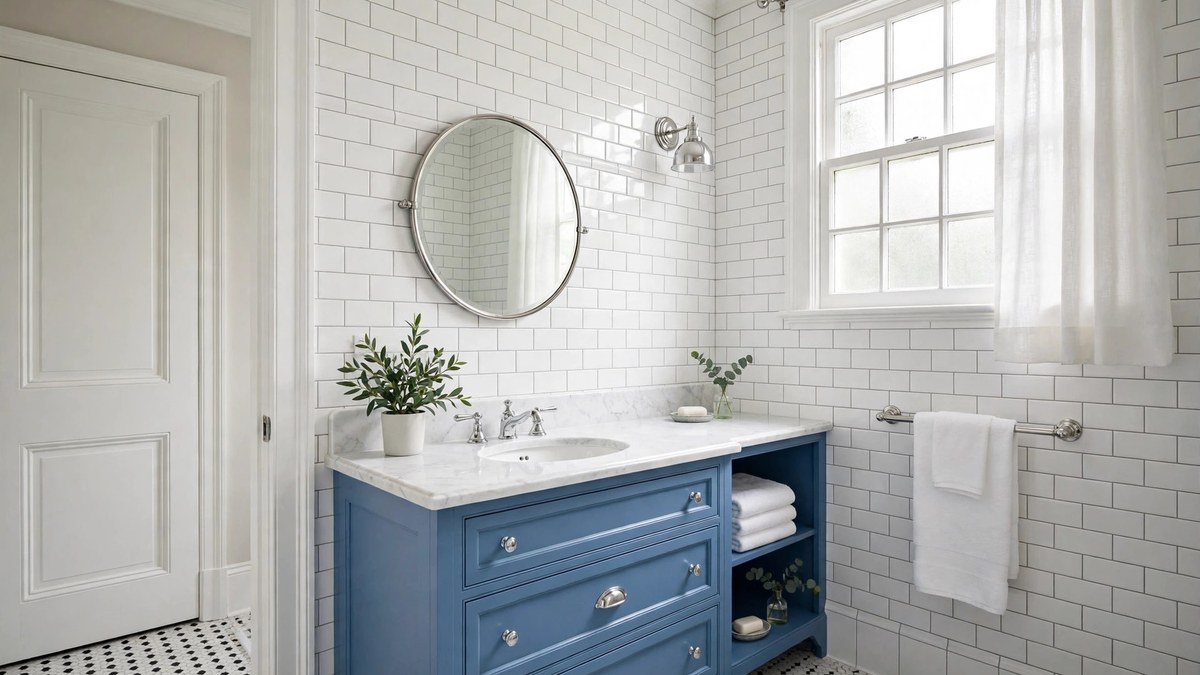
The design question is ratio. Mostly white with blue accents feels bright, coastal, and safe; mostly blue with white fixtures and trim feels enveloping, dramatic, and designed. The middle, white tile with a blue vanity, or blue walls with white wainscot, is where most beloved bathrooms live, because each color gets a full field to perform on.
Pattern is the partnership’s playmate: blue-and-white chinoiserie prints, Greek key borders, stripes, and checks have centuries of precedent and suit traditional and transitional rooms especially. In modern rooms, keep the pairing in flat fields and let one patterned textile, the curtain or a runner, carry the motif.
The white you choose matters more than people expect. With navy and other deep blues, a clean, slightly warm white such as Benjamin Moore’s Simply White OC-117 keeps the contrast crisp without going blue-cold itself. Stark blue-whites beside navy can read as icy; warm whites read as sunlight. For the tile-and-grout version of this classic, our bathroom wall tile ideas show the pairing in marble, subway, and mosaic form.
Green Bathroom Decorating Ideas That Pair With Blue
Blue’s most natural partner is its neighbor on the wheel, and green bathroom decorating ideas begin where blue leaves off: sage, eucalyptus, sea glass, and deep forest tones all share blue’s cool calm while adding the living note of plants and gardens. A blue room with green accents feels like water meeting shore, which is precisely the bathroom’s story.
The easiest entry is botanical: green towels or a leaf-print curtain in a blue room, a fern on the vanity, eucalyptus in the shower. The palette stays cool and cohesive while the green keeps the blue from feeling flat or cold. Painted in the other direction, a soft sage vanity in a blue-tiled room is one of the prettiest combinations in current design.
For a committed green moment inside a blue scheme, consider a sage like Sherwin-Williams’ Evergreen Fog SW 9130 on a vanity or a single wall; its gray-green neutrality flatters navy, sky, and denim blues equally. Deep bottle green can play the drama role usually given to navy, with blue stepping back into the textile layer.
Keep the metals warm here, brass and brushed gold especially, because blue-plus-green-plus-chrome can tip a room from spa to swimming pool. Warm metal is the campfire that lets the cool palette stay comfortable.
Gray and Green Bathroom Palettes for a Spa Mood
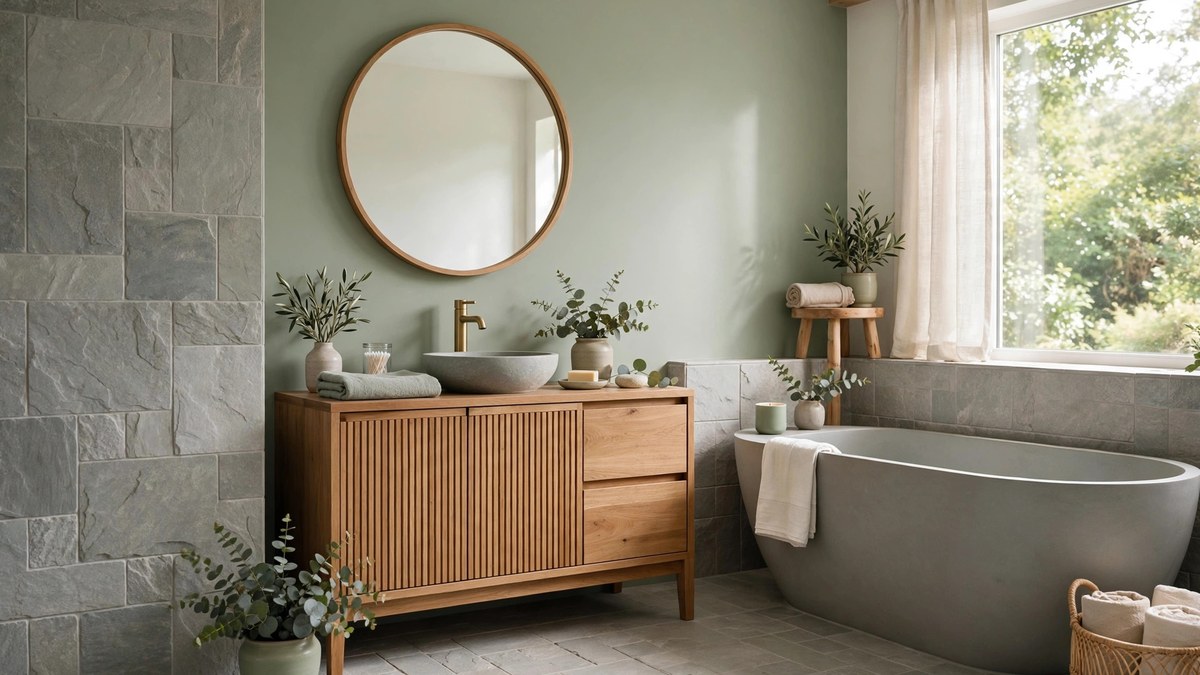
Between blue and green sits the palette that spas actually wear: gray and green bathroom schemes in their softest registers, stone gray, mist, sage, and eucalyptus, grounded by white and pale wood. This is the palette for people who love the blue-green family but want the volume turned down to a whisper.
Build it on gray first, because gray is the structure: a warm gray (greige) tile or paint keeps the palette from coldness, while cooler grays push it modern. Benjamin Moore’s Revere Pewter HC-172 and similar warm grays are the classic base. Then layer greens in nature’s order, palest sage in textiles, mid green in plants or a vanity, and one deep green accent for depth.
Texture does heavy lifting in a quiet palette: the same gray in matte paint, glossy tile, rough stone, and soft towel reads as four events instead of one flat color. Pale wood, bamboo, and woven baskets are near-mandatory; without their warmth, gray-green risks the dentist’s office.
The effect, done well, is the most restful bathroom a home can hold, and it ages gracefully because it borrows its colors from stone and leaves rather than fashion. Our spa bathroom ideas build entire rooms on this exact palette if the mood suits your house.
Bathroom Color Palette Ideas Beyond Blue
Blue rarely lives alone, and the most useful bathroom color palette ideas treat it as one member of a trio. The reliable formula: one dominant color (about 60 percent of the room), one supporting color (30), and one accent (10, in metals, art, and small objects). Blue can play any of the three roles, and the room’s personality changes completely with its assignment.
Blue as dominant with white and wood supporting is the classic of this article. Blue as support appears in navy-and-blush rooms, where pink towels and art soften navy tile into something romantic, and in blue-and-terracotta schemes, where the warm clay accent makes blue feel Mediterranean. Blue as accent is the minimalist’s move: a warm white and wood room with a single navy vanity or a wall of sea-glass tile.
Analogous palettes, blue with green and teal, feel serene and watery; complementary accents, blue with touches of coral, amber, or brass, feel energetic and designed. When a palette confuses you, borrow one whole: paint companies publish coordinated palettes, and nature publishes better ones, a beach, a forest pool, a winter sky, each with the ratios already solved.
Write your palette down, literally, three to five swatches taped inside a cabinet door. Every later purchase gets auditioned against it, which is how real rooms stay coherent across years of small additions.
Paint Colors for a Small Bathroom With No Natural Light
This is the hardest color problem in the house, and the most searched, because a small windowless bathroom receives only artificial light, which changes every color it touches. The strategy inverts the usual instinct: the room cannot borrow brightness from a window, so the paint must manufacture it, and that means choosing colors by their light reflectance value, or LRV, a scale from 0 (black) to 100 (pure white) printed on most paint chips.
For walls in a no-window bath, designers commonly aim for an LRV of roughly 60 or higher in colors that still feel like colors: pale blues and blue-grays with enough saturation to read as blue under warm bulbs, since a too-pale blue turns gray and chilly under artificial light. Benjamin Moore’s Simply White OC-117, with an LRV near 90, shows the bright end of the scale and makes a superb ceiling and trim choice to bounce light downward.
Warm the light itself, too: bulbs around 2700 to 3000 Kelvin keep blues kind, while cold 4000-plus Kelvin bulbs push blue walls toward institutional green-gray. And know the contrarian option: in a truly windowless box, going deliberately dark, navy walls, warm metals, layered lamplight, can feel like a jewel box rather than a cave, because the room stops pretending to have daylight. Both strategies work; the failure is the timid middle, a mid blue-gray that is neither bright nor dramatic.
Sheen is the windowless room’s second lever. Flat paint absorbs what little light the room has; an eggshell or satin finish, standard choices for bathroom walls because they resist moisture and wipe clean, returns a soft glow that can make the same blue look a full shade brighter. In the darkest baths, a satin ceiling in a pale tint of the wall color bounces sconce light like a reflector, which is the closest thing to a window paint can build.
Test with the door closed and the actual bulbs on, at night. A windowless room has only one light condition, which makes it, paradoxically, the easiest room to test honestly.
Tile, Metals, and Fixtures That Love Blue
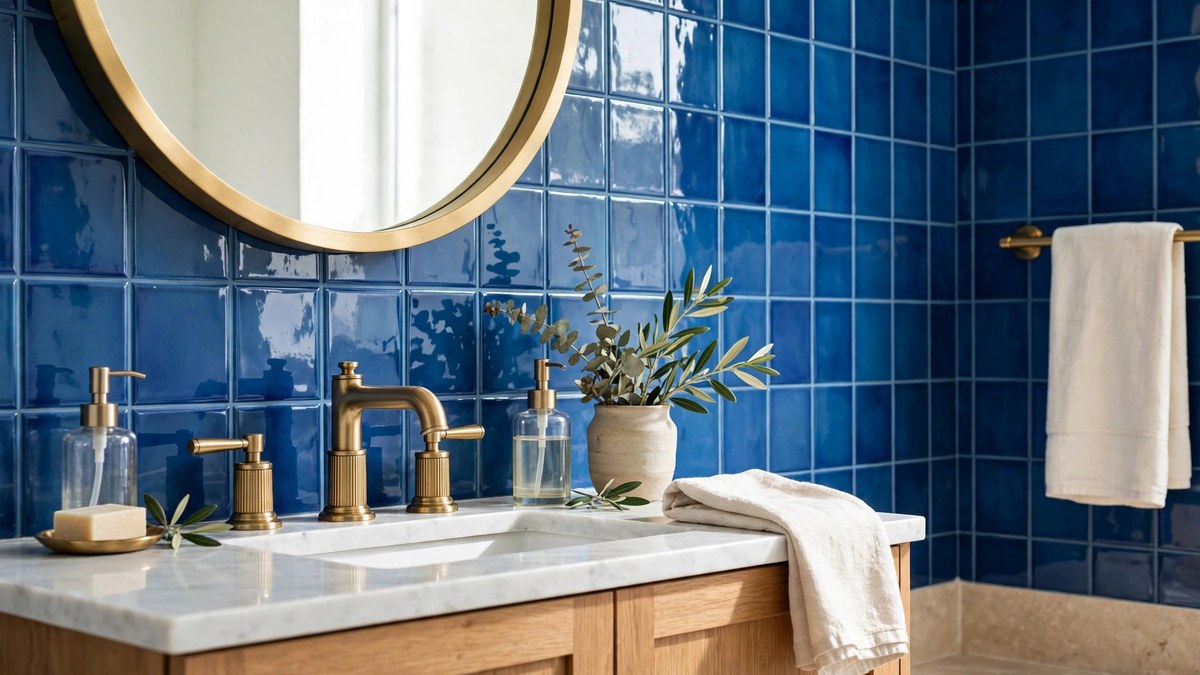
Blue’s supporting materials are a friendly crowd. White marble and marble-look porcelain are its oldest partners; white subway with blue grout reverses the classic charmingly; sea-glass and crackle-glazed ceramics in blue itself create the watery wall that defines coastal baths. Wood, especially mid-tone oak and walnut, warms blue schemes the way driftwood warms a beach.
Metals divide by temperature. Chrome and polished nickel sharpen blue into something crisp and nautical; brushed brass and gold warm it into glamour; matte black grounds it into modern contrast. Any of the three succeeds; the failure mode is all three at once. Choose one metal story and repeat it in faucets, hardware, mirror frame, and lighting.
Fixtures in white remain the safe stage for blue’s performance, but the bold can invert: a navy or slate-blue tub or vanity against white tile is a designed statement that still reads classic, because blue fixtures had their first golden age in the 1920s and wear the reference gracefully. Colored fixtures demand commitment, though; tile and paint can change in a decade, a tub intends to stay.
Blue tile has one more decision embedded in it: grout. White grout on blue tile draws the grid and feels coastal and crisp; blue-matched grout melts the wall into deep water; a warm gray grout is the diplomat that suits patterned and variegated blues whose exact match does not exist. Decide on a sample board, because grout quietly sets whether a blue wall reads as pattern or as expanse.
Glass and mirrors finish the cast: in blue rooms, clear glass and generous mirrors return the light that saturated walls absorb, keeping even deep navy schemes luminous rather than cave-like.
Blue in Small Bathrooms vs. Large Ones
Scale changes blue’s instructions. In small bathrooms, blue must work for its space: mid-to-deep blues on all walls can actually enlarge a tiny room by blurring its corners, but the safer classic is blue below, in tile wainscot, a vanity, the floor, with white above to lift the ceiling. Either way, commit fully; a shy stripe of blue in a small white room reads as indecision.
Small rooms also benefit from blue’s coolest trick: because the color recedes, a blue back wall makes a narrow bath feel longer, and glossy blue tile multiplies light in a way matte paint cannot. Keep the palette tight, two blues plus white, so the little room feels composed rather than busy. Our collection of colorful bathroom ideas shows bolder versions of the same small-room color logic.
Large bathrooms give blue its stage. A big room can hold a full navy envelope, a blue freestanding tub, or two blues in dialogue, navy vanity against sky walls, without any risk of gloom, provided the lighting is layered and the whites are present as punctuation. Large rooms fail blue by timidity: a pale blue accent wall in a sea of beige is a rumor of a theme. At scale, saturate.
In both sizes, the ceiling is blue’s secret ally: a pale blue ceiling, the old porch-ceiling tradition, lifts white rooms and completes blue ones, and costs nothing but the decision.
Common Blue Bathroom Mistakes
The first mistake is the cold room: blue walls, chrome, white tile, and cold light, a combination that reads as a swimming pool changing room. Warmth, wood, brass, warm bulbs, is not optional with blue; it is the other half of the color. Second is the lonely blue: one blue object in an unrelated room, which reads as an accident rather than a scheme. Repeat blue at least three times.
Third is ignoring the light’s effect on the shade, choosing a powder blue that turns gray-green under the room’s bulbs, or a navy that turns black in a windowless bath and eats the light. Test large, test lit, test overnight. Fourth is blue-on-blue mismatch: blues with different undertones, a purple-leaning navy beside a green-leaning teal, quarrel quietly forever. Hold swatches together; undertones should agree.
Fifth is forgetting the fixtures’ vote: stark blue-white porcelain can fight a warm blue palette, and almond or biscuit fixtures fight everything. And sixth is timidity at scale, the pale wash that satisfies no one. Blue rewards commitment at almost every dosage except a shrug.
Frequently Asked Questions
What shades of blue work best in bathrooms?
Navy and deep teal for drama and vanities; mid-tone denim, slate, and dusty blue for walls in lit rooms; pale sky, powder, and sea-glass tints for small or dark rooms and ceilings. Test any blue on two walls under your actual bulbs before committing.
Does blue make a bathroom look bigger or smaller?
Both, by shade and placement. Cool colors recede, so mid and deep blues can blur a small room’s corners and feel expansive, especially glossy tile; pale blues with white feel bright and airy. The shrinking risk comes from darkness without light, not from blue itself.
What colors go with a blue bathroom?
White is the classic partner; warm wood and brass add comfort; sage and eucalyptus greens extend blue naturally; blush and terracotta are the fashionable warm accents. Keep to one dominant, one support, and one accent for a coherent palette.
Is navy too dark for a small bathroom?
Not if the lighting is layered and the fixtures are white. In a windowless powder room, navy often looks intentional and glamorous, like a jewel box. The failure mode is navy plus one weak ceiling bulb; add sconces or a lit mirror.
What metal finish looks best with blue tile?
Brushed brass and gold warm blue into glamour; chrome and polished nickel sharpen it into nautical crispness; matte black modernizes it. Pick one finish story and repeat it everywhere in the room.
How do I add blue to a bathroom without painting?
Textiles and objects: towels, a shower curtain, a bath mat, art, a tray, and plants in blue pots. Three or more blue elements in graduated tones read as a scheme, and all of them can leave with you or change with the season.
What is the best blue paint for a windowless bathroom?
A blue with an LRV around 60 or higher and a touch of green or warmth to survive artificial light, or, contrarily, a full-commitment navy with layered warm lighting. Avoid cold bulbs, which push any blue toward gray-green.
Final Thoughts
Blue asks only two things of a bathroom: a partner for warmth and the courage to repeat it. Give it white to sparkle against, wood or brass to warm it, and at least three appearances in the room, and blue will repay you with the calmest, cleanest-feeling bathroom on the street, in a color that has been making baths beautiful for a century and shows no sign of stopping.
