
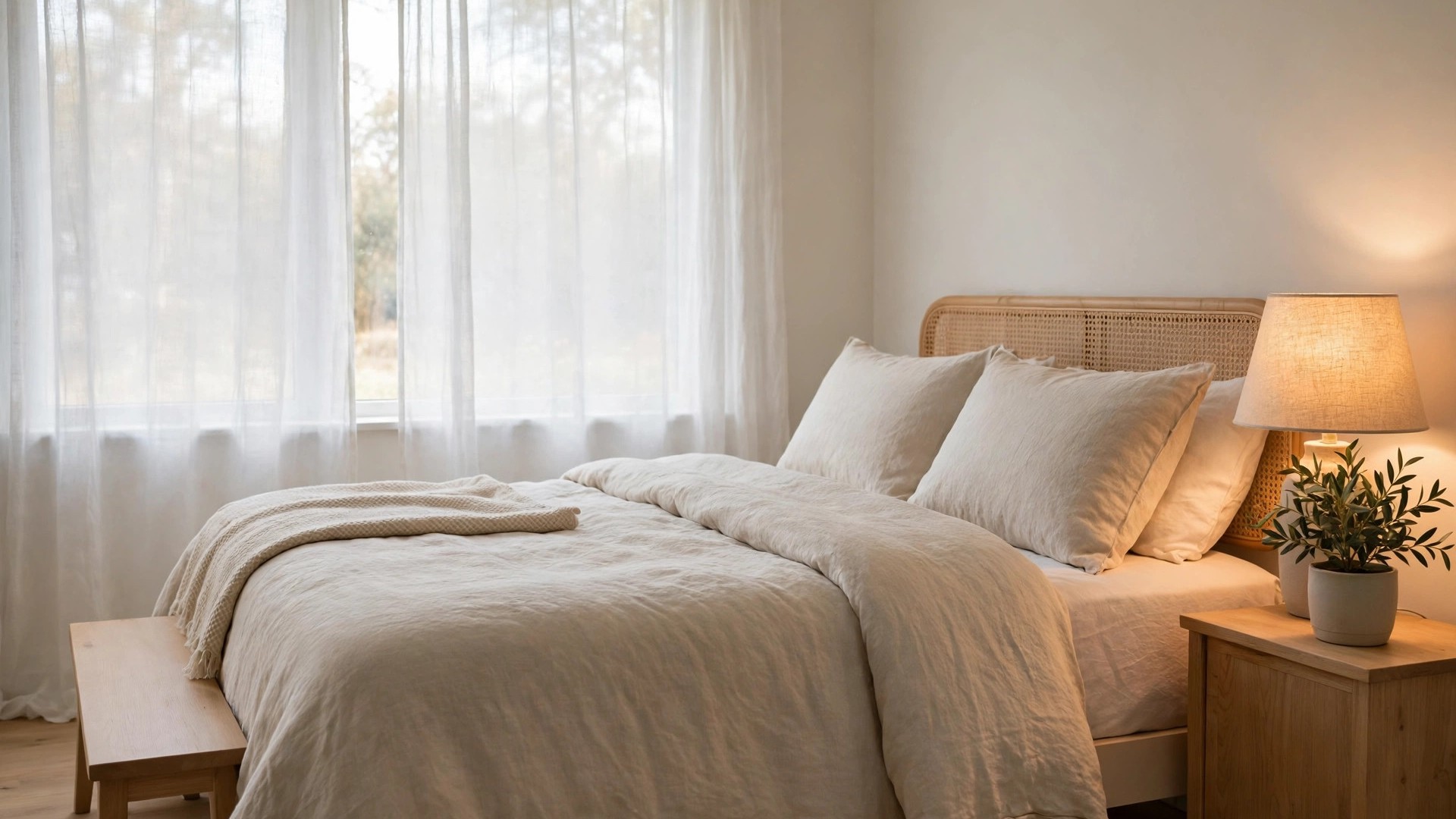

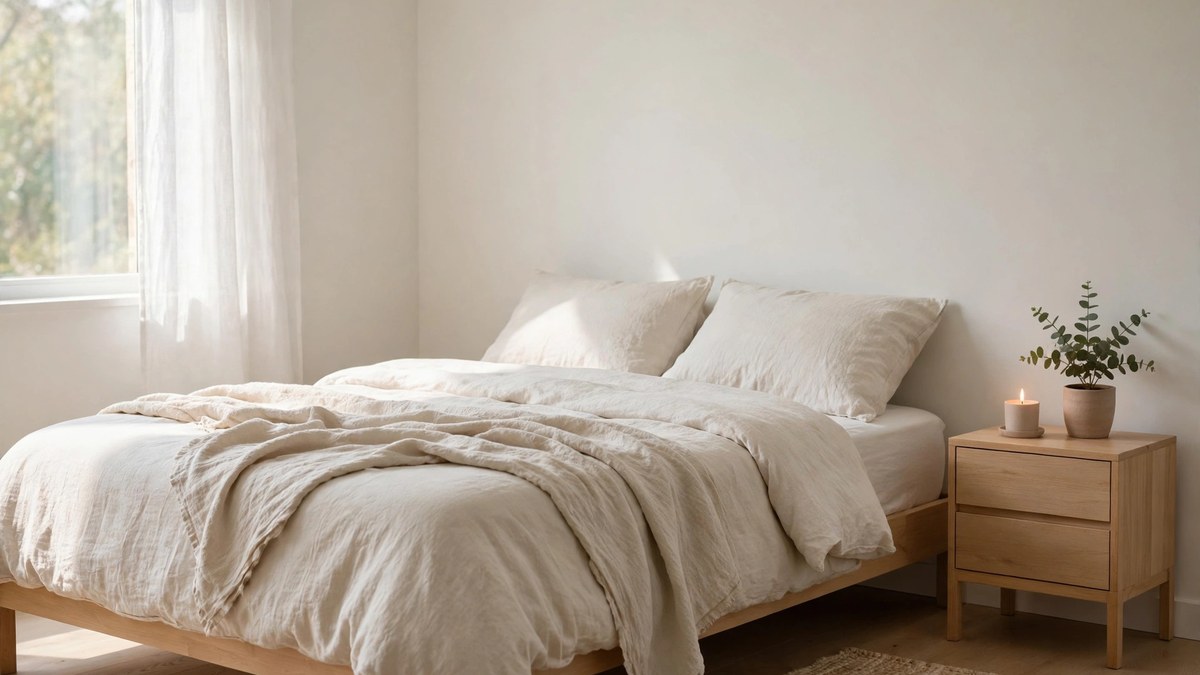
Your bedroom should lower your heart rate the moment you walk in. For many people it does the opposite: it is the house’s overflow storage, laundry depot, and second office, decorated in whatever was left over. These relaxing bedroom design ideas rebuild the room around a single job — rest — using color, light, texture, layout, and honest decluttering. None of it requires a renovation. Most of it is editing: removing what agitates, softening what remains, and letting the bed be the calm center of a quiet room.
Think of the process as turning the volume down, layer by layer, until the room itself feels like an exhale. Start with the biggest agitators and work down to the details.
Design for Sleep First, Looks Second
Every relaxing bedroom decision becomes easier once sleep is the stated priority, because sleep science and good design mostly agree: cool, dark, quiet, uncluttered, and comfortable. When a choice conflicts — the gorgeous open shelving versus the closed cabinet, the dramatic gallery wall versus a blank one — the sleep-first room picks the option your nervous system prefers at 11 p.m.
This does not mean a clinical room. It means the beauty comes from calm materials and restraint rather than stimulation: natural textures, a tight palette, soft light, and clear surfaces. The bedrooms people describe as “so relaxing” in hotels and spas are not decorated more; they are decorated less, with better things.
Make a short list of what currently disturbs your rest in this room — morning light leaks, a partner’s lamp, visible work clutter, noise, a mattress issue — and let that list, not a style board, order your projects. Fixing disturbances beats adding decor, every time.
Think of the room in three time zones — waking, winding down, and sleeping — and audit each separately. The waking zone needs bright, honest light and a view that starts the day gently; the wind-down zone (roughly the last hour) needs dim warmth, analog activities, and no work surfaces glowing; the sleep zone needs darkness, cool air, and silence you have engineered. Most bedroom frustration comes from one zone sabotaging another: the office-bright ceiling light ruining wind-down, or the beautiful sheer curtains ruining sleep at dawn. Zone the fixes and the room starts cooperating.
A Calm Color Palette
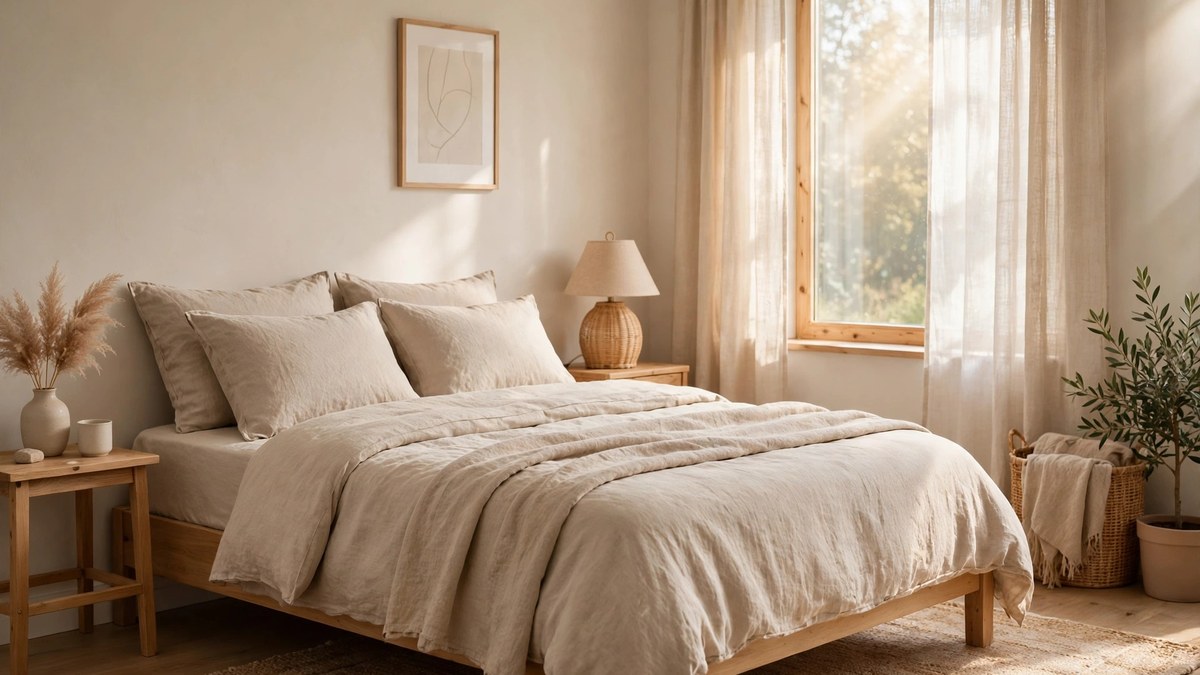
Color is the room’s background emotion. For rest, the reliable families are soft neutrals (warm white, greige, pale taupe), muted naturals (sage, eucalyptus, dusty blue, clay), and deep-but-soft shades for cocoon rooms (ink blue, forest, aubergine) in bedrooms blessed with daylight. What they share is low saturation: the colors are grayed and gentled, never electric.
Bright, high-chroma colors — pure red, vivid orange, acid yellow, bright turquoise — are stimulating by design, which is why restaurants and gyms love them. In a bedroom they belong, if at all, in one small accessory you can remove. The wall color you fall asleep facing should be the calmest color in the house.
If you need help choosing, our bedroom color ideas guide walks through the most restful palettes and what to pair them with. The testing rule from that guide applies double here: view the swatch in evening lamplight, because that is the light your bedroom actually lives in.
Undertone is the calm palette’s secret mechanic. Two bedrooms can both be “sage and white” and feel entirely different if one sage leans blue-green (cooler, more coastal) and the other leans yellow-green (warmer, more cottage). Neither is wrong, but mixing undertones within a room creates the vague unease people blame on the color itself. Gather every candidate — paint chip, bedding swatch, curtain fabric — on the bed in evening light and evict the one that argues with the rest; harmony you can see in a pile is harmony the room will have.
Lighting That Winds You Down
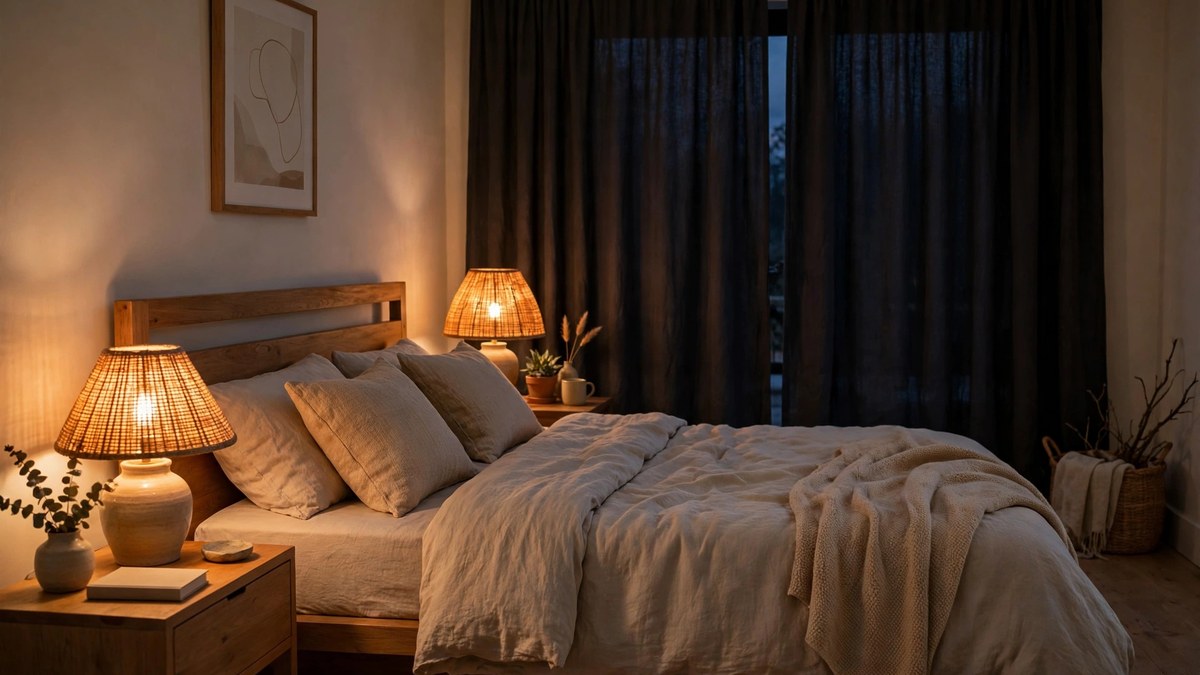
Light tells your body what time it is, and most bedrooms are lit like offices. The relaxing room runs on low, warm, layered light in the evening: bedside lamps with fabric shades, a dim secondary source (a small lamp on the dresser, a candle-style glow), and an overhead fixture that exists for cleaning day and otherwise stays off.
Bulb temperature is the lever: warm white around 2700K or lower nudges the brain toward evening; daylight bulbs around 5000K do the opposite and belong in kitchens and workshops. Dimmers — even simple plug-in or smart-bulb versions — let one room serve reading brightness and winding-down glow.
Good sleep hygiene guidance consistently pairs dim evenings with dark nights: blackout curtains or a blind behind your sheers so streetlight and dawn do not leak in, and any unavoidable LEDs (chargers, power strips) covered, turned, or banished. Darkness is a design material; budget for it like one.
Reading in bed is the relaxing room’s favorite activity, so light it properly rather than banning brightness altogether: a lamp with a directional shade per reader, warm bulb, positioned behind the shoulder so pages glow without glare. The mistake is the single shared overhead or one blazing lamp doing both jobs. Two modest, well-aimed lamps let one partner read and the other drift — a small luxury that nightly proves the whole layered-light philosophy in a single scene.
Declutter: Visual Quiet Is Real Quiet
A cluttered room keeps the brain on duty — every visible object is a small open loop. The relaxing bedroom therefore stores almost everything behind a door, a drawer front, or a lid. Nightstands get one book, a carafe, a lamp; dressers hold one tray and one beautiful object; the floor holds furniture and a rug, nothing else.
The system that maintains this is unglamorous: a closed basket for the in-between clothes, a hamper with a lid, drawers assigned by category, and a five-minute nightly reset where anything that wandered in gets escorted out. Visual quiet is a habit with a storage system underneath it.
If the full minimalist program appeals to you, our minimalist bedroom ideas show how far the editing can go; but you do not need minimalism for calm. You need surfaces that are mostly clear and a home for everything that is not.
Start the declutter with the sightline from the bed, because that is the view your brain processes while falling asleep and on waking. Clear what the pillow sees first — the dresser top, the chair, the floor corner — and the room will feel calmer even before the closets are perfect. Then work category by category rather than area by area: all books, all chargers, all cosmetics. Categories reveal duplicates (three phone chargers, five started novels) that room-by-room tidying hides, and duplicates are the easiest things in the world to release.
Bedding and Textiles That Feel Like a Retreat
Touch is the bedroom’s primary sense, and textiles are where relaxation is physically delivered. The bed should invite contact: natural-fiber sheets that suit your temperature (percale or linen for hot sleepers, sateen or flannel for cold ones), a duvet with genuine loft, and a folded layer — quilt or throw — that adds weight and texture.
Weight deserves a mention: many people sleep measurably better under a bit of pressure, which is why the quilt layer or a dedicated weighted blanket (commonly around 10 percent of body weight, as a rough guide) helps some restless sleepers. Treat it as an experiment, not a prescription.
The complete layering system, fabric comparisons, and seasonal configurations live in our bedroom bedding ideas guide. Around the bed, keep textiles soft and few: blackout-lined curtains with a soft fall, a rug your feet meet in the morning, one throw. Every textile in the room should pass the barefoot-and-bare-skin test.
The Foundation: Mattress and Pillow Support
No amount of calming decor compensates for a bed that fights your body. Mattresses typically serve well for roughly seven to ten years, depending on materials and use; the honest tests are waking with aches that ease within the hour, visible sagging or a permanent body impression, and sleeping noticeably better in a hotel bed. If two or more apply, the mattress — not the decor — is the real project.
Firmness is personal, but it is not arbitrary. Side sleepers generally do better on medium to medium-soft surfaces that let the shoulder and hip sink; back and stomach sleepers usually need medium-firm support that keeps the spine level. Treat these as starting points for in-person testing — ideally several unhurried minutes lying in your actual sleep position — rather than as rules to order by.
Pillows deserve the same fitting logic, because the goal is a neutral neck. Side sleepers typically need a firmer, higher pillow that fills the gap between shoulder and head, while back sleepers do better with something lower and softer. Replace a pillow when it fails the fold test or turns lumpy and yellowed; for most synthetic fills that lands somewhere around every one to two years.
When you do replace something, change one variable at a time and give it a week. A new pillow on an old mattress tells you exactly what the pillow fixed; replacing everything at once feels luxurious but teaches you nothing, and knowing which piece did the work makes the next replacement cheaper and smarter.
Sound, Scent, and Temperature
Three invisible factors decide whether a beautiful room actually sleeps well. Sound: soft furnishings (rug, upholstered headboard, curtains) absorb the echoes that make a room feel alert; a white-noise machine or app covers the irregular noises — traffic, pipes, early birds — that fragment sleep far more than steady sound does.
Scent: keep it subtle and consistent. A single calm scent (lavender, cedar, sandalwood are the classics) used only in the bedroom becomes a sleep cue by association. Diffusers or a linen spray are enough; strong plug-ins and layered candles can tip into headache territory, and scented products should stay away from pillows for sensitive skin.
Temperature: most sleep guidance converges on a cool room — roughly 60 to 68 degrees Fahrenheit is the commonly cited range — with bedding adjusted so the sleeper, not the room, stays warm. A small fan doubles as white noise and airflow. If partners disagree on temperature, split the bedding before you fight over the thermostat.
Humidity is the forgotten fourth factor: overly dry air irritates throats and skin, while damp rooms feel chilly and smell musty. Many sleep sources suggest keeping indoor humidity roughly in the 30-to-50 percent band; a small hygrometer (a few dollars) tells you where your room actually sits, and a quiet humidifier or a cracked window adjusts from there. Treat these as comfort ranges to test against your own sleep, not as medical prescriptions — but do test, because the fix is cheap and the difference is nightly.
Nature Touches: Plants and Natural Materials
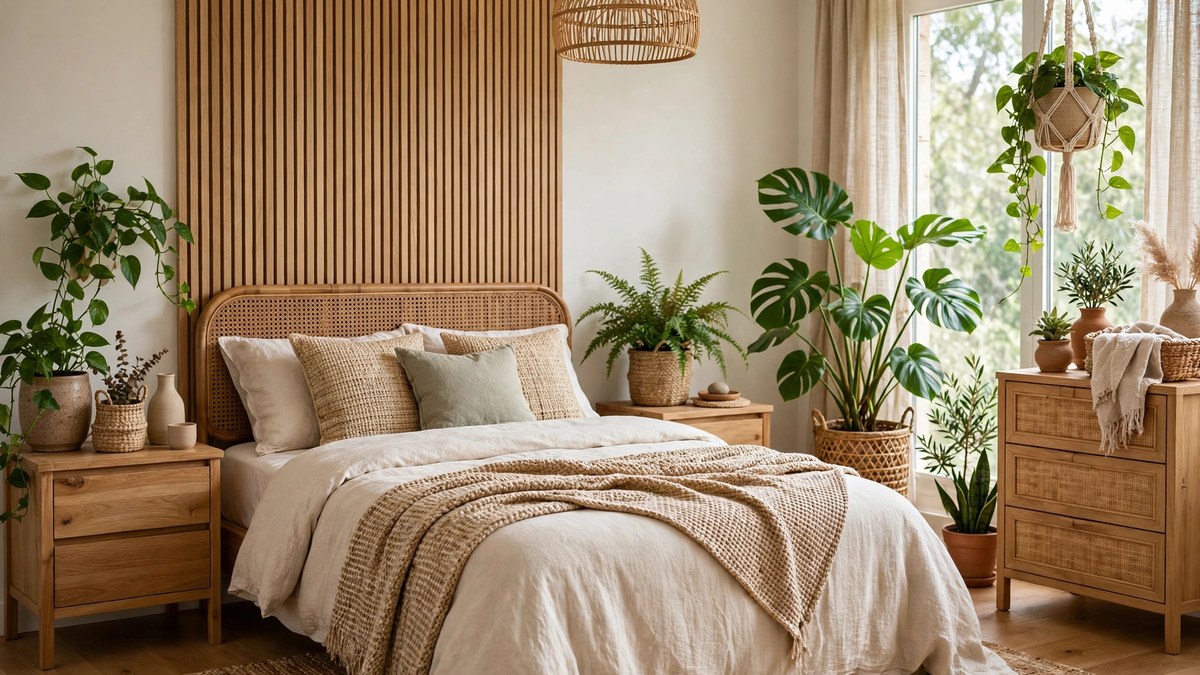
A room built from natural materials relaxes people in a way synthetic rooms struggle to match — the design world’s biophilic instinct. Wood with visible grain, linen, cotton, wool, stone, and clay all carry slight irregularities that read as restful to a brain evolved outdoors. You do not need many: a wooden bench, a linen duvet, a wool throw, a clay vase.
Plants are the living version: one or two easy, low-light-tolerant plants (a snake plant, a pothos) on the dresser or floor soften corners and quietly improve how the air feels. Keep the count low — a jungle is stimulating, and watering logistics belong in the calm column, not the chore column.
Natural light is part of this system too. Arrange the room so daylight enters kindly: sheers to diffuse glare, the bed placed so morning light does not strike pillows directly (unless you love dawn wake-ups), and a mirror positioned to borrow light into the darkest corner rather than to reflect the bed.
Layout and Flow That Feel Unhurried
A relaxing room has obvious, generous paths: from door to bed, bed to bathroom, bed to closet, none of them an obstacle course. Keep main walkways around 24 to 30 inches clear at minimum, resist filling every corner, and let furniture sit with a little air around it — crowding reads as urgency.
Symmetry around the bed calms the visual field: matched or balanced nightstands and lamps, the bed centered on its wall where possible, art in a simple arrangement rather than a scattered one. The brain processes symmetric scenes as safe and settled; it is the cheapest calm available.
Also mind what the bed faces. Waking to a calm view — a simple artwork, a plant, a tidy dresser — versus a laundry pile or a desk stacked with work changes the first emotional note of the day. If the bed must face the desk or the exercise bike, screen them at night with a curtain, a folding screen, or a closed door where the architecture allows.
Door position shapes flow more than furniture does. If the door opens directly onto the bed, a small screen, bookcase, or curtain panel near the entry creates a psychological threshold — you “arrive” in the sleep zone rather than falling into it from the hallway. In studios and shared flats this threshold matters even more: one deliberate boundary (a rug change, a shelf, a light change) tells the nervous system which mode the space is in, and the bedroom side of the line stays restful even when the other side is a home office.
Tech Boundaries for Better Rest
The modern bedroom’s biggest agitator glows. Televisions, phones, tablets, laptops, and their chargers import work, news, and other people’s arguments into the one room meant to exclude them. A relaxing room sets boundaries: ideally, screens out entirely; realistically, screens on rules.
The workable middle for most households: phones charge outside the bedroom or in a closed drawer station (an old-fashioned alarm clock restores the mornings), the TV — if it stays — gets a sleep timer and no news after a set hour, and all standby LEDs are covered or switched off at a power strip.
If you work from the bedroom, give the desk a closing ritual: laptop shut, papers in a closed box, chair pushed in, a lamp switched off like a shop sign. The ritual teaches your brain that the office inside the bedroom has hours, and they have ended.
Common Bedroom Decor Mistakes That Kill the Calm
The calm-killers are predictable. First: treating the bedroom as the house’s storage overflow — the exercise equipment, the boxes “for now,” the chair buried in clothes. Every non-sleep object is a small claim on your attention. Second: stimulating color and pattern on the biggest surfaces — the wall you face from bed and the bedding itself should be the calmest in the house.
Third: overhead-only, daylight-temperature lighting that keeps the room in office mode until the moment you switch it off. Fourth: the laundry-chair ecosystem, cured only by a lidded basket and a hook where the chair was. Fifth: noise and light leaks left unfixed for years though a door sweep, blackout liner, or white-noise app would solve them in a weekend.
Sixth, and sneakiest: decorating for photos instead of for 11 p.m. A serene-looking room with scratchy sheets, a hard pillow, and nowhere to put a book is a stage set. Test every choice against the actual hour of sleep, and the room will become as restful as it looks.
A Simple Weekend Plan to Reset Your Bedroom
You can reset most bedrooms in one weekend. Saturday morning: remove everything that does not serve sleep, dressing, or reading — be ruthless, the pile goes to its real home or out. Deep-clean, including under the bed. Assess the bed honestly: protectors on, pillows checked (fold test — a pillow that stays folded is done), sheets upgraded if they are the scratchy set.
Saturday afternoon: fix light. Blackout solution installed, bulbs swapped to warm 2700K, lamps in place, LEDs banished. Sunday: style the calm back in — make the bed with full layers, style nightstands to one book and a carafe each, place the plant, hang or re-hang the one artwork at proper height. Then the nightly five-minute reset keeps it: surfaces clear, clothes in the basket, tomorrow’s needs staged.
The plan costs little — most people spend only on bulbs, a blackout liner, and perhaps new sheets — because calm is mostly subtraction. What remains should be few, soft, and chosen.
Calm for Kids, Guests, and Light Sleepers
The relaxing-bedroom principles bend slightly for different sleepers. For kids, calm is mostly about cue consistency: the same dim light, the same soft textures, and toys stored in closed bins at night so the room visually powers down. A small night-light in a warm tone replaces the scroll of glowing toys many children sleep among.
Guest rooms relax strangers best by removing decisions: clear nightstand, visible spare blanket, a carafe of water, blackout curtains that actually work, and an empty drawer or luggage rack so visitors are not living out of a suitcase on your floor. Calm for guests is hospitality expressed as emptiness — surfaces and storage deliberately left free for them.
Light sleepers should audit the room’s micro-disturbances: the ticking clock, the standby LED, the hallway light bleeding under the door, the radiator’s first click. A door sweep, blackout tape over LEDs, and a quiet-clock swap are tiny purchases that outperform most decor. The most relaxing bedroom is not the prettiest one — it is the one where nothing wakes you at 3 a.m.
Frequently Asked Questions
What colors are most relaxing in a bedroom?
Soft, muted, low-saturation colors: warm whites, greige, sage, dusty blue, pale clay, and soft taupe. Deep shades like ink blue or forest can also relax in bright rooms when balanced with pale bedding. Avoid high-chroma brights on walls and bedding — they stimulate rather than soothe.
How dark should a bedroom be for good sleep?
As dark as you can reasonably make it: blackout curtains or liners, covered LEDs, and no glowing screens. Even dim light leaking in can fragment sleep for sensitive people. If total darkness bothers you, use a very low, warm night light pointed at the floor rather than the bed.
What temperature is best for a relaxing bedroom?
Most sleep guidance points to a cool room, commonly around 60–68°F, with the sleeper warmed by bedding rather than by room heat. Adjust within that range to personal comfort, and solve partner disagreements with split bedding instead of thermostat battles.
Do plants really help a bedroom feel calmer?
Yes, mostly through design psychology: natural materials and living greenery signal rest to the brain, and plants soften hard corners beautifully. Choose one or two easy, low-light plants. Claims about dramatic air purification from a plant or two are overstated — enjoy them for calm, not filtration.
Should I remove the TV from the bedroom?
If sleep is the priority, removing it (or enforcing a sleep timer and no late news) usually helps, because light, sound, and stimulating content delay wind-down. Couples split on this should trial two weeks without it — most arguments resolve themselves with data.
How do I make my bedroom relaxing on a small budget?
Subtract first (free): clear surfaces, remove non-sleep items, banish LEDs. Then spend small where it counts: warm bulbs, a blackout liner behind existing curtains, one decent set of natural-fiber sheets, and a lidded basket to end the laundry chair. Calm is mostly editing, not buying.
What is the fastest single change for a calmer bedroom?
Lighting. Swap daylight bulbs for warm 2700K, add a shaded bedside lamp, and stop using the overhead light in the evening. The room’s whole emotional register drops within one night, before anything else changes.
Final Thoughts
A relaxing bedroom is not a style; it is a series of mercies — darkness when you sleep, warmth of light when you wake, clear surfaces, soft things against the skin, and nothing in the room asking for your attention. Design for the sleeper first and the room becomes beautiful in the particular way rest is beautiful.
Begin with subtraction this weekend. Remove, darken, soften. What remains will tell you exactly what, if anything, deserves to be added.
