

The cabinets get all the attention, the countertops get all the budget, and the walls get whatever paint was left over. Yet in most kitchens, the walls are the largest uninterrupted surface in the room, and they decide whether the space feels finished or forgotten. The good news is that great kitchen wall ideas rarely require a renovation. A run of open shelves, a confident piece of art, a rail of copper pans, or a single wall of tile can change the whole personality of the room in a weekend.
This guide walks through the most practical ways to decorate, organize, and upgrade kitchen walls, from renter-friendly displays to permanent finishes. Along the way you will find guidance on what survives heat and steam, what adds real storage, and which mistakes make kitchen walls look cluttered instead of curated.
Start With a Plan: What Your Kitchen Walls Actually Need
Before you hang anything, stand in the doorway and divide your walls into three zones: working walls near the stove and sink, storage walls near the prep area, and display walls that are mostly seen rather than used. Each zone wants a different treatment. Working walls need wipeable surfaces and heat tolerance. Storage walls should hold the things you reach for daily. Display walls are where art, color, and personality belong.
It also helps to think about how the wall interacts with the way you move through the room. Designers have long used the kitchen work triangle — the path between sink, stove, and refrigerator — as a planning shortcut, and walls inside that triangle should stay functional and easy to clean. Walls outside it can work harder as decoration.
Finally, take stock of the fixed elements you cannot change: cabinet color, countertop pattern, floor tone, and the direction of your natural light. Wall decor that echoes one of those elements, a metal tone, a wood finish, or a color pulled from the countertop, will always look more intentional than decor chosen in isolation.
Kitchen Wall Art Ideas That Survive Heat, Steam, and Splatters
Art belongs in the kitchen, but the kitchen is harder on art than any other room. Grease mist, steam, and temperature swings will slowly damage unprotected paper and canvas, so choose pieces with those conditions in mind. Framed prints behind glass or acrylic are the safest bet, especially near the stove. Metal prints, ceramic tiles used as art, and sealed wood pieces also hold up well.
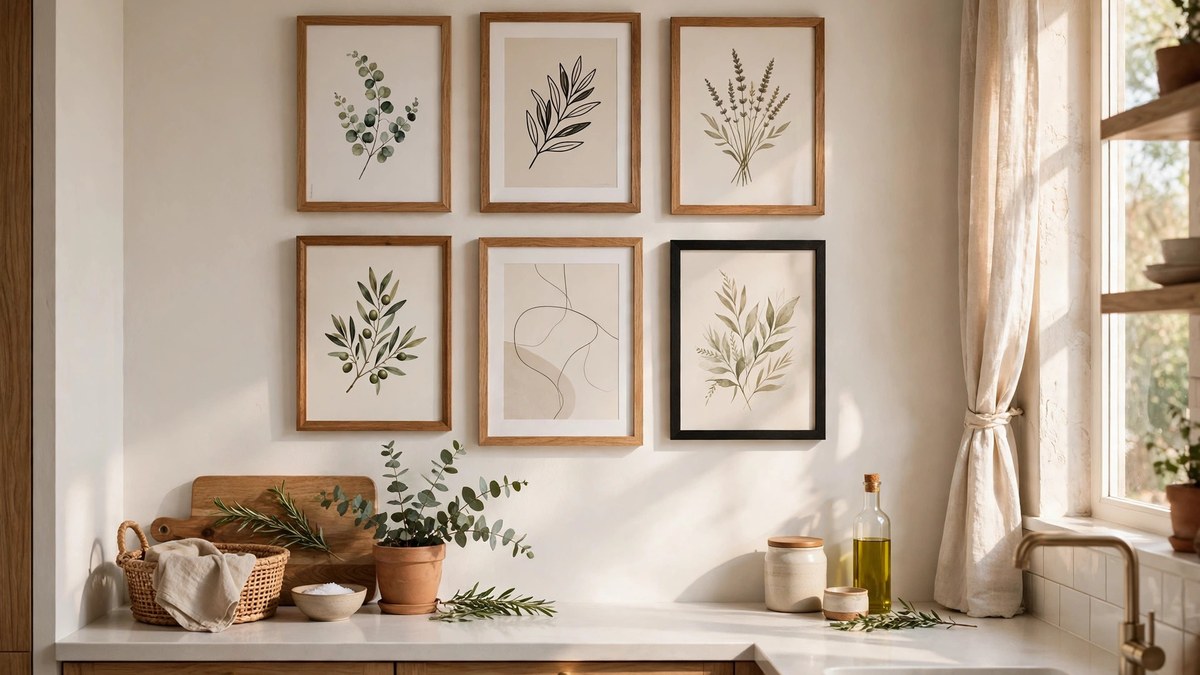
Subject matter matters less than scale. One oversized piece, roughly two-thirds the width of the furniture or counter beneath it, looks calmer and more expensive than a scatter of tiny frames. Food and botanical prints are classics for a reason, but abstract art, vintage advertising, landscape photography, and even framed textiles all work when the palette ties to the room.
Arrangement is where most people hesitate. A simple rule: hang the center of a single piece or grouping at about 57 to 60 inches from the floor, roughly eye level, and keep spacing between frames consistent at 2 to 3 inches. Over a dining bench or banquette, drop the grouping slightly so it connects to the seating rather than floating above it.
If you love the gallery look, lay the arrangement on the floor first and photograph two or three options. Kitchens have sightlines from hallways and living rooms, so check the wall from outside the room as well as inside it. The best kitchen art reads well from both distances.
Kitchen Decor Ideas for Walls That Double as Storage
The hardest-working kitchen decor is the kind that stores something. When wall decoration also solves a storage problem, small kitchens gain space and big kitchens gain that collected, lived-in character that styled photos always seem to have.
Start with what you already own. A set of matching canisters lined up on a wall-mounted shelf, cookbooks stacked under a small rail, or a row of identical glass jars for pasta and grains all read as decor because repetition creates order. If your kitchen cabinet ideas include open uppers or glass fronts, echo their colors on the wall so the whole elevation feels planned.
Magnetic knife strips are a perfect example of functional decor. Mounted on the wall beside the prep zone, they free counter space, keep blades visible, and add a strip of warm wood or brushed steel to the wall. The same goes for wall-mounted spice racks near the stove, hanging fruit baskets, and hooks for aprons and oven mitts in a fabric you actually like.
The trick is restraint. Choose two or three storage systems per wall and repeat their materials. A wall with a wood shelf, a black rail, brass hooks, and a chrome rack all at once looks like a hardware store. A wall where everything is warm wood and matte black looks like a design decision.
Open Shelves and Floating Ledges
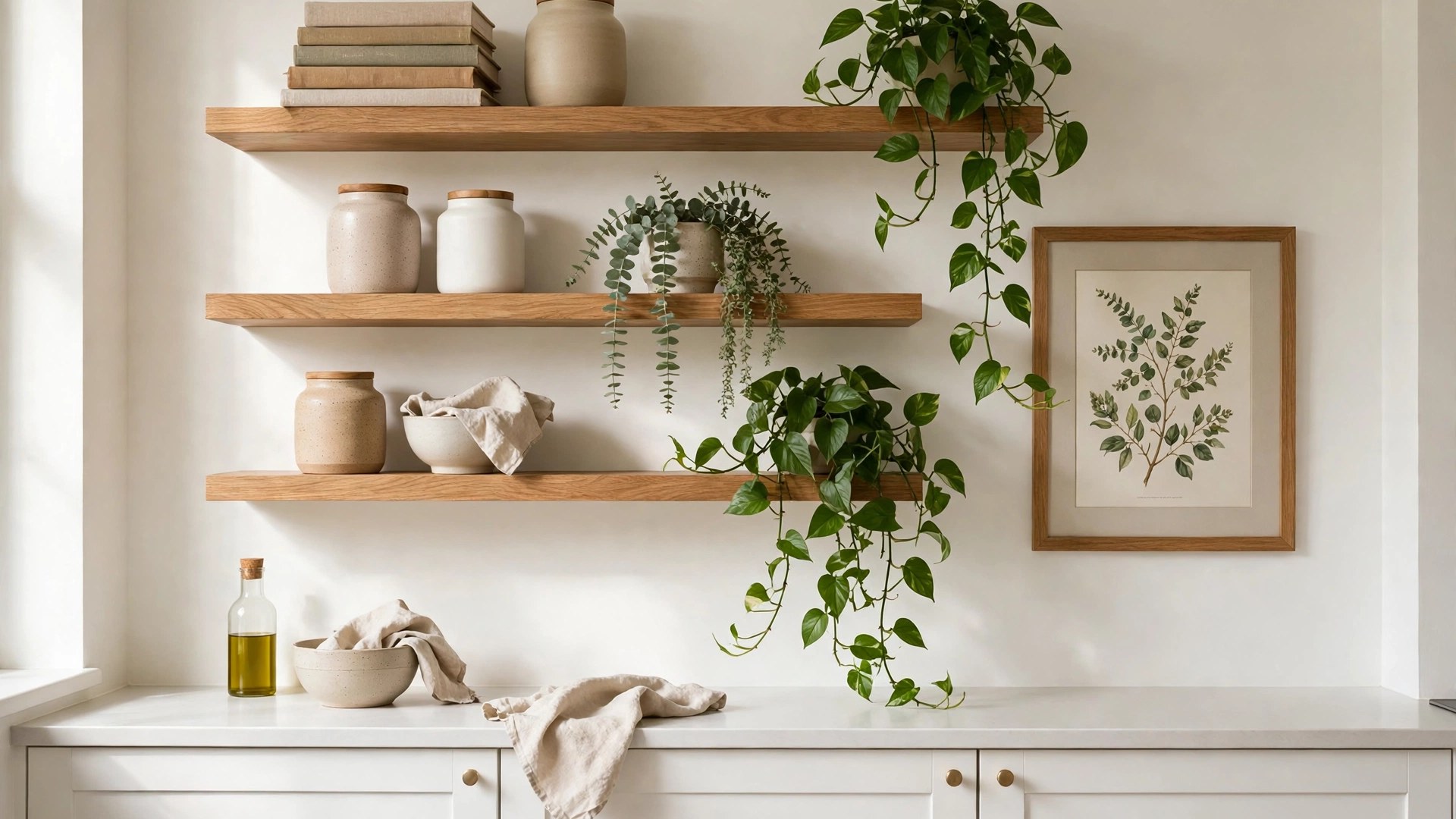
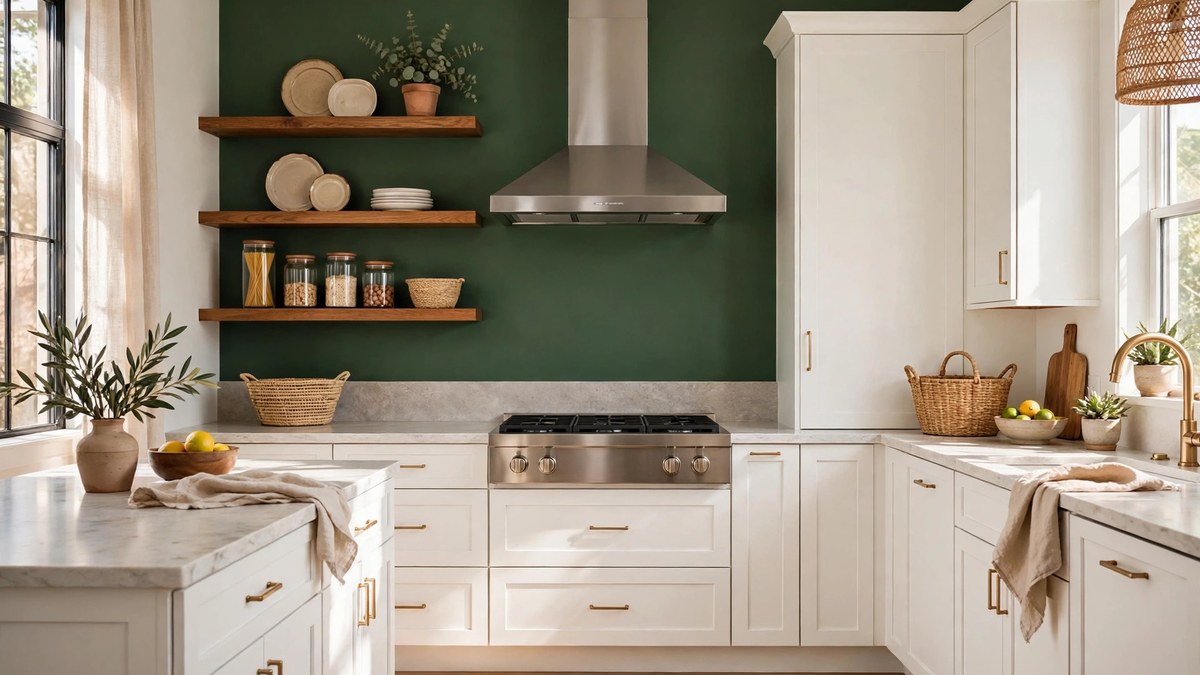
Open shelving remains the most requested kitchen wall upgrade, and it earns its place. Two floating shelves on a blank stretch of wall give you display space, everyday storage, and a place to rotate seasonal pieces without touching a cabinet. Solid wood shelves, typically 2 inches thick and 10 to 12 inches deep, hold dinnerware comfortably; shallower picture ledges, around 4 inches deep, suit cookbooks, small frames, and trailing plants.
Styling shelves is a formula, not a talent. Group items in odd numbers, vary heights, and leave roughly a third of each shelf empty. Stack bowls horizontally, stand plates vertically in a groove or rack, and place everyday glasses where hands can reach them without moving anything else. Put the prettiest, least-used pieces up high and the daily workhorses at arm level.
Be honest about dust and grease. Open shelves near a range will need a wipe-down every week or two, and their contents need regular use or washing. If your cooking style involves a lot of frying, place shelves on the wall farthest from the stove and let tile or art take the splash zone instead.
Renters can get the look with heavy-duty adhesive ledges for lightweight items, or a single leaning shelf unit against the wall. The visual effect is nearly the same, and nothing needs patching when you leave.
Tile, Shiplap, and Paneling Beyond the Backsplash
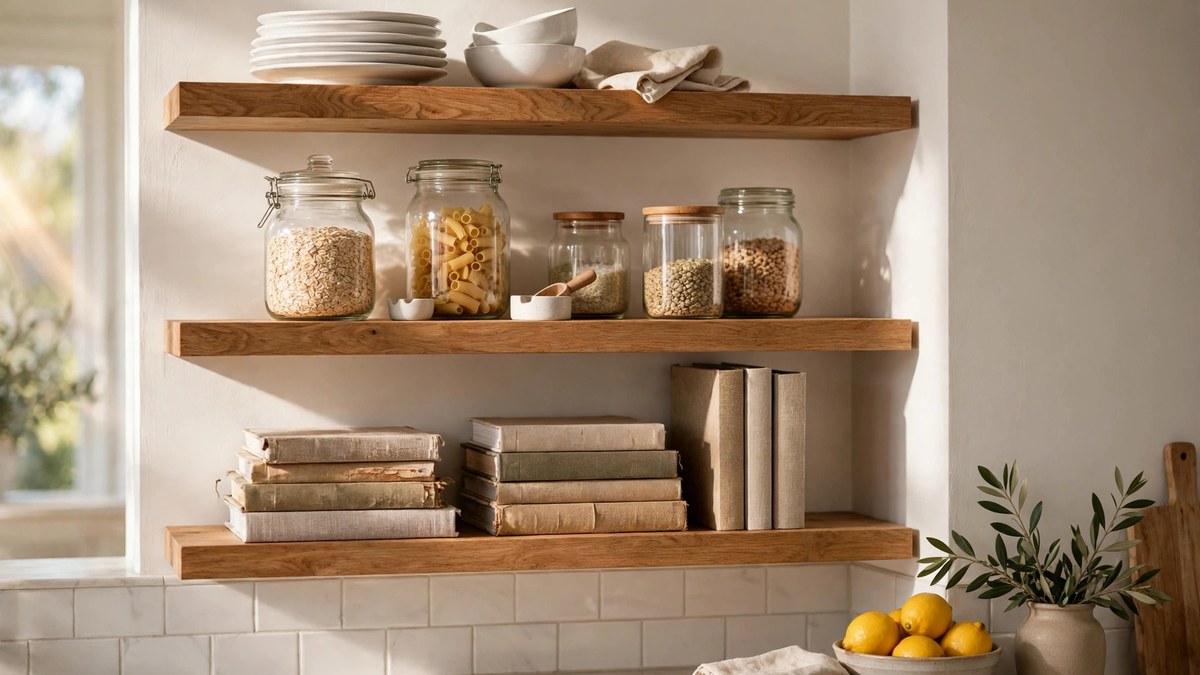
Most people stop tile at the bottom of the upper cabinets, but carrying tile, shiplap, or paneling further up, or across an entire wall, is one of the most transformative kitchen wall ideas available. A full-height tile wall behind the range creates a focal point that needs no other decoration, and it shrugs off heat and splatter better than paint ever will.
The standard gap between countertop and upper cabinets is about 18 inches, which is why backsplash tile usually covers that band. Extending the same tile to the ceiling makes the whole wall read as one architectural surface, and the cost difference is smaller than most people expect because the labor of tiling is already mobilized. Our complete guide to kitchen backsplash ideas covers materials and patterns in depth if you are planning this route.
Shiplap and beadboard bring a softer, cottage or farmhouse feel, and both can be painted to match or contrast with cabinets. In a kitchen, install them with a scrubbable paint finish, satin or semi-gloss, and caulk the joints so steam cannot creep behind the boards. Brick veneer and thin stone panels are heavier commitments but unbeatable for texture; reserve them for the wall you see first when entering.
A halfway approach works too: paneling or tile run to chair-rail height, around 36 inches, with paint above. This wainscot effect suits traditional kitchens and protects the wall where chair backs and busy hands do the most damage.
Rails, Hooks, and Pegboards: The Working Wall
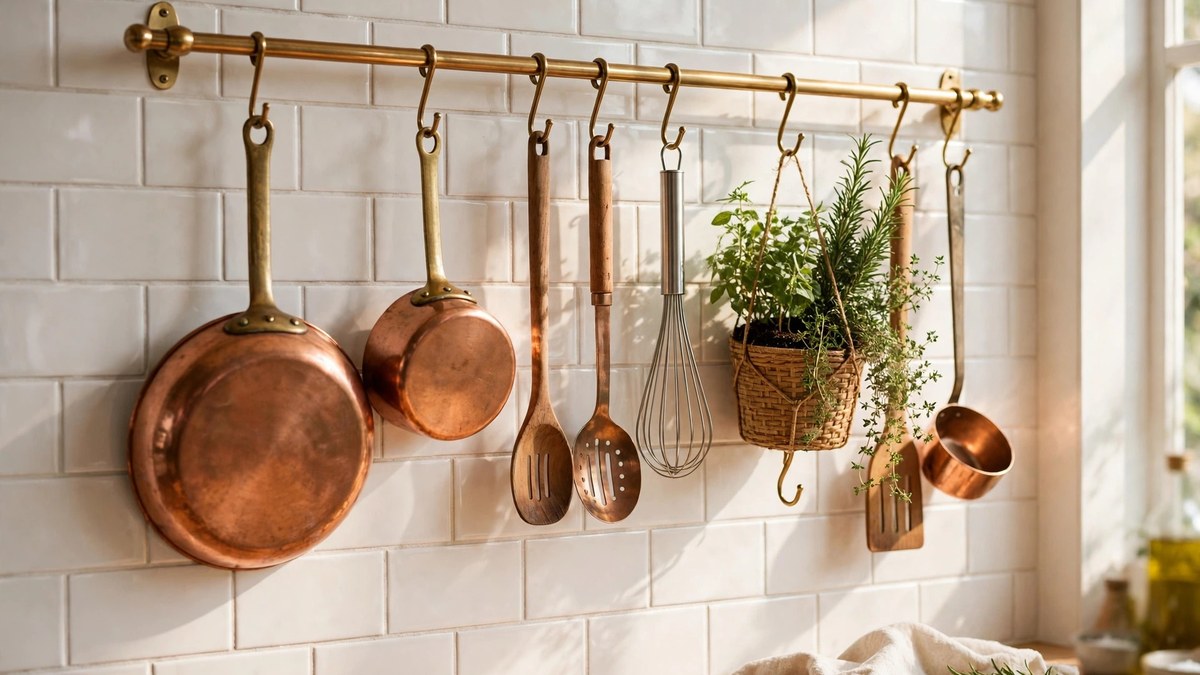
Borrowed from professional kitchens, the wall rail is the fastest way to make a kitchen feel competent. A stainless, brass, or matte black rail mounted under the cabinets or along a spare wall holds utensils, pans, scissors, and even small potted herbs on S-hooks. Everything is visible, everything is grabbable, and the collection of tools becomes the decoration.
Pegboards are the rail’s more flexible cousin. A painted pegboard panel, famously championed by Julia Child, whose husband outlined every pan in paint on theirs, can hold an entire batterie de cuisine and be rearranged in minutes. Paint the board the same color as the wall for a subtle look, or a deep contrasting shade for a deliberate feature. Outline shapes in a slightly darker tone if you want the satisfying everything-in-its-place effect.
Placement rules are simple. Keep rails at least a few inches from the cooktop’s direct heat plume, mount into studs or use proper anchors rated for the weight of cast iron, and leave the items you use weekly or more on the wall. Tools that come out twice a year are clutter with hooks; store those in a drawer and give the wall space to things that earn it.
For a softer take, combine one rail with one shelf above it. The rail handles tools, the shelf handles beauty: a plant, a small framed print, a stack of linen napkins. That pairing is the whole philosophy of kitchen wall decor in a single arrangement.
Chalkboards, Corkboards, and Family Command Centers
Some kitchen walls should work as the family’s brain. A chalkboard section, whether a full framed board or a rectangle of chalkboard paint, handles grocery lists, the week’s menu, and notes to the dog-sitter with more charm than a whiteboard. Frame it with simple wood trim and it becomes a deliberate design feature, especially in black, deep green, or navy chalkboard finishes.
Corkboards and fabric pinboards suit the paper-heavy household: school forms, invitations, takeout menus, and photos. A large board, 24 by 36 inches or bigger, looks intentional; a small one looks like an apology. Cover plain cork with linen fabric for an instant upgrade, and use matching pins or clips so the hardware does not fight the display.
A true command center combines a board with a few wall pockets or a narrow shelf for mail, a clock, and hooks for keys. Keep it near the door the family actually uses, not the door the architect intended, and edit it weekly. A command center that is ninety percent expired coupons decorates nothing.
If you rent, lean a large framed board on the counter against the wall or hang it from removable strips rated for its weight. You will get the function with none of the holes, and the frame hides the fact that it is temporary.
Plates, Cutting Boards, and Collected Displays
The collected wall, plates, boards, baskets, or vintage finds arranged as a group, gives kitchens the layered personality that showrooms cannot fake. Decorative plates are the classic choice: mix sizes from salad to charger, keep a unifying thread of color or pattern, and hang them with plate hangers or adhesive discs rated for their weight.
Cutting boards make a warmer, more rustic display. Lean two or three boards of different woods and shapes on the counter against the backsplash for an everyday version, or hang a grouped arrangement on the wall near the prep zone. Because they are genuinely used, the display refreshes itself, and oiled wood only gets better looking with time.
Woven baskets and shallow trays create an organic, textural wall that suits boho, coastal, and global styles. Keep the palette tight, naturals with one accent color, say, and vary diameters from about 8 to 20 inches for rhythm. This is also one of the cheapest wall treatments per square foot, especially with thrifted finds.
Whatever you collect, arrange the grouping on the floor first, trace it on kraft paper, and tape the paper to the wall before drilling. Live with the paper shapes for a day. Collections reward patience: a wall built slowly from pieces you love will always beat a set bought to match.
Paint and Wallpaper: The One-Wall Accent
Paint is still the highest-impact, lowest-cost wall treatment in the kitchen. A single saturated wall, deep green, inky blue, warm terracotta, behind open shelves or a dining nook gives the room a designed backbone. The remaining walls stay light, so the kitchen still feels bright at the sink and stove where you work.
Choose the wall with the fewest interruptions. The best accent wall is mostly unbroken by doors and windows, and ideally it is the wall you face from the adjoining room. In kitchens open to living spaces, painting the kitchen’s end wall also helps define where one room stops and the other starts.
Wallpaper has returned to kitchens in washable vinyl and peel-and-stick forms that tolerate steam far better than the papers of the past. Keep it away from the direct splash zone behind the sink and stove unless it is rated scrubbable, or protect it with a clear acrylic panel in that band. Bold botanical and geometric prints can carry an entire small kitchen when cabinets are plain white or wood.
Do not forget the fifth wall’s neighbor: the ceiling’s edge. A painted band or picture rail line around the room, or cabinets whose uppers are painted to meet a same-color wall, can make standard ceilings feel taller and the whole kitchen feel bespoke for the price of a gallon of paint.
Small Kitchen Walls: Go Vertical or Go Home
In a small kitchen, the walls are not decoration space, they are the storage plan. The guiding principle is to use the full height of the room. That often-ignored band between the top of the cabinets and the ceiling, typically 12 to 18 inches, fits baskets, bulk goods, and the serving pieces you use a few times a year.
Narrow floating shelves, even 6 inches deep, hold spices, oils, and coffee gear along a wall that cannot fit a counter. A rail under those shelves doubles the capacity. If your kitchen has a pass-through or a half wall, treat its kitchen side as display: a ledge for cookbooks and a plant keeps it useful rather than apologetic.
Small kitchens also benefit from keeping wall decor inside a strict palette of two or three colors. Visual calm reads as space. Reflective touches help too: a framed print with glass, a metal tray hung as art, or glossy tile bounces light around and makes walls feel farther away. If your layout includes an island or peninsula, the styling ideas in our guide to kitchen island decor ideas pair naturally with a vertical-storage wall plan.
One caution: in a tight kitchen every wall item competes with elbow room. Keep protruding pieces shallow near walkways and cooking zones, and favor flat treatments, paint, tile, boards, ledges, in the busiest paths.
Common Kitchen Wall Mistakes to Avoid
The most common mistake is scale: a scattering of small frames and trinkets spread thin across a big wall. It reads as clutter, not collection. Fewer, larger pieces almost always look better, and grouping small items into one tight arrangement counts as one large piece visually.
Second is hanging everything too high. Art and shelves placed near the ceiling disconnect from the counters and furniture they belong with. Eye-level placement, roughly 57 to 60 inches to the center of the arrangement, anchors decor to the room’s life.
Third is ignoring the kitchen environment. Unsealed paper art beside the stove, fabric hangings that absorb cooking smells, and shelves crammed with dusty, rarely used items all fail the same way: they suit a living room, not a working kitchen. Choose materials that wipe clean and displays you will actually maintain.
Fourth is forgetting light. A beautiful wall in shadow still looks dull. If a display wall has no natural light, add a picture light, a plug-in sconce, or simply a lighter paint behind the arrangement. Finally, avoid drilling into tile or stone without the right bit and a plan; cracked tile is the most expensive kitchen wall mistake of all.
Frequently Asked Questions
What can I put on a blank kitchen wall?
Almost anything that tolerates the room: framed prints behind glass, open shelves with dishes and jars, a utensil rail, a chalkboard, a plate or basket collection, or a bold paint or tile treatment. Start with one idea per wall rather than mixing several.
How do I decorate a kitchen wall without drilling?
Use adhesive picture strips and hooks rated above the item’s weight, lean framed pieces and boards on counters or shelves, choose peel-and-stick wallpaper or tiles, and try tension-mounted or over-cabinet hooks for lightweight items. Keep heavy pieces off adhesive near heat and steam.
What art is safe to hang in a kitchen?
Framed prints behind glass or acrylic, metal or ceramic art, and sealed canvas handle kitchen conditions best. Keep unprotected paper, textiles, and valuable originals away from the stove and sink, where grease and steam concentrate.
How high should kitchen wall shelves be?
The lowest shelf should clear countertop appliances, typically 18 to 24 inches above the counter, with about 12 to 15 inches between shelves for dishes and jars. Everyday items belong at reachable height, roughly counter level to eye level.
Can I use wallpaper in a kitchen?
Yes, if you choose washable vinyl or quality peel-and-stick paper and keep it out of the direct splash zone behind the sink and range, or shield that band with glass or acrylic. Satin-finish scrubbable paints remain the safest choice for heavy-use walls.
How do I decorate the wall above kitchen cabinets?
Treat it as a high shelf: baskets, large pottery, trailing plants, or a row of framed prints of the same size. Keep the palette disciplined and the count low, and plan to dust the display every month or so.
What is the cheapest way to upgrade kitchen walls?
Paint. One accent wall in a saturated color costs little more than a gallon of paint and a weekend. After that, a utensil rail, a framed chalkboard, and rearranging existing dishes onto one open shelf deliver the most change per dollar.
Final Thoughts
Kitchen walls reward the same thinking as the rest of good design: decide what each wall is for, then give it one clear job done well. A wall of working rails, a wall of collected plates, a wall of calm color, each is better than a wall of a little bit of everything. Start with the wall you see most, apply the ideas here at a scale that suits your room, and let the kitchen finally feel as finished as the rest of your home.
